Furnace Blowing Cold Air? Causes and Fixes
Furnace Blowing Cold Air? Causes and Fixes
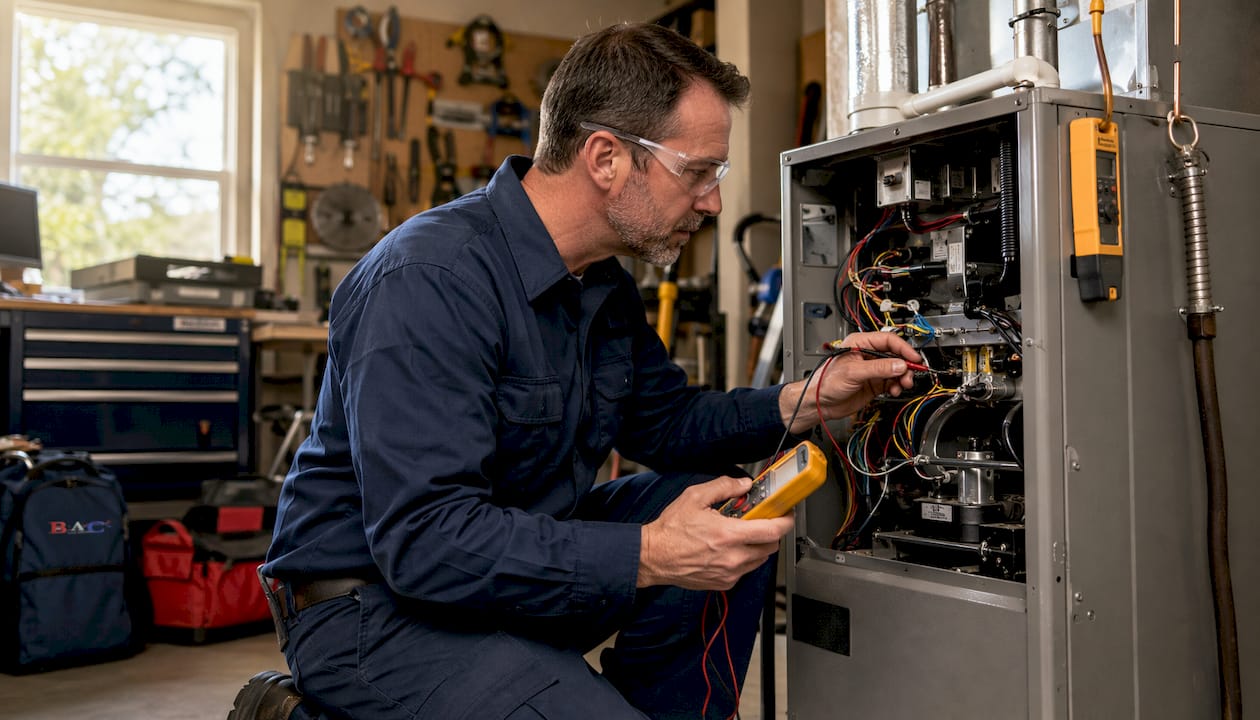
Most of the time, a furnace blowing cold air comes down to one of two things: the thermostat fan is set to “On” instead of “Auto,” or a dirty air filter has triggered a safety shutdown. Both are free homeowner checks you can run in under five minutes. If neither fixes it, the problem is likely an ignition component, a flame sensor, or a safety switch — and that’s when you call a technician.
Check these three things right now:
- Thermostat fan setting. Look at your thermostat. If the fan is set to “On,” switch it to “Auto.” On the “On” setting, the blower runs continuously, even between heat cycles, pushing room-temperature air through your vents. Bryant and Carrier both list this as the first check for any cold-air complaint.
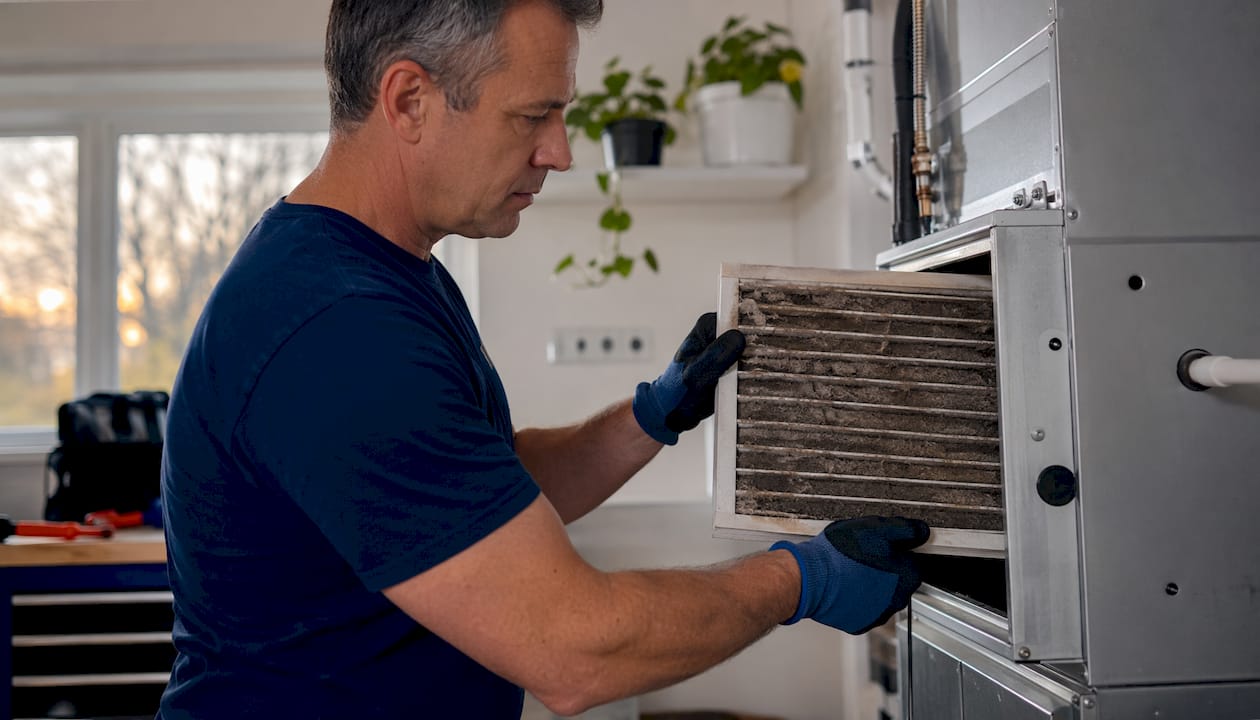
- Air filter. Pull the filter out and hold it up to a light. If you can’t see light through it, replace it. A clogged filter restricts airflow, causes the heat exchanger to overheat, and trips the high-limit safety switch, which shuts the burners off while the blower keeps running.
- Furnace power and circuit breaker. Confirm the furnace power switch (usually on the wall near the unit) is on. Check your breaker panel for a tripped breaker labeled “furnace” or “air handler.”
Safety first — stop and evacuate if you notice any of these:
- A sulfur or rotten-egg smell (gas leak)
- Hissing sounds near the furnace or gas line
- A carbon monoxide alarm going off
If any of those are present, leave the house immediately, leave the door open, and call your gas utility or 911 from outside. Do not attempt any troubleshooting.
A brief burst of cool air at startup is normal. The blower often kicks on a few seconds before the heat exchanger fully warms up. If the air is still cold after 3–5 minutes, something is preventing the burners from staying lit.
Table of Contents
- Why Is Your Furnace Blowing Cold Air? The Main Causes
- How to Troubleshoot a Furnace Not Heating: Step-by-Step
- What a Technician Will Inspect and Repair
- How to Prevent Your Furnace From Blowing Cold Air
- High-Efficiency Furnace? Check These First
- What to Do Next After Troubleshooting
- Key Takeaways
- A Technician’s Honest Take on Cold-Air Calls
- Brighton Air Corp Is Ready When the Basic Checks Don’t Work
- Useful Sources
Why Is Your Furnace Blowing Cold Air? The Main Causes
Understanding what’s actually happening inside the furnace makes troubleshooting much faster. Cold air at the vents almost always means one of two things: the blower is running but the burners never fired, or the burners fired briefly and then shut off because a safety control intervened.
Thermostat fan set to “On” vs. “Auto”
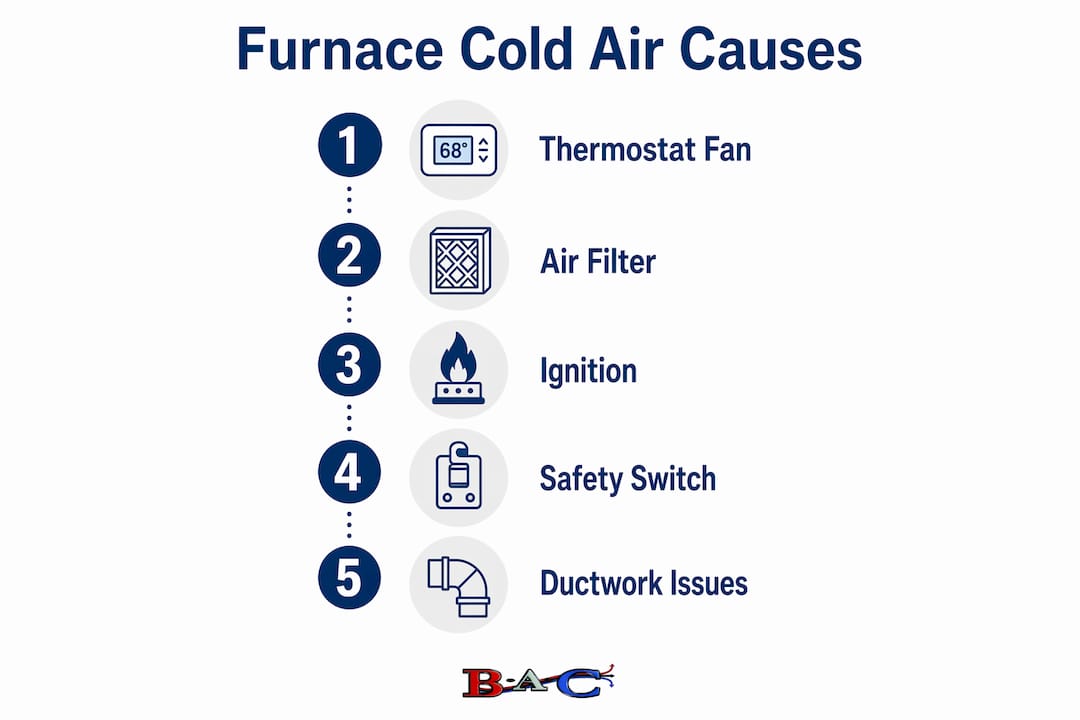
This is the most common cause, and it’s not a malfunction at all. When the fan is set to “On,” the blower circulates air around the clock. Between heat cycles, that air hasn’t been warmed, so it feels cold coming out of the vents. Switching to “Auto” keeps the blower running only when the furnace is actively producing heat. Also check that the thermostat is in “Heat” mode and that the setpoint is at least a few degrees above the current room temperature. Dead batteries in a programmable thermostat can cause erratic behavior that mimics a heating failure.
Clogged air filter tripping the high-limit switch
A dirty filter blocks airflow across the heat exchanger. With nowhere for heat to go, the exchanger temperature climbs until the high-limit switch trips and cuts power to the burners. The blower keeps running to cool the cabinet down, so you feel a steady stream of cold air. Replace the filter and give the furnace 15–20 minutes to reset before testing again.
Ignition failures: pilot light, hot-surface ignitor, or electronic ignition
Older furnaces use a standing pilot light; if it’s out, no heat is produced even though the blower runs. Modern furnaces use a hot-surface ignitor, a fragile ceramic element that glows orange to light the gas. When it cracks or burns out, the furnace goes through its startup sequence, the ignitor never glows, and the control board shuts everything down for safety. You’ll hear the system attempt to start, pause, and try again before locking out.
Flame sensor contamination
The flame sensor is a thin metal rod that confirms combustion is happening. When carbon buildup coats the rod, it can’t conduct properly, and the control board reads “no flame” and closes the gas valve within seconds. The classic symptom: burners light for 5–10 seconds, then shut off, while the blower continues running. Cleaning or replacing the flame sensor is one of the most common pro repairs for this exact complaint.
Safety switches: limit switch, condensate float, and pressure switch
The high-limit switch trips on overheating (usually from airflow restriction). On high-efficiency condensing furnaces, a blocked condensate drain trips a float switch that stops ignition entirely. Pressure switches prevent ignition if the venting draft isn’t correct. All of these leave the blower running while the burners stay off.
Ductwork and vent problems
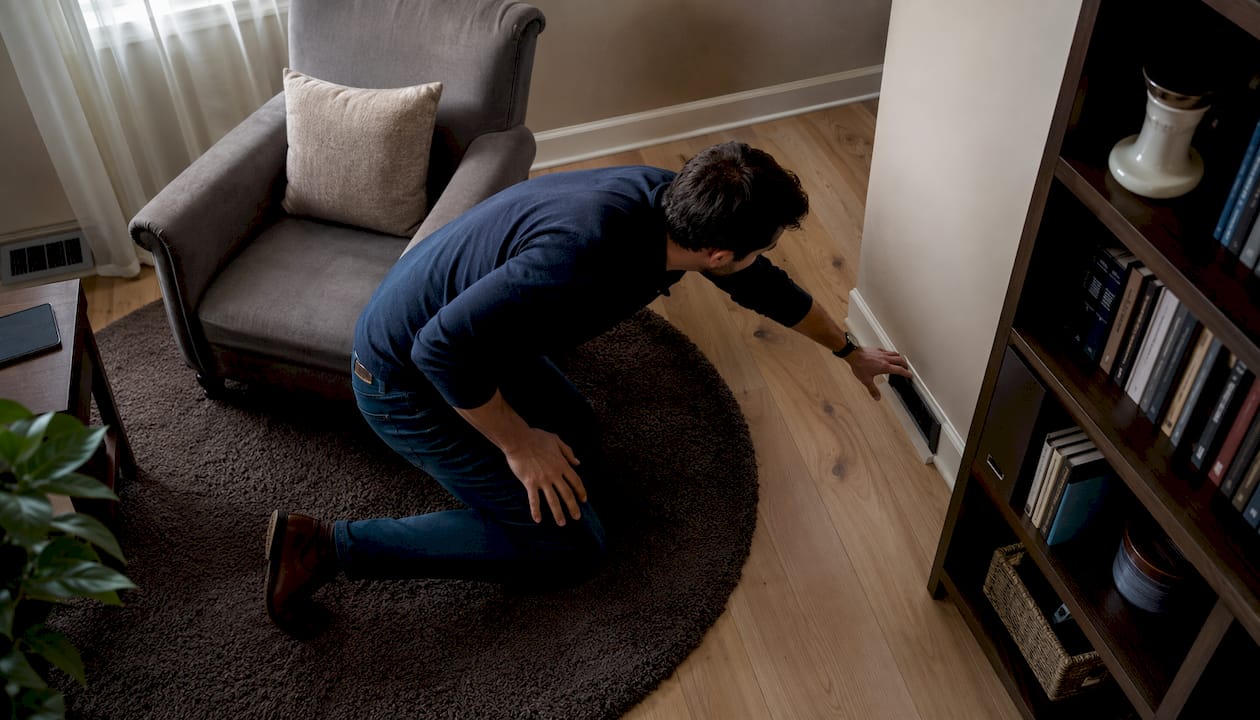
Sometimes the furnace is producing heat, but it never reaches your living space. Closed supply registers, blocked return vents, or leaky ductwork in unconditioned spaces like attics and crawlspaces can all cause warm air to dissipate before it reaches the room. Poorly insulated ducts lose heat fast in cold weather. Check that all registers are open and that no furniture or rugs are blocking return grilles. For a deeper look at how plenum airflow affects heat delivery, the issue often starts well before the vent.
Blower motor, capacitor, or control board faults
If the basic checks don’t resolve the problem, the issue may be electrical. A weak blower capacitor can keep the fan spinning at reduced speed while the control board fails to command a heat cycle. A faulty control board may not send the ignition signal at all. These faults require professional diagnosis with a multimeter and manufacturer-specific diagnostic codes.
How to Troubleshoot a Furnace Not Heating: Step-by-Step
Work through these in order. Stop at any step that fixes the problem, and stop entirely if you encounter gas odor, unusual sounds, or repeated ignition failures.
Before touching any gas or electrical components: turn the furnace power switch off. Never attempt to access internal gas components without proper training.
- Check thermostat mode and fan setting. Set the system to “Heat,” fan to “Auto,” and raise the setpoint 5°F above room temperature. Wait 2–3 minutes for the furnace to respond.
- Inspect the air filter. Locate the filter slot (usually at the return air duct or furnace cabinet). Pull the filter and check it visually. Replace it if it’s gray, clogged, or you can’t see through it. Standard 1-inch filters should be replaced regularly according to manufacturer recommendations.
- Check supply and return vents. Walk through the house. Open any closed registers and move furniture or rugs blocking return grilles. Closing too many vents raises system pressure and can trip the high-limit switch.
- Confirm furnace power. Find the power switch on the furnace or nearby wall. It looks like a standard light switch. Make sure it’s on. Then check the breaker panel for a tripped breaker.
- Look for status lights or blink codes. Most modern furnaces have a small LED on the control board that blinks error codes. Count the blinks and compare them to the code chart usually printed inside the furnace door. Common codes point directly to the failed component.
- Try one reset — only one. If the furnace is in lockout, turn the power switch off, wait 30 seconds, and turn it back on. If the furnace starts and runs normally, monitor it. If it locks out again, stop resetting. Modern control boards enter a hard lockout after repeated failed ignition cycles, and continued resets can complicate the technician’s diagnosis.
- Wait for warm air. After a successful startup, give the system 3–5 minutes. A short burst of cool air at the beginning is normal as the heat exchanger warms up. Persistent cold air after that window means the burners aren’t maintaining combustion.
Call a technician if: the furnace won’t start after one reset, you see repeated lockouts, you hear unusual clicking or banging, or you smell anything unusual near the unit.
What a Technician Will Inspect and Repair
When basic homeowner checks don’t resolve the problem, a technician runs a structured diagnostic. Here’s what that typically covers and what it costs.
Common pro repairs for a furnace blowing cold air:
- Flame sensor cleaning: The sensor rod is removed, lightly sanded to remove oxidation, and reinstalled. Often resolves the “burners light then shut off” symptom immediately.
- Hot-surface ignitor replacement: The ceramic ignitor is inspected for cracks and replaced if it fails to glow. Ignitors are model-specific parts.
- Limit switch testing and replacement: The technician checks the switch with a multimeter and replaces it if it’s stuck open or closed.
- Condensate drain clearing: On high-efficiency furnaces, the drain line is flushed or replaced, and the float switch is tested.
- Control board diagnostics: Blink codes are read, wiring is inspected, and the board is tested for proper sequencing.
- Gas valve and pressure checks: Gas pressure is measured at the manifold to confirm the valve is opening and delivering the correct pressure.
- Blower motor and capacitor inspection: The capacitor is tested with a multimeter; the motor is checked for overheating or bearing wear.
| Repair | Typical Cost Range | Typical Job Time |
|---|---|---|
| Flame sensor cleaning | $150 | 15–20 minutes |
| Hot-surface ignitor replacement | $150 | — |
| Limit switch replacement | $150 | — |
| Condensate drain clearing | — | 15–20 minutes |
| Control board replacement | — | 1–3 hours |
| Blower motor/capacitor repair | $150 | 1–2 hours |
Cost ranges are estimates for the U.S. market and vary by region, brand, and labor rates.
For a scheduled service call, most technicians arrive within 24–48 hours. Emergency calls, especially during peak winter demand, may carry a higher diagnostic fee but typically arrive the same day. Understanding what a diagnostic fee covers before you book helps avoid surprises.
Pro Tip: Before calling for service, write down your furnace’s model and serial number (on a label inside the cabinet door), the age of the unit, when you last changed the filter, and what the status light blink code shows. A technician who arrives with that information can often diagnose and repair in a single visit.
A cracked heat exchanger is the most serious finding. If a technician flags one, stop using the furnace. Carbon monoxide can enter the home through a cracked exchanger, and repair usually means full furnace replacement on older units.
How to Prevent Your Furnace From Blowing Cold Air
Most cold-air calls are preventable. The two biggest culprits, a dirty filter and a neglected flame sensor, are both addressed by a basic maintenance routine.
- Replace the air filter on schedule. Standard 1-inch filters need replacement every 1–3 months. Homes with pets, heavy dust, or multiple occupants should lean toward the shorter end. Higher-MERV filters (MERV 11–13) catch more particles but restrict airflow faster, so check them monthly. A clean filter is the single most effective thing you can do to prevent safety shutdowns.
- Schedule an annual tune-up before heating season. A professional tune-up includes cleaning the flame sensor, inspecting the ignitor, testing the limit switch, verifying combustion efficiency, and checking for CO safety. Catching a failing ignitor in October costs far less than an emergency call in January.
- Keep returns and registers clear. Walk through the house at the start of each heating season and confirm no furniture, rugs, or stored items are blocking return grilles or supply registers. Closing more than 10–15% of registers in a forced-air system can create enough backpressure to trigger safety shutdowns.
- Check the condensate drain on high-efficiency furnaces. At the start of each heating season, visually inspect the condensate drain line for kinks, clogs, or standing water in the secondary pan. A quick flush with water can prevent a mid-winter shutdown.
- Test your thermostat batteries. Replace them every fall. Weak batteries cause erratic behavior that can look exactly like a heating failure.
Pro Tip: Keep a simple log on your phone: date of last filter change, last tune-up, and any error codes you’ve seen. When a technician asks, you’ll have the answers immediately, and that speeds up the repair.
A seasonal HVAC preparation checklist covers these steps in more detail and adds checks specific to the transition from cooling to heating season.
High-Efficiency Furnace? Check These First
Condensing furnaces (typically 90%+ AFUE units) have an extra class of safety controls that standard furnaces don’t. They extract so much heat from combustion gases that those gases condense into water, which must drain out of the unit. When that drainage fails, the furnace shuts down ignition entirely while the blower may continue running.
Signs of a condensate-related shutdown:
- Water pooling near the base of the furnace or in the secondary drain pan
- A status light blinking a code for “pressure switch” or “float switch”
- Repeated short cycles that stop before the unit reaches full heat
- A frozen condensate line in very cold weather (common when the drain runs through an unheated space)
What you can safely check yourself: Look at the condensate drain line (a white PVC pipe, usually 3/4 inch, running from the furnace to a floor drain or utility sink). Check for visible kinks, disconnections, or standing water in the pan. If the line is frozen, warming the area around it may restore drainage temporarily, but the underlying routing issue needs a technician’s attention.
Accessing the float switch or pressure switch inside the cabinet involves electrical components and should be left to a professional. For general gas heater safety checks before winter, a qualified technician can inspect both the condensate system and the gas-side components in a single visit.
What to Do Next After Troubleshooting
Three paths, depending on what you found:
- Path A — Quick homeowner fix: Thermostat was on “On,” filter was clogged, or a vent was blocked. You fixed it, the furnace started, and warm air is coming through within 5 minutes. Monitor for the next few cycles. If it happens again, schedule a tune-up.
- Path B — Schedule a technician: Basic checks didn’t fix it, the furnace locks out after one reset, or the status light is blinking an error code. The issue is likely a flame sensor, ignitor, limit switch, or control board. These are safe to wait on for a scheduled appointment unless the weather is extreme.
- Path C — Emergency action: Gas odor, CO alarm, hissing near the furnace, or visible damage to the unit. Leave the house, leave the door open, and call your gas utility or 911 from outside. Do not re-enter until cleared by emergency services.
Normal startup lag is 3–5 minutes from the time the thermostat calls for heat to the time warm air reaches the vents. If you’re still feeling cold air after 5 minutes and the furnace sounds like it’s running, the burners aren’t staying lit.
Pro Tip: If you’re heading into a cold snap and the furnace isn’t working, a space heater in a central room buys you time to get a technician scheduled without risking frozen pipes. Never use a gas range or oven for heat.
For local service in New Jersey, Brighton Air Corp’s repair team handles both emergency and scheduled furnace diagnostics, with 24/7 availability and upfront diagnostic pricing.
Key Takeaways
A furnace blowing cold air is almost always a safety shutdown or a simple setting error, not a system failure, and the thermostat fan setting plus a dirty filter resolve the majority of calls.
| Point | Details |
|---|---|
| Check thermostat fan first | Switch fan from “On” to “Auto” — this single change resolves many cold-air complaints at no cost. |
| Replace a clogged filter | A dirty filter trips the high-limit switch and shuts off burners; replace every 1–3 months. |
| One reset only | Repeated manual resets can push the control board into hard lockout, requiring a technician to clear it. |
| Call a pro for ignition issues | Flame sensor, ignitor, limit switch, and control board problems need professional diagnosis and repair. |
| Brightonaircorp for NJ homeowners | Brighton Air Corp has served New Jersey since 1993 and offers 24/7 emergency furnace diagnostics. |
A Technician’s Honest Take on Cold-Air Calls
The conventional advice is to call a technician the moment your furnace acts up. That’s not wrong, but it skips something useful: a large share of cold-air calls get resolved before the technician even touches the furnace, because the homeowner changed the thermostat setting or swapped the filter while waiting for the appointment.
That’s not a knock on technicians. It’s a case for doing the basic checks first. A furnace that’s blowing cold air because the fan is set to “On” is not broken. A furnace that’s locked out because the filter hasn’t been changed in eight months is not broken either. Both are fixable in minutes.
Where homeowners get into trouble is the repeated reset. It feels productive. It’s not. Every failed ignition cycle that ends in a manual reset is a cycle the control board logged. Push it far enough and the board locks out hard, which turns a $150 flame sensor cleaning into a more complicated diagnostic visit. One reset is reasonable. More than that, stop and call.
The other thing worth saying plainly: if a technician finds a cracked heat exchanger, believe them. It’s not a sales tactic. A cracked exchanger is a carbon monoxide pathway, and no amount of repair makes an old, cracked exchanger safe. That’s the one situation where the answer is replacement, not a repair estimate.
Brighton Air Corp’s technicians have been running these diagnostics since 1993, with over 150 years of combined experience across the team. The approach is the same every time: check the simple things first, read the codes, confirm safety, then repair.
Brighton Air Corp Is Ready When the Basic Checks Don’t Work
When the thermostat and filter checks don’t bring the heat back, you need a technician who shows up prepared, not one who charges a diagnostic fee just to tell you what you already know.
Brighton Air Corp has served New Jersey homeowners and businesses since 1993, with 24/7 emergency availability and technicians who arrive with the tools and parts to handle the most common furnace repairs in a single visit. Flame sensor cleaning, ignitor replacement, limit switch testing, condensate drain clearing — these are routine calls for the Brighton Air Corp team. Diagnostic fees are explained upfront before any work begins, so there are no surprises on the invoice.
If your furnace is still blowing cold air after running through the checks in this guide, schedule a diagnostic visit or call Brighton Air Corp’s emergency line for same-day service.
Useful Sources
The following sources were used to verify the claims and repair guidance in this article. Bryant and Carrier manufacturer pages are the primary references for thermostat settings, filter guidance, and ignition failure behavior.
- Furnace Blowing Cold Air? Causes, Fixes & When to Call a Pro — Bryant
- Why Is My Furnace Blowing Cold Air? — Carrier
- Furnace Blowing Cold Air? 7 Causes & How to Fix Each — National HVAC Parts
- Furnace Fan Works But No Heat: Common Causes and Fixes — HVAC.com
- Why Is My Heater Blowing Cold Air? — Hawthorne PHC
- Furnace Is Running But No Heat: Troubleshooting Guide — Centerline Mechanical
- Furnace Runs But No Heat? 7 Common Causes & Solutions — Sigler Heat & Air
- Brighton Air Corp — Local HVAC Service, New Jersey
“A furnace blowing cold air is usually a safety shutdown, not a random failure. Start with the thermostat, then airflow, then ignition basics. If the warning signs show up, stop troubleshooting.” — Centerline Mechanical
This article is general informational guidance, not a substitute for professional HVAC advice. Furnace repair involves gas and electrical systems. Confirm current safety standards and your specific equipment requirements with a licensed HVAC technician before performing any work beyond the basic homeowner checks described here.