
Network First VRF Maintenance for Building Staff and Managers
Network First VRF Maintenance for Building Staff and Managers
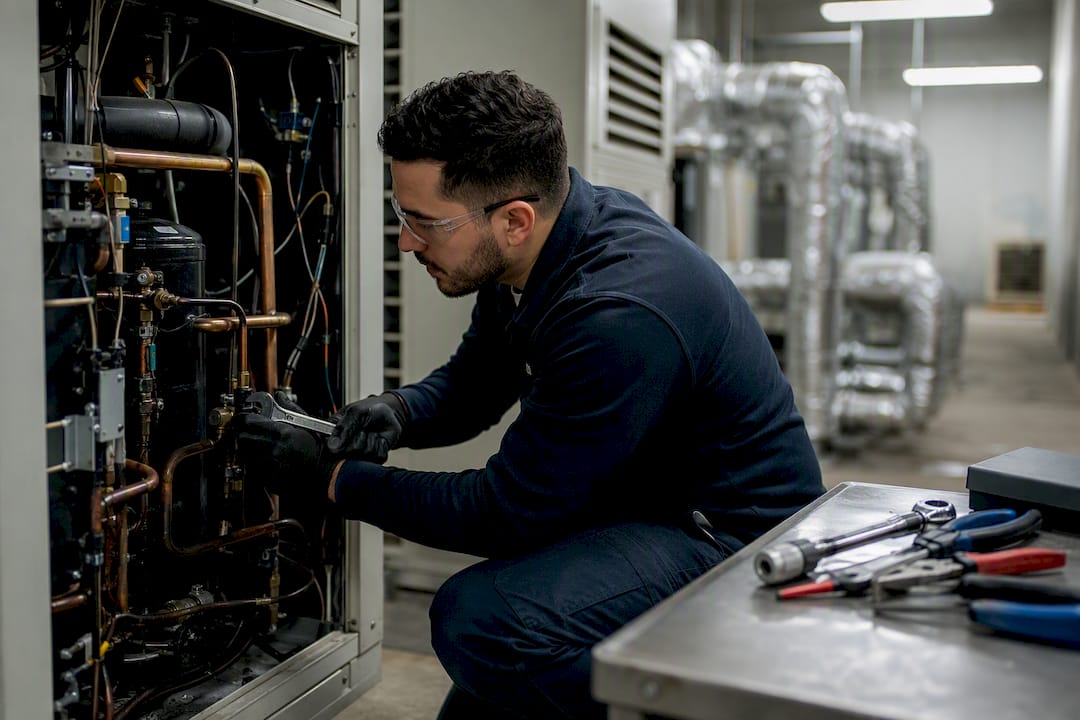
The right program is simple: monthly filter and drain checks by building staff, two seasonal tune-ups from a factory-certified technician each year, and one annual diagnostic pass that logs refrigerant, communication, and fault-history data. Skip any leg of that stool and you get the same outcome every time: shorter compressor life, higher energy bills, and a service call that arrives at the worst possible moment. Refrigerant charge work, inverter diagnostics, and PCB troubleshooting stay off-limits for anyone without factory certification.
TL;DR:
- Regular filter cleaning, condensate line flushing, and visual checks are crucial to prevent system icing, pressure faults, and moisture issues that reduce compressor lifespan.
- Refrigerant charge verification and communication network testing require factory-certified technicians using manufacturer-specific tools to prevent systemic failures.
- Monitoring data such as discharge temperatures, refrigerant pressures, and fault frequency enables predictive maintenance, reducing emergency repairs and extending system life.
- Most failures stem from refrigerant leaks, communication faults, and dirty coils, which can be minimized through trained staff logging zone performance and factory technician diagnostics.
- Preventive maintenance costs are generally 1 to 2 percent of the system value annually, often saving significantly on emergency repairs and shortening system lifespan without proper care.
Table of Contents
- What Should a VRF Maintenance Checklist Include?
- Why Does My VRF System Keep Faulting?
- What Should a Professional VRF Service Visit Include?
- How Does Monitoring Data Lower VRF Maintenance Costs?
- What Does VRF Maintenance Cost, and Is It Worth It?
- What Goes Into a Brighton Air Corp VRF Report?
- Why Most VRF Maintenance Advice Undersells Network Diagnostics
- Schedule a VRF Assessment With Brighton Air Corp
- Sources
What Should a VRF Maintenance Checklist Include?
VRF systems fail in stages, not all at once. That’s the whole logic behind a tiered checklist: catch the small stuff monthly, catch the medium stuff seasonally, and catch the systemic stuff annually before it turns into a compressor replacement.
Monthly (building staff, no certification required):
- Inspect and clean or replace indoor air filters. Dirty filters are the single most common upstream cause of icing and pressure faults on VRF indoor units, according to OxMaint’s troubleshooting guide.
- Check condensate pans and drain lines for blockage, and flush lines showing slow drainage.
- Do a visual walk of each indoor unit for frost, moisture staining, or unusual noise.
- Glance at the controller or remote display for active fault codes, without clearing them.
- Confirm outdoor unit clearances are free of debris, snow, or stored equipment.
Filter cleaning and condensate maintenance sit squarely in the building-staff lane. HCR’s VRF maintenance recommendation lists both as baseline monthly tasks, no HVAC license required.
Quarterly or seasonal (technician visit):
- Clean condenser coils and inspect fins for corrosion or bent surfaces restricting airflow.
- Verify refrigerant charge using superheat and subcooling readings, not just static pressure.
- Run leak detection at flare joints, brazed connections, and service valves.
- Check electrical connections for loose lugs and confirm torque specs on terminal blocks.
- Inspect fan motors and bearings for vibration or unusual draw on amperage.
- Test branch controller operation across each zone.
Annually (system-level diagnostics):
- Pull the full fault-code history from the outdoor unit before any reset.
- Run a communication network integrity test across indoor units, branch controllers, and the outdoor unit.
- Check compressor health indicators: startup current, running current, and oil return behavior.
- Document everything in a service record suitable for warranty claims.
Treating a VRF system as a single connected refrigerant and communication network, not a collection of standalone units, is what separates a maintenance program that actually prevents failures from one that just checks boxes. Sendwork’s operator guide makes the same point: charge, communication, and zone balance are the three variables worth tracking every visit.
Not every finding needs the same urgency. Categorize issues as monitor (log it, recheck next visit), schedule (needs a technician within two to four weeks), or urgent (call today). A dusty coil is a monitor item. A refrigerant leak is urgent. Buildings running high occupancy loads, coastal salt exposure, or heavy dust environments should shorten every interval by roughly a third.
Pro Tip: Keep one running log per outdoor unit, not per building. Fault patterns tied to a specific compressor or circuit get buried when you log by building instead of by system.
Why Does My VRF System Keep Faulting?
Five fault categories account for most VRF service calls: refrigerant leaks, communication faults between indoor and outdoor units, inverter or circuit board faults, condensate blockages, and airflow restriction from dirty coils or filters.
Here’s a safe triage sequence building staff can run before calling anyone:
- Record the fault code and timestamp exactly as displayed, without clearing it. Historical fault sequences are what a technician uses for root-cause analysis, and clearing codes before they’re logged erases that trail, per OxMaint’s fault-code guidance.
- If the unit is unsafe to run (unusual smell, visible arcing, tripped breaker repeatedly), power-cycle the isolator switch once, and only once.
- Clean or swap filters if airflow restriction is a plausible cause.
- Flush the condensate line if drainage is slow or the pan is showing standing water.
- Note ambient temperature, recent occupancy changes, and any recent construction or duct work nearby. Environmental context speeds up diagnosis.
What not to do matters just as much. Never open a refrigerant circuit, add refrigerant, or swap an inverter board without factory certification. VRF systems run tight refrigerant tolerances, and a miscalculated charge on a multi-zone system doesn’t just hurt one room, it throws off performance across every connected indoor unit.
Communication faults and repeated compressor lockouts fall into the “urgent” bucket almost every time. Have the fault history, filter condition, and any recent environmental changes ready before the technician arrives. That prep alone often cuts diagnostic time on-site by a real margin, since the tech isn’t starting from zero.
What Should a Professional VRF Service Visit Include?
Spring and fall tune-ups exist for a reason tied to load, not calendar convention: spring prep catches refrigerant and coil issues before peak cooling demand, and fall prep catches heating-mode faults before the system runs in reverse for months. Buildings with high occupancy swings, commercial kitchens, or server rooms often need a third check mid-summer.
Core tasks that require a factory-certified technician:
- Refrigerant charge verification against manufacturer specs, using superheat/subcooling math specific to that system’s design.
- Leak detection with electronic sniffers or UV dye, not visual inspection alone.
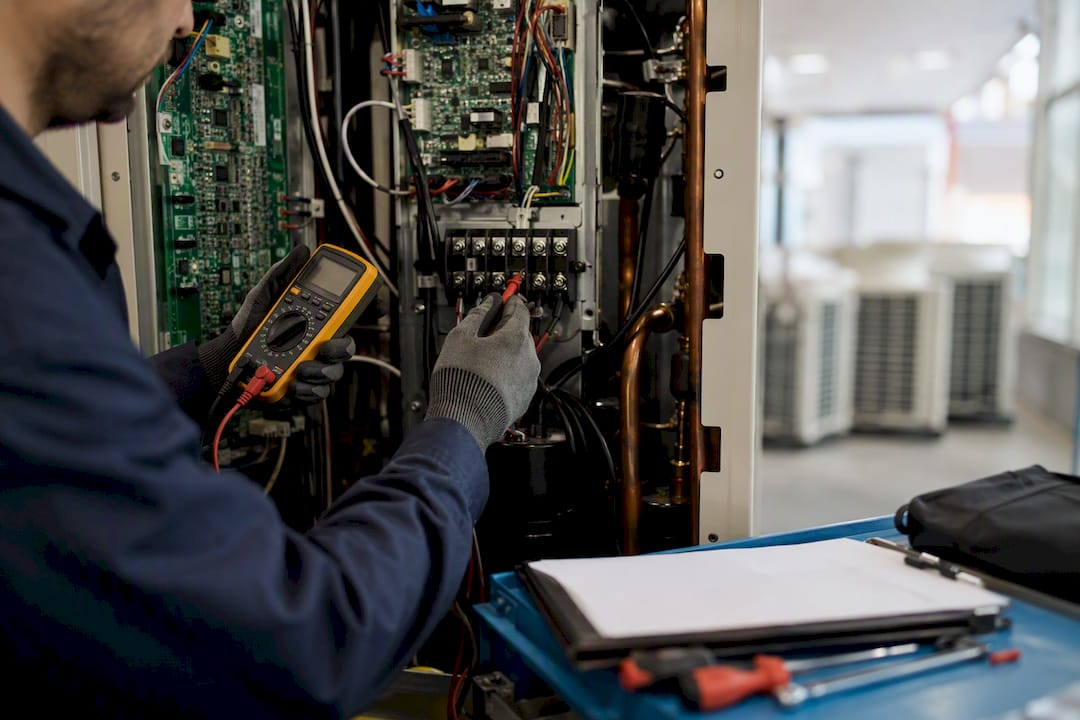
- Inverter diagnostics run through manufacturer software. Brand-specific tools like Daikin’s D-Checker or Mitsubishi’s MelView are often the only way to read circuit-level fault data accurately, according to OxMaint’s digital management guide.
- Firmware updates on branch controllers and communication modules.
Pro Tip: When you’re bidding out a VRF service contract, ask each vendor to show you a sample fault-history report from a prior job. If they can’t produce one, they’re not capturing the data that actually prevents repeat failures.
A solid vendor checklist covers factory certification, on-truck diagnostic software matched to your equipment brand, documented fault-history capture at every visit, torque-checked electrical connections, and sourcing of genuine OEM parts. Your service contract should spell out visit frequency, response-time guarantees, and documentation formatted for warranty support.
How Does Monitoring Data Lower VRF Maintenance Costs?
A handful of metrics, tracked consistently, tell you more than any single inspection: suction and discharge pressure, discharge and suction temperatures, compressor running current, coefficient of performance (COP), fault frequency per unit, refrigerant-charge drift over time, and the delta between zone setpoint and actual temperature.
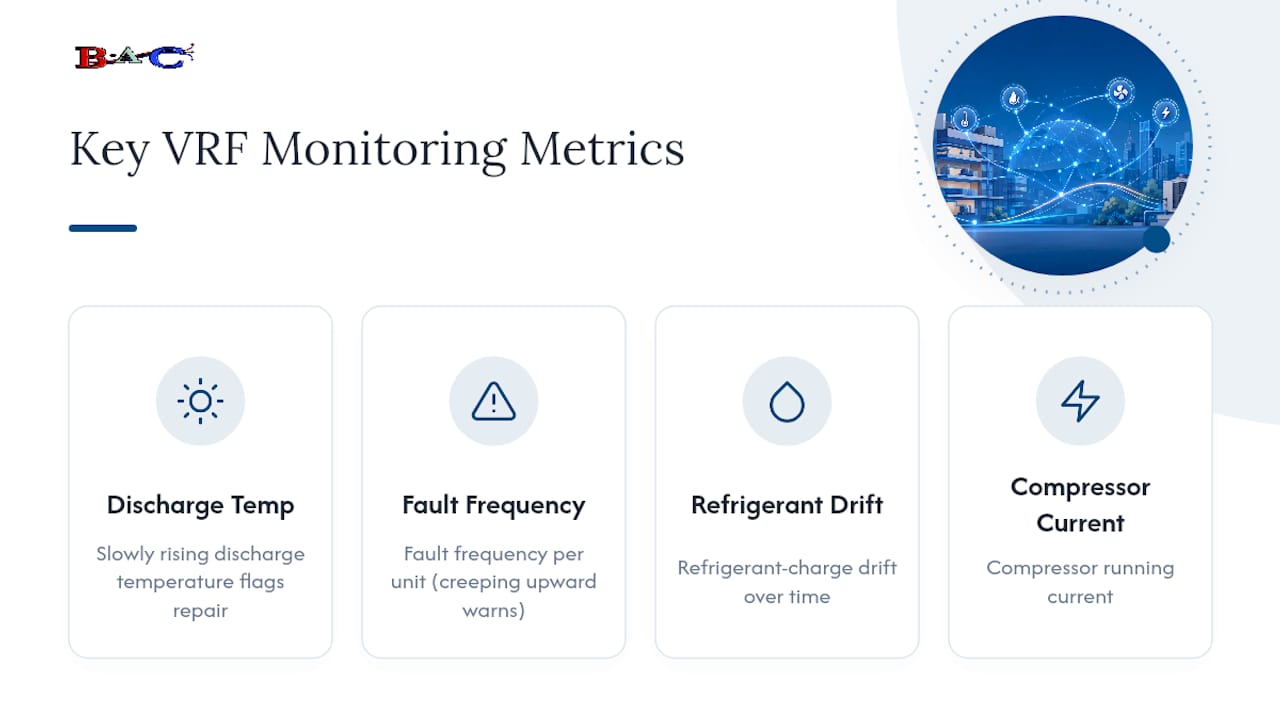
Remote monitoring turns those numbers into early warnings instead of after-the-fact explanations. Systems that flag a slowly rising discharge temperature or a fault frequency creeping upward let you schedule a repair instead of eating an emergency callout, and monitoring platforms built for VRF report converting what would have been an emergency visit into a routine parts-and-repair job.
Feed that same data into a CMMS. Log every fault, schedule the follow-up automatically, and use the trend history to justify preventive budget requests instead of arguing them from scratch every fiscal year.
What Does VRF Maintenance Cost, and Is It Worth It?
A planned seasonal visit typically runs $400 to $600, while an emergency callout on a faulted VRF system commonly lands between $2,500 and $4,000 depending on failure type and access. That gap is the entire argument for preventive maintenance in one number.
- Budget rule of thumb: plan for maintenance costs around 1 to 2% of system replacement value annually.
- Well-maintained outdoor units commonly reach 15 to 20 years of service; reactive-only service tends to cut that in half.
- One avoided emergency callout, or one avoided compressor failure, often covers most of an annual maintenance contract on its own.
Run the math against your own HVAC lifecycle costs and the preventive route wins in nearly every building profile we’ve seen.
What Goes Into a Brighton Air Corp VRF Report?
The failures we see repeat: dirty filters causing icing, neglected condensate lines backing up into ceilings, and fault codes cleared before anyone wrote them down. A good service report captures superheat/subcooling readings, amperage draws, fault history, and photos of coil and drain condition, graded by severity so the next technician isn’t starting from zero.
[author_bio]
Why Most VRF Maintenance Advice Undersells Network Diagnostics
Most maintenance checklists treat VRF like a scaled-up split system: clean the coil, check the filter, call it done. That misses what actually breaks these systems. VRF is a network, refrigerant loops and communication buses tied across dozens of indoor units, and the failures that cost real money start as small imbalances in that network, not dirty filters.
Zone balancing and communication integrity get almost no attention in the maintenance advice I see circulating, yet they’re often the first sign something is drifting before a fault code ever appears. If one zone is consistently short-cycling while others run fine, that’s data, and most buildings never capture it because nobody’s logging zone-level performance over time.
Building staff should own the basics, filters, drains, visual checks, without hesitation. The moment refrigerant, inverters, or communication networks enter the conversation, that’s a factory-certified technician’s job, full stop. The gap between those two categories is where most maintenance programs quietly fail: either staff attempt work above their training, or certified visits get treated as a once-a-year formality instead of a data-gathering exercise. Fix that gap first.
— John
Schedule a VRF Assessment With Brighton Air Corp
Brighton Air Corp handles the technician side of this checklist across New Jersey: seasonal tune-ups, refrigerant charge verification, leak detection, and the documentation your warranty provider actually wants to see.

Beyond scheduled visits, our team runs a 24/7 emergency line for the faults that can’t wait for a quarterly appointment, and we offer service plans that bundle spring and fall tune-ups with priority response so you’re not competing with every other building for a slot during peak season. Financing options are available for buildings weighing a larger corrective repair against a full system replacement, and every visit comes with a free estimate before any work begins. If your building runs on VRF and hasn’t had a network-level diagnostic in the past year, request a service assessment and we’ll walk your system before small issues turn into an emergency callout.
Sources
- HCR maintenance recommendation: Variable Refrigerant Flow (VRF) — February 12, 2024
- VRF system maintenance for commercial buildings: An operator’s guide