
Vapor Barrier HVAC Systems: A Homeowner's Guide
Vapor Barrier HVAC Systems: A Homeowner’s Guide
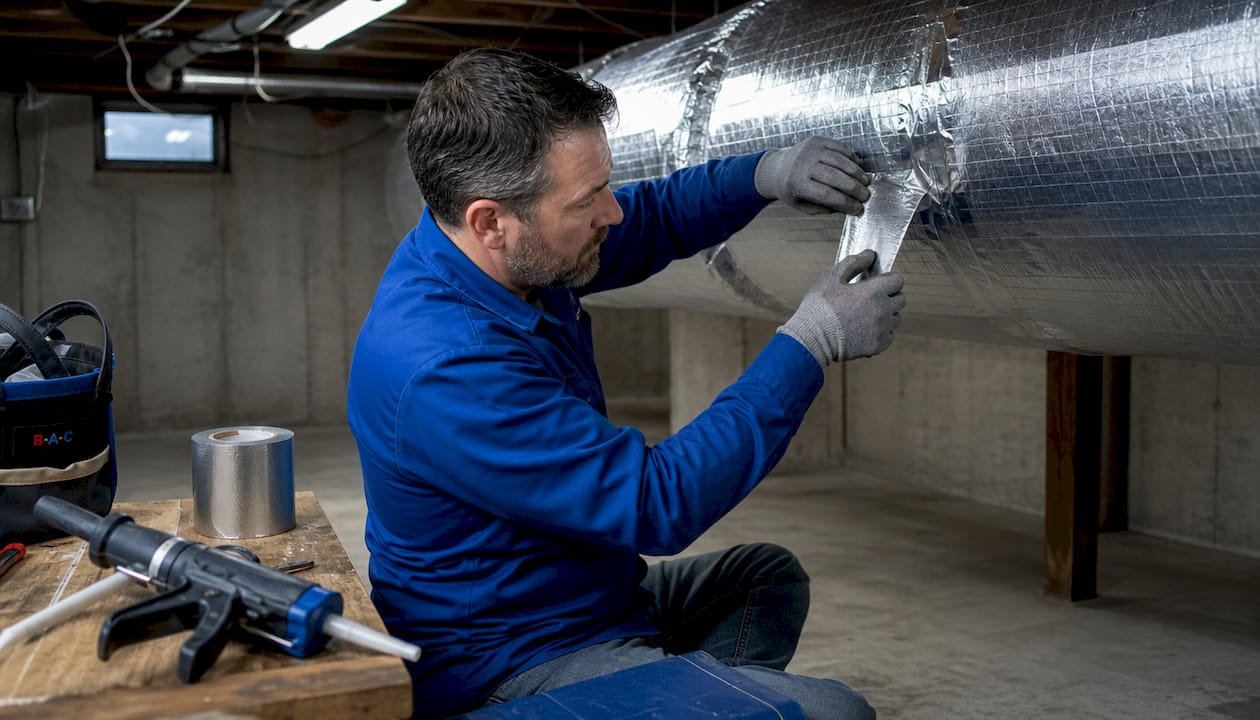
A vapor barrier in an HVAC system is a material layer designed to block water vapor from penetrating duct insulation and surrounding building assemblies. The role of vapor barrier HVAC systems goes far beyond simple wrapping. Without proper vapor management in HVAC, condensation forms on cold duct surfaces, soaks insulation, and creates conditions for mold growth and structural decay. IRC 2024 requires vapor retarder protection on supply duct insulation in humid climate zones, and ignoring this requirement can cost you 0–30% in energy efficiency losses. For homeowners and building managers in New Jersey and similar humid regions, understanding how these systems work is the first step toward protecting your investment.
What is the role of vapor barrier HVAC systems?
A vapor barrier, more precisely called a vapor retarder in building science, controls moisture diffusion through insulation and duct assemblies. When your air conditioner runs, supply ducts carry air that is often 20°F or more below the surrounding air temperature. That cold surface attracts water vapor from the warm, humid air around it. Without a barrier, vapor diffuses through insulation and condenses on the duct wall, saturating the insulation and reducing its thermal resistance.
The consequences compound quickly. Wet insulation loses its ability to resist heat transfer, forcing your HVAC system to work harder. Mold colonies establish within days of sustained moisture contact. Metal duct walls corrode from the inside out, shortening system lifespan significantly. Vapor barriers actively protect the thermal envelope by stopping this moisture pathway before it starts.
Vapor retarders are classified by their permeance rating, measured in perms. The lower the perm rating, the less moisture passes through. IRC 2024 specifies a perm rating of 0.02 or less for supply duct insulation in humid zones. That threshold matters because materials above it allow enough vapor diffusion to cause condensation under typical summer operating conditions in states like New Jersey.
How do vapor barriers prevent HVAC condensation?
Condensation forms when moist air contacts a surface cooled below its dew point. In an HVAC system, supply ducts are the primary risk zone. They carry cold air continuously during cooling season, and the duct surface temperature frequently drops below the dew point of the surrounding air, especially in unconditioned spaces like attics, crawlspaces, and mechanical rooms.
A vapor barrier works by creating a continuous low-permeance layer on the outside of duct insulation. This layer stops water vapor from reaching the cold duct surface. The insulation stays dry, maintains its rated R-value, and the duct wall stays above dew point. Advanced vapor barrier and moisture control strategies can reduce surface condensation by up to 75% and improve moisture removal efficiency by 30–40% compared to conventional methods. That is a measurable, direct impact on both comfort and system performance.
Latent moisture loads also affect energy consumption in ways many homeowners overlook. When an HVAC system must remove excess moisture from indoor air because vapor has infiltrated the building envelope, it runs longer cycles. Mismanaged latent moisture loads can increase energy consumption by 15–30% and create persistently uncomfortable indoor conditions. A properly installed vapor barrier reduces the moisture entering the building assembly, which directly reduces the latent load your HVAC system must handle.
The benefits of vapor barriers extend to HVAC insulation efficiency as well. Dry insulation performs at its rated R-value. Wet insulation can lose a significant portion of that rating, meaning your ducts are losing more energy to the surrounding space than your energy bills reflect.
What vapor barrier materials work best for HVAC ducts?
The most common vapor barrier materials used in HVAC applications fall into three categories: polymeric films, all-service jacket (ASJ) kraft paper facings, and mastic coatings with vapor-barrier tape. Each has a specific application range and performance profile.
Polymeric films such as polyethylene sheeting are used primarily in crawlspaces and wall assemblies. They are inexpensive and widely available, but they require careful sealing at seams to maintain continuity.
ASJ kraft paper facings come factory-applied to fiberglass duct wrap insulation. They provide a moderate vapor retarder and are standard on most commercial duct insulation products. Their limitation is that they are paper-based and can be damaged during installation, creating gaps in vapor control.
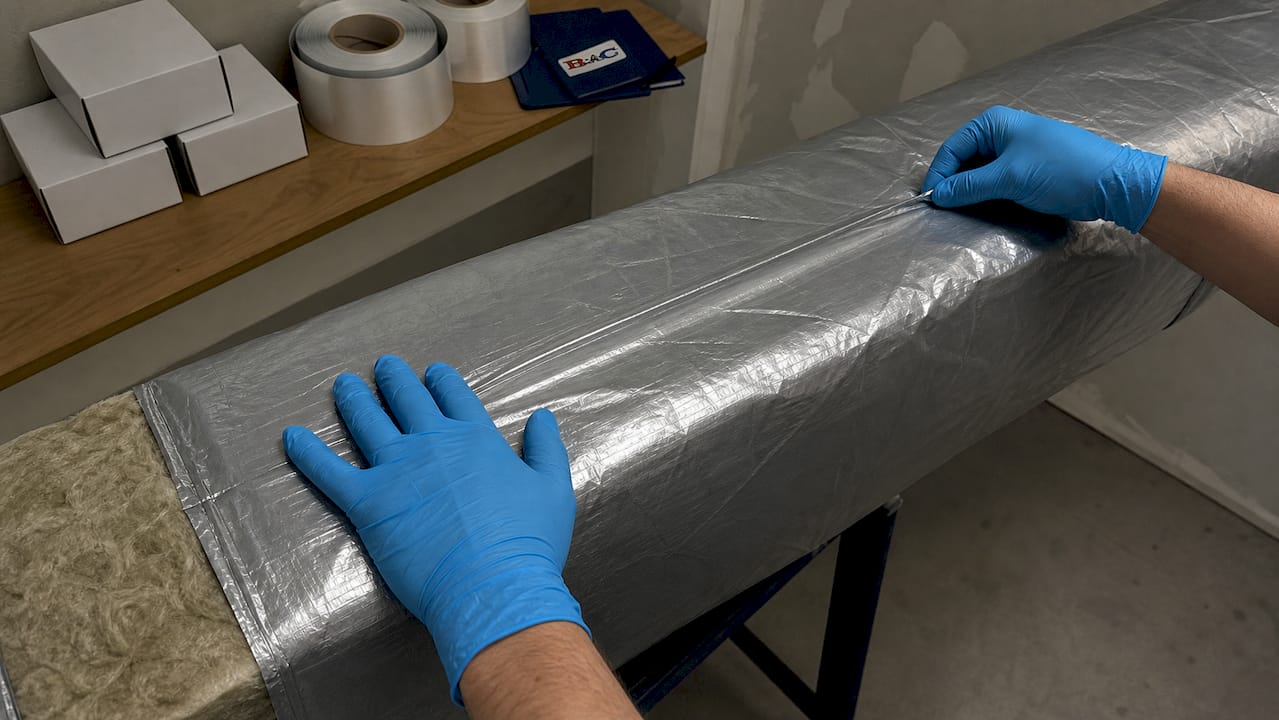
Mastic and vapor-barrier tape are used to seal joints, seams, and penetrations. Mastic is a paste-like sealant applied with a brush. Vapor-barrier tape, typically foil-faced, bonds to insulation facings and maintains the barrier at every seam.
Rubber-plastic closed-cell insulation is the preferred choice for humid environments. Its closed-cell structure resists moisture penetration even if the outer facing is punctured during installation. This makes it far more forgiving than fiberglass in high-humidity conditions like those found in New Jersey summers.
Installation quality determines whether any of these materials actually perform. Follow these steps to get it right:
- Measure and cut insulation to fit duct sections without gaps or compression. Compressed insulation loses R-value.
- Seal all longitudinal seams with vapor-barrier tape rated for the application. Overlap tape edges by at least 2 inches.
- Wrap duct hangers and supports using vapor-barrier-approved boots or tape. Unsealed hangers and supports create hidden moisture pathways that cause mold and insulation saturation despite a surface barrier that looks intact.
- Seal around equipment connections where insulation meets air handlers, coil boxes, and plenums. These transitions are the most common failure points.
- Inspect for punctures before closing walls or ceilings. Even small holes allow vapor diffusion under sustained pressure.
Pro Tip: In humid climates, use closed-cell rubber-plastic insulation on all supply duct runs in unconditioned spaces. If you must use fiberglass duct wrap, apply a secondary layer of foil-faced vapor-barrier tape over every seam and at every hanger location.
What is the difference between vapor barriers and air barriers?
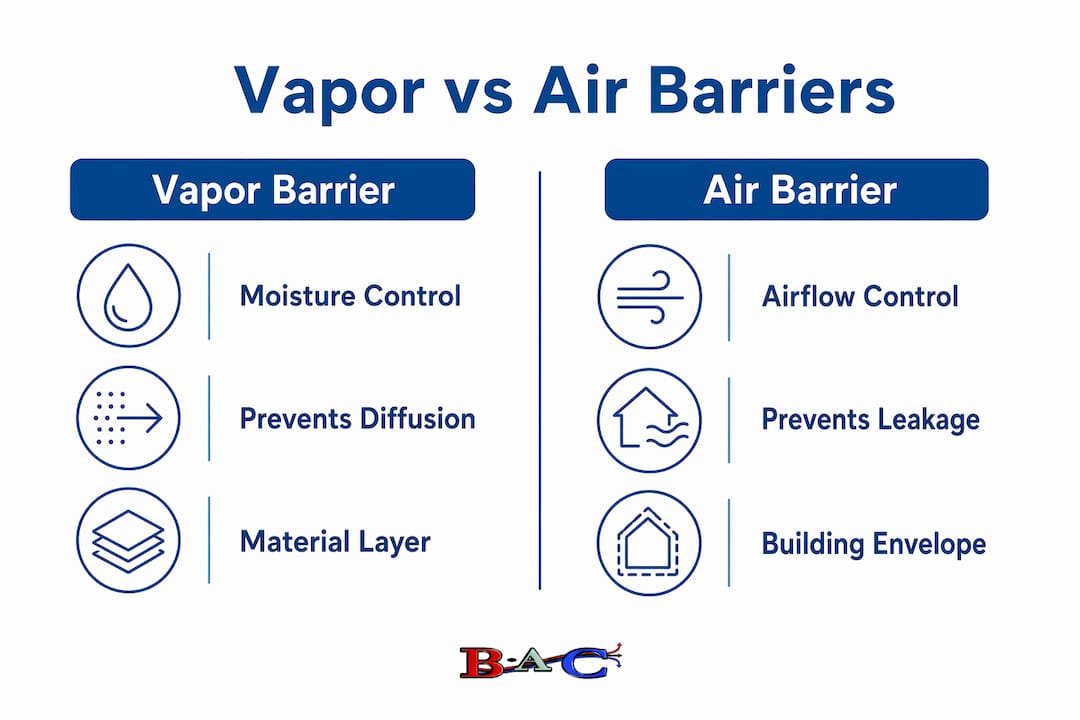
Vapor barriers and air barriers are two distinct systems that work together, but they control different things. Confusing them leads to installation errors that trap moisture inside wall and duct assemblies.
An air barrier stops bulk air movement through the building envelope. It controls infiltration and exfiltration of air, which carries moisture, heat, and pollutants. Air barriers must be continuous, rigid enough to resist air pressure, and installed on the exterior side of the assembly in most climates.
A vapor barrier stops moisture diffusion through materials. Moisture moves by diffusion even without air movement, driven by vapor pressure differences between warm and cold sides of an assembly. Air barriers stop bulk air movement; vapor barriers stop moisture diffusion, and both must be placed correctly on the warm-in-winter side of insulation to prevent trapped moisture.
The table below shows the key differences:
| Property | Vapor barrier | Air barrier |
|---|---|---|
| What it controls | Moisture vapor diffusion | Bulk air movement |
| Primary material | Polymeric film, foil facing, closed-cell foam | House wrap, rigid foam board, sealed drywall |
| Placement | Warm side of insulation | Exterior side of assembly (most climates) |
| Permeance requirement | 0.02 perms or less (IRC 2024) | Air leakage rate, not permeance |
| Failure mode | Moisture saturation, mold, corrosion | Drafts, heat loss, moisture-laden air infiltration |
Placing a vapor barrier on the wrong side of insulation is one of the most damaging installation errors possible. If the barrier sits on the cold side, it traps moisture inside the insulation where it condenses and cannot escape. Misplacement causes trapped moisture and insulation damage that often goes undetected for years until mold or structural decay becomes visible.
How do you maintain vapor barriers and avoid common mistakes?
Vapor barrier maintenance is straightforward but frequently skipped during routine HVAC inspections. The barrier must remain continuous and intact to perform. Any puncture, tear, or unsealed joint becomes a moisture entry point.
Routine inspection should cover these areas:
- Duct hangers and supports: Check that tape or boots remain bonded and have not pulled away from the insulation facing.
- Seams along duct runs: Look for tape lifting at edges, especially in areas with temperature cycling that causes expansion and contraction.
- Equipment connections: Inspect where insulation meets air handlers and plenums for gaps or compression damage.
- Crawlspace and attic runs: These areas experience the most extreme temperature swings and are most prone to condensation and barrier degradation.
One persistent myth is that ducts in conditioned space do not need vapor barriers. This is incorrect. Supply ducts in conditioned spaces can still develop condensation when they carry air below the dew point of the surrounding conditioned air, particularly in humid climates. IRC 2024 addresses this directly by requiring vapor retarder protection based on climate zone, not just duct location.
A damaged or missing vapor barrier produces consequences that go well beyond a damp insulation jacket. Mold growth inside duct insulation can contaminate supply air. Corrosion on metal duct walls creates leaks that reduce system airflow. Saturated insulation drives up energy costs by reducing thermal resistance. Replacing degraded duct insulation and vapor barriers costs significantly more than maintaining them. For a full picture of how these costs accumulate, the HVAC lifecycle cost analysis from Brightonaircorp breaks down long-term system expenses in detail.
Pro Tip: Add vapor barrier inspection to your seasonal HVAC checklist. Spring is the best time to check, before cooling season begins and condensation risk peaks. A flashlight and a firm hand along every duct seam takes less than 30 minutes and can prevent thousands of dollars in damage.
Key Takeaways
Vapor barriers are active moisture control components, not passive wrapping, and their installation quality directly determines HVAC energy efficiency, system lifespan, and indoor air quality.
| Point | Details |
|---|---|
| Vapor barriers prevent condensation | They block moisture diffusion to cold duct surfaces, reducing condensation by up to 75%. |
| Material choice matters | Closed-cell rubber-plastic insulation outperforms fiberglass in humid climates. |
| Continuity is non-negotiable | Sealing hangers, supports, and seams is as critical as the barrier material itself. |
| Vapor and air barriers are different | Each controls a different moisture pathway and must be placed on the correct side of insulation. |
| Conditioned space is not exempt | IRC 2024 requires vapor retarders in humid climate zones regardless of duct location. |
What I’ve learned after years of watching vapor barriers fail
Most vapor barrier failures I’ve seen are not material failures. They are installation failures. A contractor wraps the duct, tapes the long seam, and moves on. The hanger bracket punches through the insulation facing. The connection at the air handler gets a half-wrap of tape that peels off in six months. Two years later, the homeowner calls about mold smell from the vents.
The industry talks about vapor barriers as if selecting the right material is the hard part. It is not. The hard part is maintaining continuity at every transition, every penetration, and every support point. Proper installation and maintenance are as critical as material selection, and overlooked details cause widespread failures that are expensive to remediate.
What genuinely excites me right now is the direction moisture control technology is heading. Near-isothermal dehumidification systems can reduce dehumidifier energy consumption by 65–85%. That kind of efficiency gain reframes moisture control from a comfort issue to a core energy strategy. Vapor barriers are the passive foundation of that strategy. Advanced dehumidification and home dehumidifier systems build on top of it. Neither works well without the other.
My honest advice: treat your vapor barrier the way you treat your HVAC filter. Inspect it on a schedule. Replace it when it shows damage. Do not wait for symptoms.
— John
Brightonaircorp’s HVAC vapor barrier services in New Jersey
Brightonaircorp has served New Jersey homeowners and building managers since 1993, with over 150 years of combined technician expertise across residential and commercial HVAC systems.

Vapor barrier installation requires more than wrapping ducts. It requires sealing every hanger, every seam, and every equipment connection to IRC 2024 standards. Brightonaircorp technicians inspect existing duct insulation for moisture damage, identify barrier failures before they become mold problems, and install vapor retarder systems that hold up through New Jersey’s humid summers. Whether you need a new installation or a full assessment of your current system, request a free estimate from Brightonaircorp and get a clear picture of what your building actually needs.
FAQ
What does a vapor barrier do in an HVAC system?
A vapor barrier blocks water vapor from diffusing through duct insulation and reaching cold duct surfaces, preventing condensation, mold growth, and insulation degradation. Without it, moisture saturates insulation and forces the HVAC system to work harder.
Do ducts in conditioned spaces need vapor barriers?
Supply ducts in conditioned spaces still require vapor barriers in humid climate zones because they carry air below the dew point of surrounding air. IRC 2024 mandates vapor retarder protection based on climate zone, not duct location.
What is the best vapor barrier material for HVAC ducts?
Closed-cell rubber-plastic insulation is the best choice for humid environments because its closed-cell structure resists moisture penetration even if the outer facing is punctured. Fiberglass duct wrap with foil-faced tape is acceptable in drier climates with careful seam sealing.
How often should vapor barriers be inspected?
Inspect vapor barriers at least once per year, ideally in spring before cooling season begins. Focus on duct hangers, seams, and equipment connections, which are the most common failure points.
What is the difference between a vapor barrier and an air barrier?
A vapor barrier stops moisture diffusion through materials, while an air barrier stops bulk air movement through the building envelope. Both must be placed on the warm-in-winter side of insulation to prevent trapped moisture and insulation damage.