
UV Light for HVAC: Is It Worth It for Your Home?
UV Light for HVAC: Is It Worth It for Your Home?
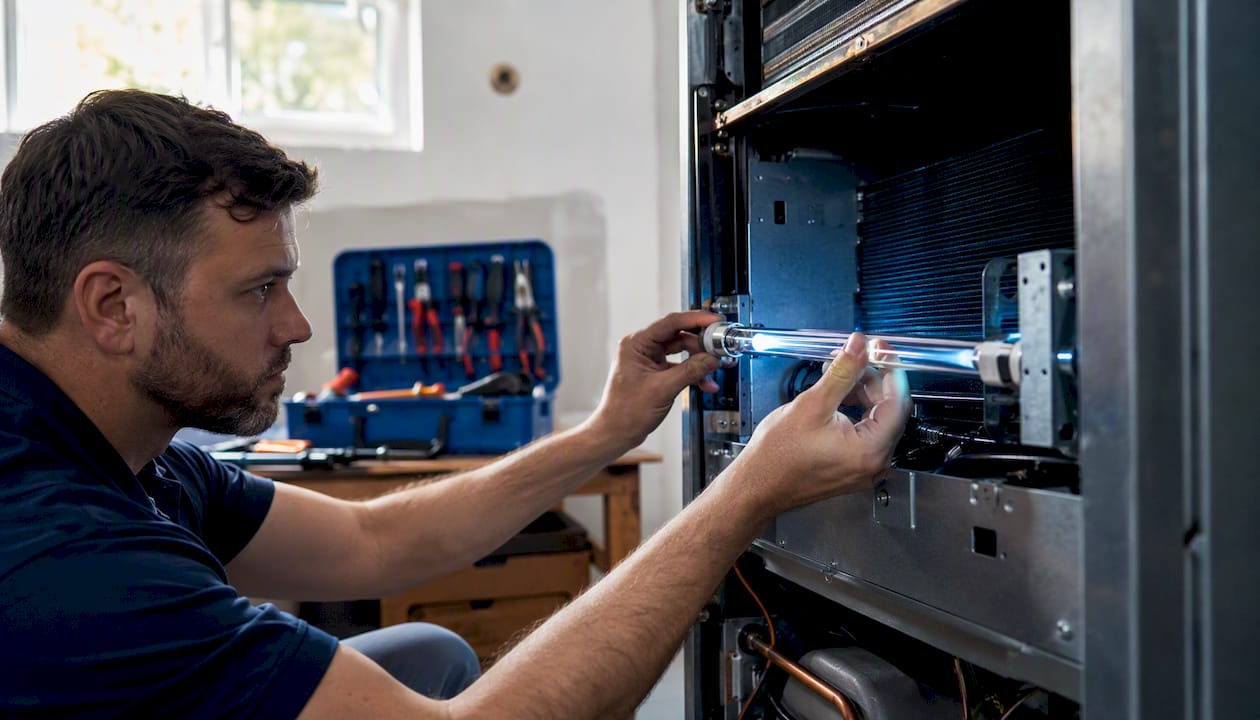
UV light for HVAC systems works best as a targeted coil-sanitation tool, and the evidence for that specific use case is solid. For airstream disinfection, results vary considerably depending on dose, airflow speed, and lamp layout. The short version: if your system runs in a humid climate, you have had coil mold, or you manage a high-occupancy building, a properly installed UV system is worth serious consideration. If you’re expecting it to replace your air filter or eliminate all airborne pathogens, it won’t. The right first step is a system assessment from a licensed HVAC contractor who can calculate the dose your specific setup actually needs.
Who benefits most:
- Homeowners in humid regions where coil biofilm and mold growth are recurring problems
- Building managers in high-occupancy spaces (schools, clinics, offices) where airborne pathogen reduction matters
- Anyone who has noticed reduced airflow or higher energy bills tied to dirty coil surfaces
UV is one layer of a complete indoor air quality strategy, not a standalone fix.
Key Takeaways
A properly dosed, professionally installed UV light in an HVAC system delivers real coil sanitation benefits and, in the right setup, modest airborne pathogen reduction — but dose calculation and safety interlocks are non-negotiable.
| Point | Details |
|---|---|
| Coil treatment is the strongest use case | Surface-mounted UV at 50–100 μW/cm² prevents biofilm and maintains heat transfer efficiency. |
| Dose calculation separates real installs from guesswork | Request irradiance targets, airflow modeling, and a UV-C meter reading at installation. |
| Safety interlocks and correct wavelength are required | Demand interlocked panels and confirm lamps emit at ~253.7 nm, not 185 nm, to avoid ozone. |
| Lamp replacement runs every 1–3 years | Budget for recurring replacement and annual output verification as part of operating costs. |
| Brightonaircorp serves New Jersey homeowners and building managers | Licensed technicians provide system assessments, verified UV installations, and maintenance plans. |
Table of Contents
- How does UV light for HVAC actually work?
- Does HVAC UV light really work? Evidence, limits, and realistic outcomes
- Where should you install a UV light in your HVAC system?
- What does a UV light installation actually cost?
- Safety risks, ozone concerns, and what the EPA actually says
- DIY units vs. hiring an HVAC contractor: when does it make sense to call a pro?
- How technicians measure UV effectiveness and what to request from your installer
- What most UV light guides get wrong
- Brightonaircorp’s UV installation and indoor air quality services
- Sources
How does UV light for HVAC actually work?
The technology is called Ultraviolet Germicidal Irradiation, or UVGI. It uses short-wavelength ultraviolet light to disrupt the DNA and RNA of microorganisms, preventing them from reproducing. According to ASHRAE guidance, UVC energy in the 220–280 nm range is most effective, with peak germicidal activity near 265 nm. Low-pressure mercury lamps, the most common type used in residential and commercial HVAC, emit at approximately 253.7 nm, which sits close to that peak.
Three distinct system types exist, and they are not interchangeable.
| System Type | Primary Target | Typical Placement | Realistic Claim | Key Trade-off |
|---|---|---|---|---|
| Coil-mounted (surface) | Biofilm, mold on coil and drip pan | Aimed directly at evaporator coil | Prevents coil fouling; maintains heat transfer efficiency | Does not treat passing air; limited to surface contact |
| In-duct / airstream | Airborne microorganisms in moving air | Inside supply or return duct | Modest pathogen reduction if dose is sufficient | Requires high irradiance; airflow speed limits exposure time |
| Upper-room | Airborne pathogens in occupied spaces | Near ceiling, above occupant breathing zone | Historically effective for diseases like tuberculosis | Requires careful design; not an HVAC-internal solution |
Coil-mounted systems have the most consistent track record because the lamp targets a stationary, wet surface with essentially unlimited exposure time. Airstream systems face a harder physics problem: air moves fast, so the lamp has only a fraction of a second to deliver a germicidal dose. Upper-room UVGI, recognized by the CDC as an engineering control for airborne pathogen reduction when combined with ventilation and filtration, is primarily a commercial or healthcare application.
One point worth repeating: UVGI and filtration do different jobs. Filters capture particulates; UV inactivates microorganisms that grow on wet surfaces or pass through the system. A well-designed IAQ strategy uses both, along with adequate ventilation. Learning how HVAC systems improve indoor air quality gives useful context for where UV fits in the broader picture.
Does HVAC UV light really work? Evidence, limits, and realistic outcomes
The evidence for coil surface treatment is strong. The evidence for in-duct airstream disinfection is real but conditional, and the conditions matter a lot.
ASHRAE notes that coil surface irradiance levels of 50–100 μW/cm² are typical guidance for surface biofilm control. Because the lamp runs continuously against a stationary surface, even lower irradiance can be effective over time. Airstream disinfection, by contrast, demands much higher irradiance because the exposure window is measured in fractions of a second.
What the research actually shows: A 2022 systematic review published in MDPI Energies identified 66 qualifying publications on UVGI in HVAC systems. The finding that should give every buyer pause: dose was reported in only a small number of those papers. Without dose data, performance claims are essentially unverifiable. That gap is why asking your installer for a dose calculation is non-negotiable, not optional.
NADCA’s white paper reports that one office-system study observed a 25–30% reduction in airborne bacteria with coil and drip pan irradiation. Coil pressure-drop improvements and better heat transfer have also been documented in controlled studies. Those are real, measurable benefits. They are not the same as “eliminates all pathogens from your air.”
Realistic outcomes for most residential and commercial installs:
- Reduced coil biofilm and mold accumulation, which translates to lower maintenance frequency and more consistent airflow
- Modest reduction in airborne bacteria in some system geometries, particularly when lamps are correctly positioned relative to airflow
- Maintained coil heat-transfer efficiency, which can reduce energy consumption over time
- No meaningful improvement in particulate removal (that is filtration’s job)
NADCA is direct on one point: UVGI supplements mechanical cleaning and source removal. It does not replace them. A UV lamp mounted near a coil that is already caked with debris will underperform because the biofilm blocks UV penetration.
Where should you install a UV light in your HVAC system?
Placement determines whether the system works or wastes money. The best location depends on your objective.
For coil sanitation: Mount the lamp so it shines directly and continuously on the evaporator coil and drip pan. The lamp should be close enough to deliver adequate irradiance across the full coil face. Homes with high humidity or a history of moisture-related HVAC issues benefit most from this placement.
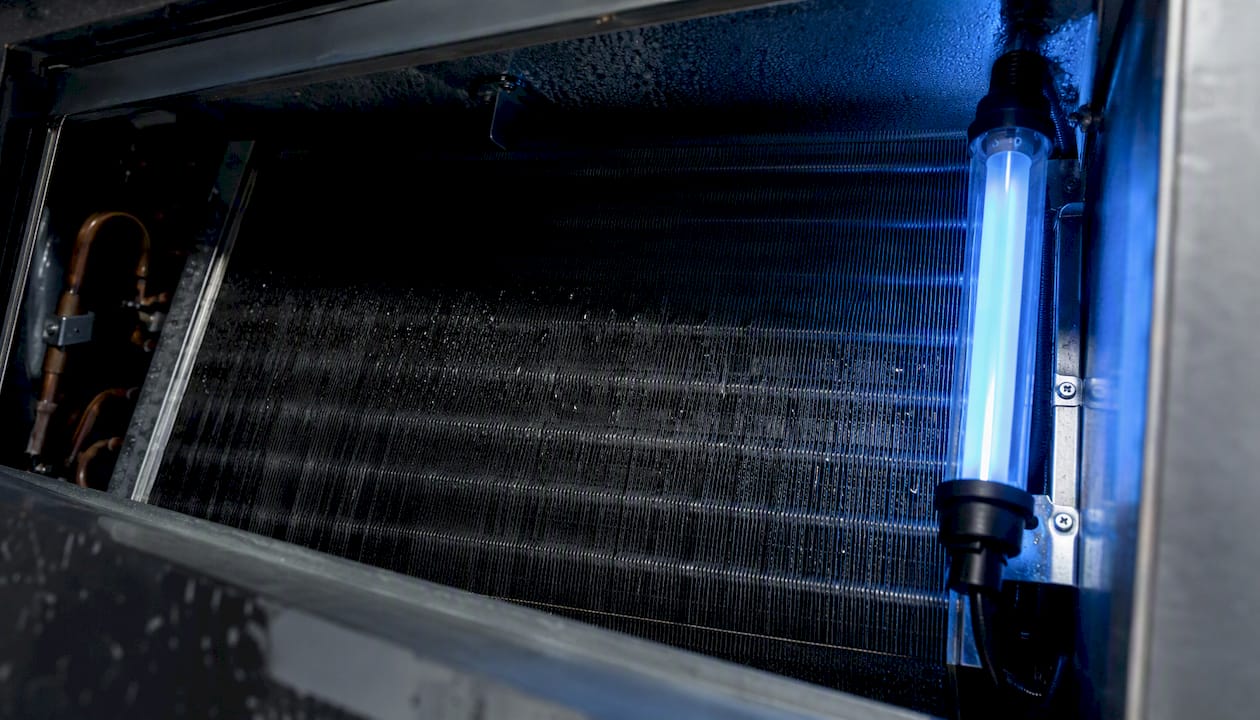
For airstream disinfection: Lamps go inside the supply or return duct, positioned to maximize the time air spends in the UV field. One lamp rarely suffices for high-volume ductwork. A proper design requires modeling airflow speed against lamp output to confirm the delivered dose. Understanding plenum space in an HVAC system helps clarify where in-duct lamps can and cannot be safely placed.
For upper-room applications: These belong near the ceiling in occupied spaces, above the breathing zone, and are almost always a commercial or healthcare decision requiring a specialist design.
Required safety features — demand all of these from any installer:
- Interlocked access panels that cut power to the lamp the moment the panel opens. No interlock means a technician or homeowner can be exposed to direct UVC during routine service.
- Sealed or ducted lamp housings for airstream installations so UV cannot leak into occupied spaces.
- Correct wavelength selection. Lamps that emit at 185 nm generate ozone as a byproduct. Standard germicidal lamps at 253.7 nm do not. Verify the lamp spec sheet before installation.
- Lamp shielding around any organic materials (gaskets, wiring insulation, plastic seals) that continuous UVC exposure will degrade over time.
- Lockout/tagout procedures documented for service calls, per NADCA’s safety guidance.
Pro Tip: Before the installer leaves, ask them to open the access panel and confirm the lamp powers off automatically. Watch it happen. If the interlock does not function, the installation is not complete.
Do not place lamps where direct or reflected UVC can reach occupied areas. Do not use consumer-grade lamps without verifying wavelength and safety certifications (ETL, UL, or CE markings are baseline indicators). Do not assume that more lamps automatically mean better results without a dose calculation to back the layout.
What does a UV light installation actually cost?
Cost ranges vary by system type, building size, and whether you hire a professional.
NADCA notes that lamp lifespan typically runs 1–3 years, with low-pressure lamps performing optimally within a typical temperature range for HVAC environments. Output degrades before the lamp physically fails, so replacement on a schedule matters more than waiting for burnout.
Recurring costs go beyond the lamp itself. Electricity consumption is modest for most residential lamps, but continuous operation adds up. More significant is the potential for UV-related material degradation: NADCA’s blog guidance specifically warns that organic HVAC components, including gaskets, adhesive seals, and wiring insulation, can degrade under continuous UVC exposure. Replacing or shielding those materials at installation time is often an overlooked line item in contractor quotes. Factor it in when comparing bids.
For a fuller picture of how UV fits into long-term system ownership costs, a lifecycle cost analysis for HVAC puts the investment in context alongside other system upgrades.
Some manufacturers claim their systems guarantee coil cleanliness within a set timeframe. Independent verification, such as a before-and-after coil inspection or UV-C meter reading, is more reliable than a marketing claim.
Safety risks, ozone concerns, and what the EPA actually says
UVC light is effective precisely because it damages biological material. That same mechanism makes it hazardous to human skin and eyes. Even brief, indirect exposure can cause photokeratitis (essentially a sunburn on the cornea) and skin irritation. This is not a theoretical risk; it is the reason professional installation with proper interlocks is the standard, not an upgrade.
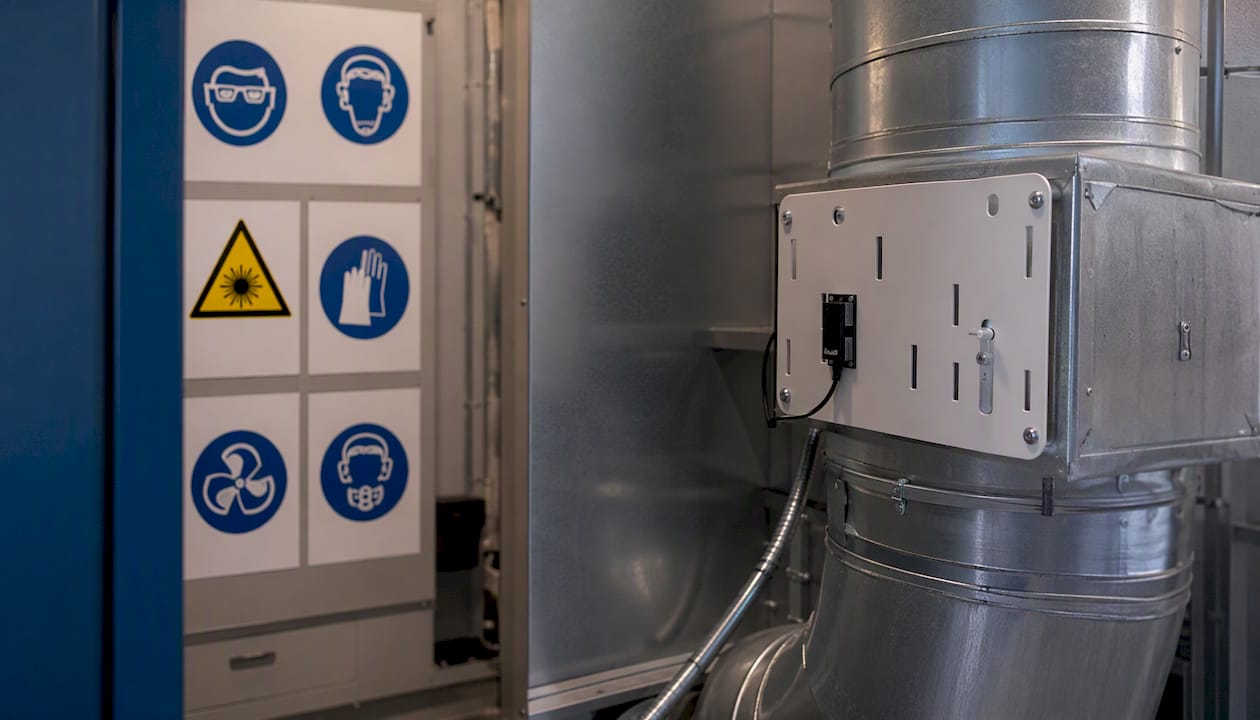
Ozone generation is a separate concern. Standard germicidal lamps at 253.7 nm do not produce ozone. Lamps that also emit at 185 nm do, and ozone at indoor concentrations is a respiratory irritant with documented health effects. The EPA’s guidance on indoor ozone is clear: elevated ozone concentrations cause lung irritation and can worsen asthma and other respiratory conditions. Specifying a 253.7 nm lamp and verifying the spec sheet eliminates this risk.
The EPA/FIFRA regulatory angle is something most homeowners never hear about. According to the EPA’s compliance advisory, UV devices sold with claims to kill viruses or bacteria are regulated as pesticide devices under the Federal Insecticide, Fungicide, and Rodenticide Act (FIFRA). The EPA does not routinely verify those efficacy claims, which means a product can carry bold marketing language about pathogen elimination without any independent confirmation that it performs as advertised.
Safety checklist for homeowners and building managers:
- Confirm the lamp does not emit at 185 nm (request the spec sheet)
- Verify interlocks are installed and tested before the contractor leaves
- Ask about mercury-containing bulbs and the installer’s breakage protocol
- Require written lockout/tagout procedures for any future service
- Do not operate the system with access panels removed or bypassed
- Check for ETL, UL, or CE certification on the lamp and ballast
DIY units vs. hiring an HVAC contractor: when does it make sense to call a pro?
Small consumer coil-facing kits are a reasonable starting point for a homeowner who wants supplemental surface treatment in a straightforward residential system. The lamp mounts near the evaporator coil, runs continuously, and requires minimal setup. The limitation is that most consumer kits lack robust interlocks, come with limited documentation, and offer no dose verification.
Any in-duct, upper-room, or commercial installation should involve a licensed HVAC professional. The physics of airstream disinfection require dose calculations specific to your system’s airflow rate and duct geometry. A lamp placed without those calculations may deliver a fraction of the required dose while still consuming power and creating maintenance obligations.
Questions to ask any HVAC contractor before hiring them for a UV install:
- What wavelength does the lamp emit, and can you show me the spec sheet?
- What dose calculation method are you using for my system’s airflow rate?
- How many lamps are you specifying, and where exactly will each one go?
- What interlock system will you install, and how will you verify it works?
- What organic materials in my system need shielding or replacement?
- What is the lamp replacement interval, and do you offer a maintenance plan?
- Will you provide a UV-C meter reading at installation as a baseline?
Red flags that should push you toward a professional:
- No interlock offered or installer dismisses it as unnecessary
- Vague dose claims (“kills 99% of germs”) with no calculation backing them
- Lamps specified without confirming wavelength
- No maintenance plan or lamp replacement schedule
- Installer cannot explain the difference between coil treatment and airstream disinfection
Brightonaircorp has been serving New Jersey homes and commercial buildings since 1993, with over 150 years of combined technician experience. For a UV installation with documented safety features and a written verification plan, request a system assessment from their team.
How technicians measure UV effectiveness and what to request from your installer
Dose is the core metric: irradiance (measured in μW/cm²) multiplied by exposure time (in seconds). A lamp with high output positioned where air moves slowly delivers a high dose. The same lamp in a high-velocity duct delivers a fraction of that dose. This is why placement and airflow calculations are inseparable from lamp selection.
Here is what a competent installer should provide, in order:
- Lamp specification sheet confirming wavelength (target: ~253.7 nm), rated wattage, and expected output at operating temperature.
- Airflow rate for your system (in cubic feet per minute), used to calculate residence time in the UV field.
- Dose calculation showing modeled irradiance at the target surface or in the airstream, based on lamp output, distance, and airflow speed.
- Placement diagram showing exact lamp position(s) relative to the coil, duct geometry, and any obstructions.
- UV-C meter reading taken at installation as a documented baseline. This is the only way to confirm the lamp is actually delivering the calculated dose in your specific system.
- Baseline photos of the coil surface before installation, useful for comparison at the first annual inspection.
- Maintenance log or schedule specifying lamp replacement interval, cleaning procedure, and annual output verification.
The MDPI systematic review found that most published studies on UVGI in HVAC omit dose reporting entirely. That gap in the literature is exactly why documented dose calculations and meter readings from your installer are the clearest signal of a competent job. An installer who cannot or will not provide these documents is specifying by guesswork.
ASHRAE’s technical standards provide the design framework that professional installers should reference. Ask your contractor which ASHRAE guidance they used for your system design. For commercial and warehouse applications, the verification requirements are more detailed still, and managing HVAC for large facilities adds useful context on what documentation building managers should keep on file.
Field technicians also document lamp output with a calibrated UV-C meter annually, since dirty lamps lose output before they fail visually. Cleaning instructions should be part of any maintenance contract, not an afterthought.
What most UV light guides get wrong
The conventional wisdom on HVAC UV systems tends to collapse into two camps: enthusiastic marketing that overpromises pathogen elimination, and skeptical dismissal that ignores the genuine, documented benefits for coil sanitation. Both miss the point.
The more interesting question is not “does UV work?” but “does this specific installation deliver the dose your system actually needs?” That framing changes what you ask for and what you pay attention to. A UV lamp installed without a dose calculation is not a germicidal system. It is a light bulb in a duct. The difference between those two things is entirely in the design process, not the hardware.
What also gets underweighted is the material degradation issue. Organic components inside HVAC units, gaskets, adhesive seals, wiring insulation, can break down under continuous UVC exposure. A contractor who does not address this at the quoting stage is either unaware of it or ignoring it. Either way, you end up paying for it later. Ask about it before signing anything.
The EPA/FIFRA angle is another blind spot. Most homeowners assume that if a product is sold at a hardware store with claims about killing viruses, someone verified those claims. The EPA’s compliance advisory makes clear that is not how it works for UV devices. The regulatory framework exists, but routine efficacy verification does not. That puts the burden of verification on the buyer, which is why the documentation checklist in the previous section matters as much as it does.
One more thing: UV and filtration are genuinely complementary, not competing. Upgrading to a higher-MERV filter while adding a coil-mounted UV lamp addresses two different failure modes simultaneously. Combining better ventilation and filtration strategies with a properly dosed UV system gives you a layered IAQ approach that no single technology can match on its own.
Brightonaircorp’s UV installation and indoor air quality services
If your home or building is in New Jersey and you want a UV system that actually delivers the dose it promises, Brightonaircorp offers the full path from assessment to verified installation.

The team has been handling complex residential and commercial HVAC work since 1993, and UV installations are part of their indoor air quality service line. Here is what a typical engagement looks like:
- System assessment and quote: A licensed technician evaluates your existing HVAC setup, airflow rates, and coil condition, then recommends the right UV system type and placement with a written dose rationale.
- Professional installation with safety verification: Every install includes interlocked access panels, wavelength-confirmed lamps, and a UV-C meter reading at completion so you have a documented baseline.
- Maintenance plan with lamp replacement reminders: Scheduled lamp output checks and replacement intervals are built into the service plan, so the system keeps performing rather than quietly degrading.
Financing options and free estimates are available. Schedule your on-site assessment with Brightonaircorp and get a written verification plan before any work begins.
Sources
The following sources informed this article. When requesting a UV system design or verification from any contractor, ask them to reference the applicable ASHRAE or NADCA standard for your installation type.
- ULTRAVIOLET AIR AND SURFACE TREATMENT
- NADCA White Paper on Ultraviolet Lighting Applications in HVAC Systems
- Ultraviolet (UV) Light Device Regulation and Compliance Advisory (EPA)
- A Systematic Review on the Application of Ultraviolet Germicidal Irradiation to HVAC Systems
- Guidelines for Environmental Infection Control in Health-Care Facilities (CDC)
This article is general information, not a substitute for advice from a qualified doctor. Consult a qualified healthcare professional about your own circumstances before acting on anything here.