
Commercial Refrigeration Units: A Buyer's Guide
Commercial Refrigeration Units: A Buyer’s Guide
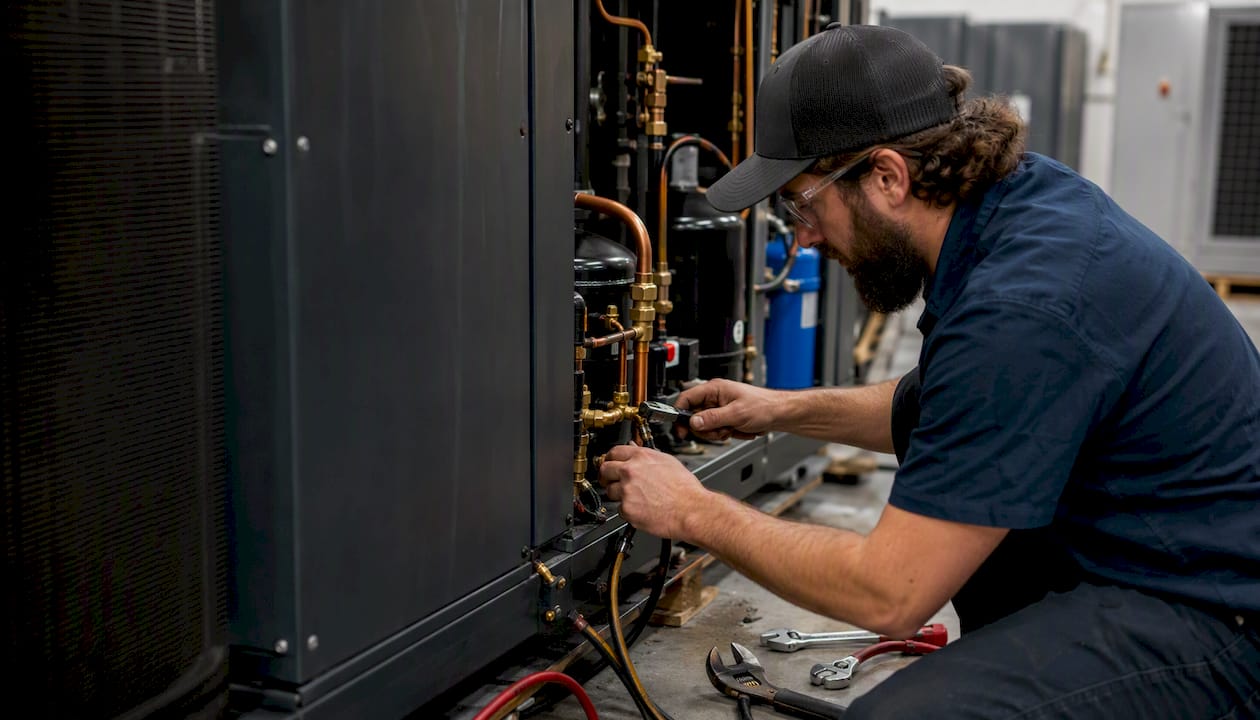
Commercial refrigeration equipment falls into three decision layers: system configuration (self-contained, split/remote condensing, or rack/supermarket), unit family (walk-in, reach-in, merchandiser, undercounter, and more), and application-specific equipment (blast chillers, prep tables, ice machines). For a café or small foodservice operation, self-contained reach-ins and undercounter units cover most needs. A full-service restaurant typically adds a walk-in cooler and a prep table. A grocery or large retail operation almost always needs remote condensing or centralized rack systems to handle multiple display cases efficiently. Catering kitchens often rely on roll-in units and blast chillers for volume throughput.
Three compliance signals run through every purchase decision: ENERGY STAR certification for energy-efficient procurement, NSF/ANSI 7 for sanitation and construction standards on food-display and storage equipment, and EPA SNAP rules governing refrigerant approvals across end-use categories.
The single most expensive mistake in commercial refrigeration is buying the right unit for the wrong system configuration. A reach-in that works perfectly in a self-contained setup can become a maintenance headache when it’s part of a poorly planned remote condensing layout with inadequate condenser access.
- Café / coffee shop: Self-contained reach-in refrigerators, undercounter units, back-bar coolers
- Full-service restaurant: Walk-in cooler/freezer, reach-in prep tables, ice machine
- Grocery / convenience store: Remote condensing or rack systems, glass-door merchandisers, open-air display cases
- Catering / commissary kitchen: Roll-in or roll-thru units, blast chillers, large walk-ins
Key Takeaways
Choosing the right commercial refrigeration system requires matching system configuration, unit family, and compliance requirements before a single piece of equipment is ordered.
| Point | Details |
|---|---|
| System configuration first | Decide between self-contained, remote condensing, or rack systems before selecting unit families — this drives condenser placement, piping, and service access. |
| Unit family by workflow | Match the cabinet type to the operational role: walk-ins for bulk storage, reach-ins for line access, merchandisers for customer-facing display. |
| Closed doors save money | Open-air cases consume more energy than closed-door units; night curtains and door retrofits often deliver faster payback than full unit replacement. |
| Verify compliance before buying | Confirm ENERGY STAR eligibility by product class, NSF/ANSI 7 compliance for food-contact equipment, and EPA SNAP refrigerant approval for your specific end-use category. |
| Brightonaircorp for NJ installs | Brightonaircorp provides site surveys, EPA 608-certified installation, and commercial maintenance plans for foodservice and retail operators in New Jersey. |
Table of Contents
- What types of commercial refrigeration units does the industry recognize?
- How do self-contained, remote condensing, and rack systems differ?
- What are the common unit types and how do they compare?
- How do you choose the right commercial refrigeration system?
- What maintenance and lifecycle costs should you plan for?
- How a qualified contractor supports your refrigeration project
- What operators often get wrong about refrigeration selection
- Brightonaircorp handles commercial refrigeration from site survey to service plan
- Sources
What types of commercial refrigeration units does the industry recognize?
The refrigeration industry classifies equipment along two parallel tracks, and confusing them leads to procurement mistakes. The first track is system configuration, which describes where the compressor and condenser live relative to the display or storage cabinet. The second track is unit family, which describes the cabinet’s physical form and operational role.
EPA’s retail food refrigeration framework formalizes this by treating stand-alone equipment, remote condensing units, and supermarket systems as distinct end-use categories. That framing matters because refrigerant approvals under the SNAP program, efficiency program eligibility, and installation engineering all follow those categories, not just the cabinet shape.
Unit families include walk-in coolers and freezers, reach-in refrigerators and freezers, glass-door and open-air merchandisers, undercounter units, prep tables, back-bar and beverage coolers, roll-in and roll-thru units, blast chillers, and ice machines. DOE/EERE research and ENERGY STAR product criteria enumerate these classes and specify which are eligible for efficiency programs — and which are not, depending on the specification version.
Taxonomy matters for more than vocabulary. Remote condensing units require rooftop or mechanical-room condenser space that must be planned before construction. A self-contained unit plugs into a standard circuit. Getting the taxonomy wrong at the spec stage means expensive change orders later.
FEMP purchasing guidance maps these product classes to UNSPSC procurement codes, which is useful when writing RFPs or applying for utility rebates. Not every refrigerated cabinet qualifies for ENERGY STAR or FEMP incentives — eligibility depends on the unit family and enclosure class, not just the brand or model number.
How do self-contained, remote condensing, and rack systems differ?
System configuration is the engineering decision that shapes everything downstream: condenser placement, piping runs, noise levels, heat rejection, service access, and refrigerant compliance. Two operations with identical cabinet counts can have completely different maintenance profiles because of this choice alone.
Self-contained units
All refrigeration components — compressor, condenser, evaporator — are packaged inside or directly on the cabinet. Installation is straightforward: position the unit, connect to a power circuit, and verify clearances for condenser airflow. Heat is rejected into the kitchen or sales floor, which adds to the HVAC cooling load. Self-contained units are the right call for small operations, back-bar applications, undercounter positions, and any location where running refrigerant piping is impractical.
Split/remote condensing units
The compressor and condenser are located remotely — typically on a rooftop, in a mechanical room, or on an exterior wall — while the evaporator stays inside the cabinet. DOE/EERE analysis identifies this two-part split as the defining engineering boundary between self-contained and remote systems. Remote placement removes heat rejection from the sales floor, reduces noise inside the store, and allows larger refrigerating capacities. EPA classifies remote condensing units as a distinct end-use category with typical refrigerating capacities from 1 kW to 20 kW (roughly 0.3 to 5.7 refrigeration tons).
The tradeoffs: longer refrigerant piping runs, more complex installation, and a condenser that needs its own service access. Refrigerant charge is larger, which raises the stakes for leak detection and EPA 608-certified technician work.
Multiplex rack systems and supermarket configurations
Centralized rack systems connect multiple display cases to a shared compressor rack, usually located in a dedicated machine room. This is the standard approach for supermarkets and large grocery operations. Efficiency gains from shared compressors are real, but so is the complexity: a rack failure can take down an entire aisle of cases simultaneously. Direct supermarket designs use dedicated compressors per case or small groups; indirect designs use secondary coolant loops to separate the refrigerant from the sales floor entirely.
Pro Tip: Before specifying a rack system, confirm the machine room dimensions, ventilation capacity, and structural load rating. Rack systems are heavy, generate significant heat, and need clear service corridors. Discovering these constraints after equipment is ordered is a costly problem.
EPA’s SNAP program treats remote condensing and supermarket systems as separate regulated end-use categories. Refrigerant substitutes approved for stand-alone equipment may not be approved for supermarket rack systems. Verify SNAP status for your specific end-use before finalizing refrigerant selection.
For operators choosing between distributed remote condensing and a centralized rack, the deciding factors are usually the number of cases, the distance between them, and whether a dedicated machine room is feasible. Fewer than six to eight cases often favor distributed remote condensing; larger installations with many cases in close proximity lean toward rack systems.
What are the common unit types and how do they compare?
Unit families are what buyers see and operators use daily. Each has a distinct physical form, temperature range, and workflow role. Understanding the differences prevents mismatches between the unit and the operation it serves.
Walk-in coolers and freezers
Walk-ins are the bulk storage backbone of most serious foodservice operations. A walk-in cooler typically holds 35°F–41°F; a walk-in freezer runs at 0°F or below. They range from small modular panels assembled on-site to large custom-built rooms. Capacity scales with floor area and ceiling height, making them the most flexible option for high-volume storage. Installation requires a condensing unit (self-contained or remote), insulated panel assembly, and a floor drain. Walk-ins used for food storage must meet NSF/ANSI 7 sanitation and construction requirements.
Reach-in refrigerators and freezers
The workhorse of the commercial kitchen. Reach-ins come in single, double, and three-door configurations, with solid or glass doors. Solid-door units are more energy-efficient and better suited for back-of-house storage; glass-door reach-ins work well in grab-and-go or front-of-house positions where visibility drives sales. Temperature ranges: 33°F–41°F for refrigerators, 0°F or below for freezers. A practitioner buying guide notes that reach-ins are the primary unit type for kitchen-line access, where staff need fast retrieval without walking to a walk-in.
Merchandisers and display cases
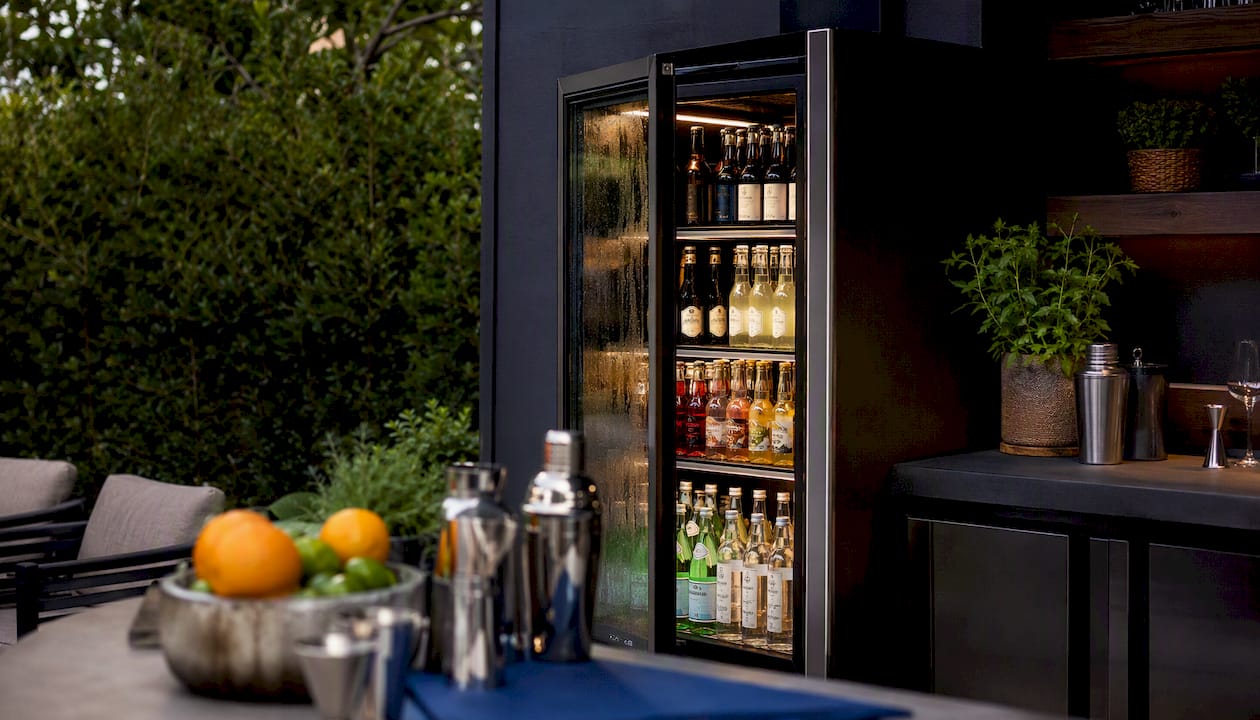
Glass-door merchandisers and open-air display cases are customer-facing. Glass-door units hold 33°F–41°F and are common in convenience stores, delis, and grab-and-go retail. Open-air cases — the kind you reach into at a grocery store — sacrifice energy efficiency for product accessibility. ENERGY STAR’s V5.0 discussion guide documents that open merchandisers consume more energy than closed-door units due to air infiltration, and ENERGY STAR has treated open cases differently in certification discussions. Night curtains and door retrofits can materially reduce heat load during closed hours, changing the payback math on replacement versus retrofit.
Undercounter units and prep tables
Undercounter refrigerators fit beneath a standard 36-inch counter and are common in bars, coffee stations, and small prep areas. Prep tables combine a refrigerated base with a cold rail on top, keeping ingredients at safe temperatures during active cooking. Both types are self-contained and plug into standard circuits. Temperature ranges match reach-ins (33°F–41°F for refrigerators). Footprint is compact by design, which makes them useful in tight kitchens where every square foot matters.
Back-bar and beverage coolers
Back-bar coolers hold beverages at serving temperature, typically 33°F–38°F, and are built for high door-opening frequency. They often have glass doors for product visibility and are designed to handle the ambient heat of a bar environment. Beverage merchandisers serve a similar function in retail settings.
Roll-in and roll-thru units
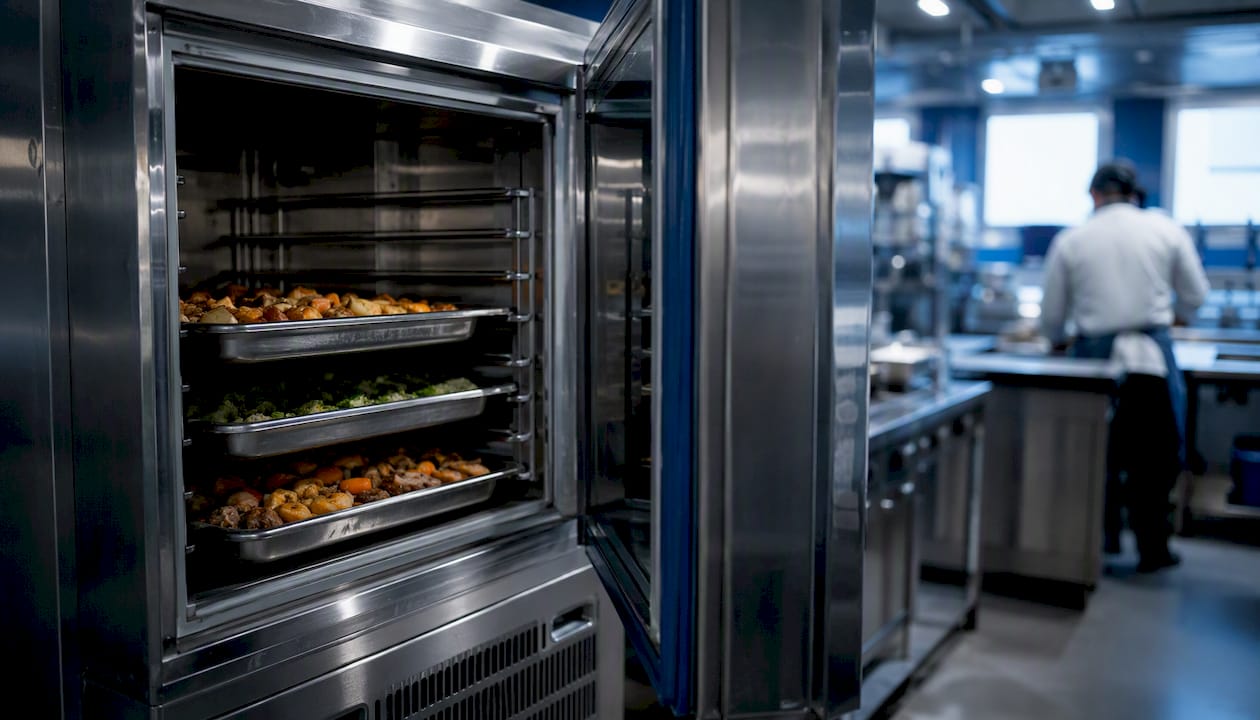
Roll-in units accept full sheet pan racks, which roll directly into the cabinet. Roll-thru units have doors on both sides, allowing racks to enter from one side and exit from the other — useful in high-volume banquet or catering kitchens where throughput speed matters. Both types are common in institutional foodservice and hotel operations.
Ice machines
Ice machines are a distinct equipment category: they produce ice rather than store food, and they have their own efficiency and sanitation standards. Capacity is rated in pounds of ice per 24 hours. Air-cooled, water-cooled, and remote-cooled configurations exist, each with different installation and operating-cost profiles. Air-cooled units are the most common but add heat to the kitchen; water-cooled units use more water but reject less heat into the space.
Blast chillers
Blast chillers rapidly cool cooked food from 140°F to 37°F, meeting HACCP food-safety requirements for cook-chill operations. They are not general-purpose refrigerators — they are process equipment used in high-volume cooking workflows. A blast chiller paired with a walk-in is standard in large catering kitchens and institutional foodservice.
| Unit Type | Best Use | Temp Range | Energy Efficiency | Installation | NSF/ANSI 7 |
|---|---|---|---|---|---|
| Walk-in cooler/freezer | Bulk storage, back-of-house | 35°F–41°F / 0°F and below | Moderate; depends on insulation and door design | Moderate to complex; panel assembly, condensing unit | Required for food storage |
| Reach-in (solid door) | Kitchen-line access, back-of-house | 33°F–41°F / 0°F and below | Higher efficiency than glass-door | Simple; self-contained, standard circuit | Required |
| Reach-in (glass door) | Grab-and-go, front-of-house | 33°F–41°F | Lower than solid-door; more infiltration | Simple; self-contained | Required |
| Open-air merchandiser | Grocery display, impulse purchase | 33°F–41°F | Lowest; significant air infiltration | Moderate; often remote condensing | Required |
| Glass-door merchandiser | Convenience, deli, beverage retail | 33°F–41°F | Better than open-air; ENERGY STAR eligible | Simple to moderate | Required |
| Undercounter / prep table | Bar, coffee station, cooking line | 33°F–41°F | Compact load; self-contained | Simple; plug-in | Required |
| Back-bar / beverage cooler | Bar service, beverage retail | 33°F–38°F | Moderate; high door-open frequency | Simple; self-contained | Required |
| Roll-in / roll-thru | Catering, banquet, institutional | 33°F–41°F | Moderate | Moderate; requires level floor, clearances | Required |
| Blast chiller | Cook-chill operations | 37°F pull-down from 140°F | Specialized; high short-cycle load | Moderate to complex | Varies by jurisdiction |
| Ice machine | Ice production | Varies by type | Varies; air vs. water vs. remote cooled | Simple to moderate | Separate NSF standards apply |
Energy note: Closed-door units consistently outperform open cases on operating cost. If your operation uses open-air merchandisers, night curtains during closed hours are one of the highest-ROI retrofits available before committing to full unit replacement.
How do you choose the right commercial refrigeration system?
Selection is a process, not a product search. Work through these steps before requesting quotes.
-
Assess your storage load and workflow. List every food category, volume, and access frequency. A kitchen that pulls ingredients every 15 minutes needs reach-ins on the line; bulk prep storage belongs in a walk-in. Confusing the two creates bottlenecks.
-
Define your temperature zones. Separate refrigeration (33°F–41°F) from freezer (0°F and below) requirements. Some operations need dual-temperature units or separate cabinets for each zone.
-
Map condenser placement options. For remote condensing or rack systems, identify available rooftop space, mechanical room dimensions, and structural load capacity before specifying equipment. Correct sizing and condenser siting are the two decisions that most often cause expensive change orders when skipped.
-
Estimate BTU and electrical requirements. Each unit’s BTU/hr rating determines the load on your electrical panel and HVAC system. Self-contained units add heat to the space; remote condensing units move that heat outside. Both affect your building’s cooling load.
-
Choose enclosure type. Solid door for back-of-house efficiency; glass door for visibility and sales; open case for maximum accessibility with the highest energy cost. ENERGY STAR guidance treats these differently for certification purposes — check eligibility before writing specs.
-
Confirm ENERGY STAR and NSF/ANSI 7 eligibility. Not every unit qualifies. Check the ENERGY STAR product criteria against your specific unit family and enclosure class. Verify NSF/ANSI 7 compliance for any unit storing or displaying food. FEMP guidance is useful for procurement teams writing RFPs or applying for rebates.
-
Verify refrigerant compliance. Confirm the refrigerant is approved under EPA SNAP for your specific end-use category. A refrigerant approved for stand-alone equipment may not be approved for supermarket rack systems. Any service work on systems with more than a minimal refrigerant charge requires an EPA 608-certified technician.
Questions to ask vendors and contractors:
- Will you conduct a site survey before quoting? (If not, walk away.)
- What refrigerant does this unit use, and what is its SNAP status for my end-use?
- What is the warranty on the compressor and cabinet separately?
- What is the lead time, including condenser siting and permitting if applicable?
- Do you offer a maintenance plan, and what does it cover?
- Is this unit ENERGY STAR-certified for my specific product class?
Red flags to avoid:
- A quote delivered without a site visit
- Ambiguous or unspecified refrigerant type
- No mention of EPA 608 certification for the installing technician
- Lead times that don’t account for condenser placement, permitting, or panel upgrades
- A “maintenance plan” that only covers emergency calls, not scheduled preventive service
Typical cost ranges vary widely by project scale. Small self-contained units (undercounter, single-door reach-in) run from roughly $1,500 to $5,000 for equipment, with installation adding $500–$2,000 depending on electrical work. Mid-size projects (walk-in installation, multiple reach-ins) typically range from $10,000 to $40,000 installed. Large remote condensing or rack system projects for grocery or retail operations can run $50,000 to $200,000 or more, with lead times of 8–20 weeks when custom panels, permitting, and condenser work are involved. These are ballpark figures; actual costs depend on local labor rates, electrical panel capacity, and site conditions.
What maintenance and lifecycle costs should you plan for?
Commercial refrigeration equipment is not set-and-forget. The operating cost over a unit’s life often exceeds the purchase price, and most of that cost is controllable through maintenance.
Typical lifespans by unit family:
- Reach-in refrigerators and freezers: 10–15 years with regular maintenance; door gaskets and evaporator fans are the most common early-failure points.
- Undercounter units: 7–12 years; compact compressors in warm environments wear faster.
- Walk-in coolers and freezers: 15–25 years for the insulated panels; condensing units typically need replacement at 10–15 years.
- Remote condensing units and rack systems: Compressor racks can last 15–20 years with proper maintenance; individual compressors within a rack may need replacement sooner.
Routine maintenance schedule:
- Clean condenser coils every 90 days (more frequently in dusty or greasy environments).
- Inspect and replace door gaskets annually or when visible wear appears.
- Check refrigerant charge and inspect for leaks at every service visit.
- Clean evaporator coils and drain pans every 6 months.
- Verify defrost cycle timing and duration quarterly.
- Inspect fan motors and blade condition every 6 months.
- Log temperature readings daily; unexplained drift is an early warning sign.
Operating-cost drivers beyond energy use include door-opening frequency (each opening dumps warm, humid air into the cabinet), ambient temperature around the unit (a reach-in in a 90°F kitchen works harder than one in a 70°F space), and refrigerant charge accuracy (an overcharged or undercharged system runs inefficiently and stresses the compressor). Control system upgrades — electronic expansion valves, demand-defrost controls, and building management system integration — can meaningfully reduce energy consumption by matching compressor and defrost cycles to actual load rather than fixed timers.
Pro Tip: A preventive maintenance contract that includes coil cleaning, gasket inspection, and refrigerant leak checks typically pays for itself in reduced energy costs and avoided emergency repairs. A dirty condenser coil alone can increase energy consumption by 10–30%, and a failed gasket on a walk-in door can cost more in wasted energy per month than the gasket costs to replace.
Smart monitoring systems that log temperature, door-open events, and compressor run time are increasingly affordable and can flag problems before they become food-safety incidents. For operations with multiple units, a building management system integration that centralizes alerts is worth the upfront cost. For HVAC and refrigeration maintenance best practices, a structured service schedule is the single most reliable way to extend equipment life.
How a qualified contractor supports your refrigeration project
Selecting equipment is only half the job. Installation quality, commissioning, and ongoing service determine whether that equipment performs as specified or becomes a recurring problem.
A professional site survey covers load calculation, condenser siting, electrical panel capacity, refrigerant piping routes, service access corridors, and compliance with local building codes. Skipping this step is the most common reason commercial refrigeration projects run over budget.
What to expect from a qualified contractor:
- Written load calculation and equipment recommendations before any equipment is ordered
- Condenser placement plan with structural and ventilation confirmation
- EPA 608-certified technicians for all refrigerant handling
- Commissioning documentation: temperature pull-down verification, refrigerant charge confirmation, and defrost cycle setup
- Clear warranty terms for both equipment and labor
- A structured maintenance plan with scheduled visits, not just emergency response
Brightonaircorp has been serving commercial clients in New Jersey since 1993, with over 150 years of combined technician expertise across HVAC and refrigeration systems. The team handles commercial refrigeration installations, planned maintenance agreements, and emergency service for retail, foodservice, and industrial facilities. EPA 608 certification and manufacturer training are part of the technician qualification standard.
The gap between a quoted installation and a commissioned system is where most problems hide. Pull-down time, refrigerant charge verification, and defrost cycle calibration are not optional finishing steps — they determine whether the unit holds temperature under real operating conditions. Always ask for commissioning documentation before signing off on an installation.
For operators managing multiple locations or planning a new build, Brightonaircorp’s commercial HVAC and refrigeration services include site surveys, system design input, and service plan structures that cover both HVAC and refrigeration under a single agreement. That matters when a refrigeration failure at 2 AM needs the same rapid response as an HVAC emergency. Emergency repair response is part of the service model, not an add-on.
When evaluating contractors, ask specifically about their experience with your system configuration type. A contractor experienced with self-contained reach-ins may not have the rack system or remote condensing expertise your project needs. Ask for references from similar installations, and confirm that the technicians who will do the work hold current EPA 608 certification.
What operators often get wrong about refrigeration selection
Most buyers focus on the unit and underestimate the system. A reach-in refrigerator is a straightforward purchase until it’s part of a remote condensing layout with a condenser on a rooftop that nobody planned for, piping runs that exceed the manufacturer’s recommended length, and a service technician who has to climb a ladder to check refrigerant charge. The unit was right. The system was wrong.
The second common mistake is treating ENERGY STAR certification as a binary. Operators assume that if a unit has an ENERGY STAR label, it qualifies for every rebate and procurement incentive. It often doesn’t. Eligibility depends on the specific product class and enclosure type, and some open-case configurations are excluded from certain specification versions entirely. Check the ENERGY STAR product criteria against your exact unit before writing it into an RFP or rebate application.
The third mistake is underweighting lifecycle cost. A unit that costs $2,000 less upfront but runs 15% less efficiently than an ENERGY STAR-qualified alternative will cost more over five years in most U.S. energy markets. The ROI calculation for enclosure upgrades — adding doors to open cases, installing night curtains — often beats full unit replacement on payback period. That’s a decision worth running the numbers on before committing to new equipment.
Brightonaircorp handles commercial refrigeration from site survey to service plan
Choosing the right refrigeration system is one decision. Getting it installed correctly, commissioned properly, and maintained on schedule is what determines whether it performs for 15 years or becomes a recurring expense. Brightonaircorp has been doing exactly that for commercial clients across New Jersey since 1993.
The service covers the full project lifecycle: site survey and load calculation, equipment specification support, installation with EPA 608-certified technicians, commissioning documentation, and structured maintenance plans that include coil cleaning, refrigerant checks, and gasket inspections on a scheduled basis. For operators managing multiple units or planning a new build, a single service agreement covering both HVAC and refrigeration simplifies vendor management and guarantees consistent response times, including 24/7 emergency coverage.
Request a commercial site survey or refrigeration quote at Brightonaircorp. A site visit is the starting point for any serious project, and it costs nothing to schedule one.
Sources
The sources below support the regulatory, efficiency, and sanitation claims throughout this article. Each is a primary or authoritative U.S. source.
- Retail Food Refrigeration | US EPA
- Energy Savings Potential and R&D Opportunities for Commercial Refrigeration (DOE/EERE)
- Types of Commercial Refrigerators: Buying Guide | Parts Town
- ENERGY STAR Commercial Refrigerators and Freezers V5.0 Discussion Guide
- Energy