
The Role of HVAC Engineers in New Builds Explained
The Role of HVAC Engineers in New Builds Explained
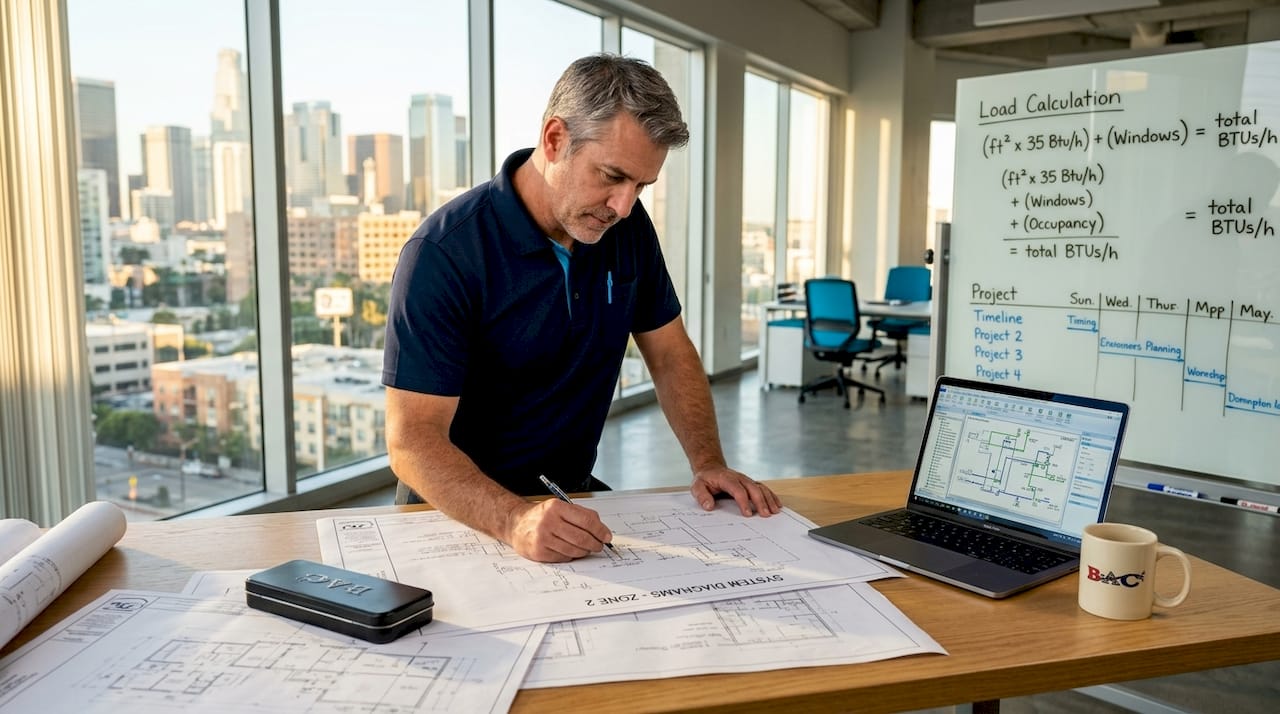
An HVAC engineer is responsible for designing, coordinating, and verifying the heating, ventilation, and air conditioning systems in new building projects to deliver comfort, energy efficiency, and code compliance. The role of an HVAC engineer in new builds is not a single-phase task. It spans the full project lifecycle, from the first load calculation on a blank set of blueprints to the final commissioning test before a building opens. For construction professionals and project managers, understanding exactly what an HVAC engineer does at each stage is the difference between a smooth handover and a costly rework.
HVAC engineers, formally classified as mechanical engineers specializing in building systems, carry responsibilities that touch every other discipline on a project. They work alongside architects, structural engineers, electrical engineers, and plumbing contractors. Their decisions affect ceiling heights, structural penetrations, electrical panel sizing, and the long-term operating costs of the building. Getting them involved early and keeping them engaged throughout construction is one of the highest-leverage decisions a project manager can make.
What are the core design responsibilities of HVAC engineers in new builds?
The design phase is where an HVAC engineer’s technical depth matters most. Load calculations and equipment sizing form the foundation of every decision that follows. Engineers use tools like Manual J for residential projects, and software platforms like TRACE 700 or Carrier HAP for commercial buildings, to calculate heat gains and losses based on building orientation, envelope construction, occupancy, and internal loads. These numbers determine every piece of equipment that gets specified.
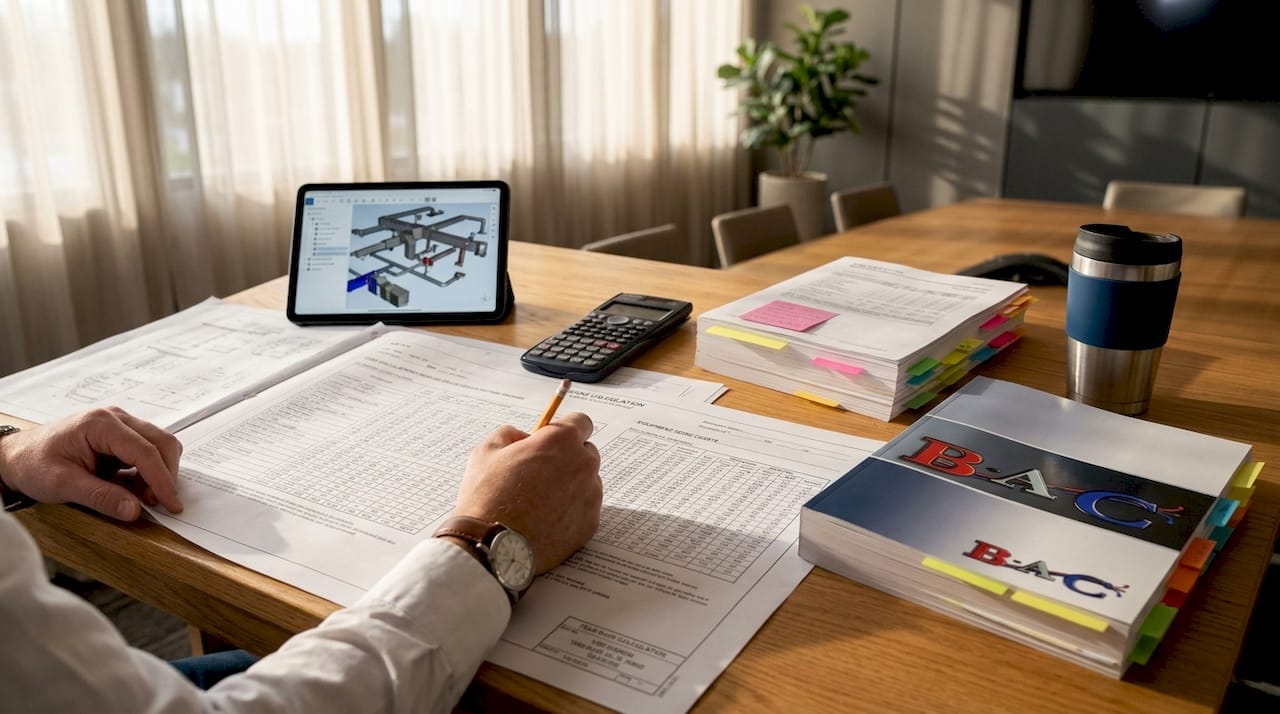
From those calculations, the engineer selects chillers, boilers, air handlers, VAV (variable air volume) boxes, fan coil units, and the ductwork and hydronic piping that connects them. Each selection involves balancing first cost against operating efficiency, spatial constraints, and manufacturer lead times. A chiller that fits the mechanical room on paper may not fit through the building’s access points. That kind of detail lives in the engineer’s scope.
The design phase also produces the construction documents that every trade will work from. Constructible plans, P&IDs, equipment schedules, and specifications must be clear enough that a contractor can price and build from them without constant clarification. Engineers increasingly produce these documents using BIM platforms like Autodesk Revit, which allows 3D coordination with architectural and structural models before a single piece of steel is erected.
Key deliverables from the HVAC design phase include:
- Heating and cooling load calculation reports
- Equipment schedules with performance specifications
- Ductwork and piping layout drawings
- Mechanical room plans and equipment clearance details
- Control sequences and points lists for building automation systems
- Energy compliance documentation per ASHRAE 90.1
Pro Tip: Request that your HVAC engineer deliver a BIM-coordinated model before construction documents are issued for bid. Clash detection at this stage costs a fraction of what field conflicts cost during installation.
How do HVAC engineers collaborate with other project stakeholders?
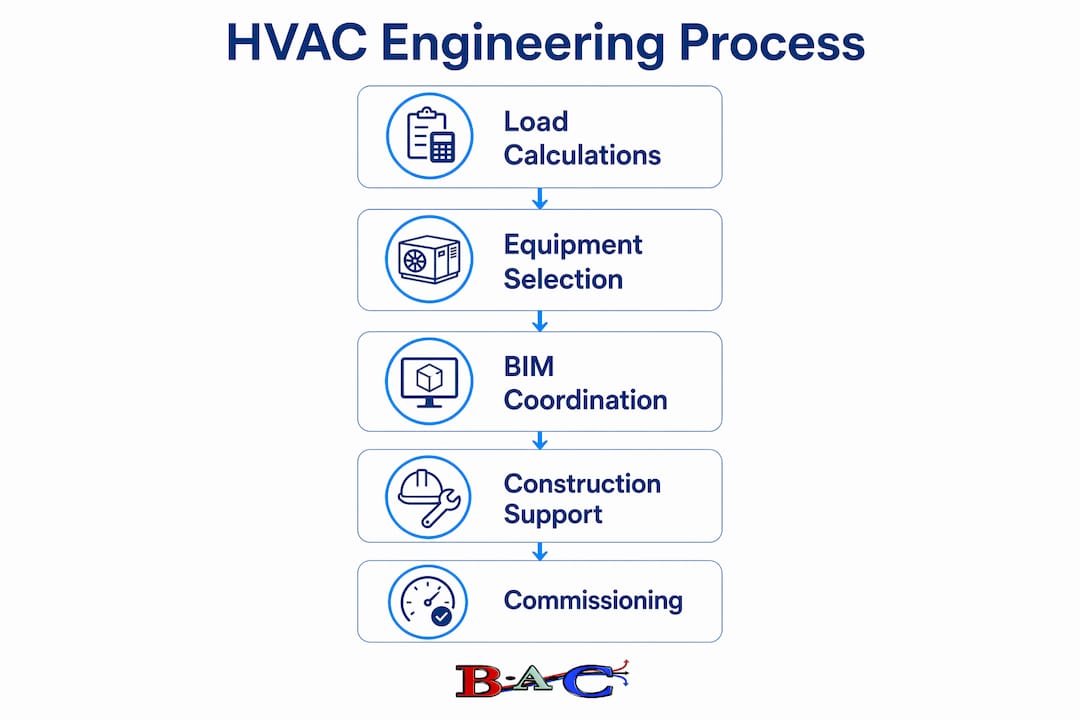
HVAC systems do not exist in isolation. Ductwork competes for the same ceiling plenum space as structural beams, electrical conduit, fire suppression piping, and data cable trays. Early coordination with architectural and structural plans is the single most effective way to prevent the expensive conflicts that slow construction schedules and inflate change order logs.
The coordination process typically follows this sequence:
- Kickoff alignment. The HVAC engineer reviews architectural and structural drawings to identify mechanical room locations, shaft placements, and ceiling height constraints before any system layout begins.
- BIM coordination sessions. The engineer participates in multi-discipline coordination meetings where models from all trades are overlaid to identify spatial conflicts. Issues found here are resolved with a markup, not a change order.
- RFI management. When field conditions differ from design drawings, the HVAC engineer issues formal responses to Requests for Information (RFIs) from the contractor. Clear, timely RFI responses keep installation moving.
- Submittal reviews. Contractors submit product data and shop drawings for engineer approval before ordering equipment. The engineer verifies that proposed substitutions meet specification requirements.
- Construction sequencing input. Large mechanical equipment, particularly rooftop units and chillers, must often be set before the building envelope closes. The HVAC engineer coordinates this sequence with the general contractor.
Pro Tip: Assign a single point of contact on the construction management team to route all HVAC RFIs and submittals. Fragmented communication is the leading cause of delayed engineer responses and downstream installation errors.
Design drawings and shop drawings serve fundamentally different functions. Design drawings communicate the engineer’s intent. Shop drawings, produced by the contractor or fabricator, convert that intent into detailed, buildable instructions with exact dimensions and connection details. The HVAC engineer reviews shop drawings to confirm the contractor’s interpretation matches the design. This review step is where many specification deviations are caught before they become installed problems.
What role do HVAC engineers play during construction and commissioning?
Construction-phase involvement is where many projects underutilize their HVAC engineer, and where that underutilization shows up most visibly at startup. Reviewing contractor submittals, responding to RFIs, conducting site visits, and participating in commissioning are all standard responsibilities that keep the design intent intact through the build.
Site visits serve a specific purpose. The engineer walks the installation to verify that ductwork routing, equipment placement, and control wiring match the construction documents. Deviations caught during installation are corrected with sheet metal and labor. Deviations caught after ceiling closure require demolition.
The commissioning phase is the formal verification that the installed system performs as designed. ASHRAE Guideline 0-2019 and Guideline 1.1 define the standard commissioning process, which includes four distinct phases: design review, construction verification, functional performance testing, and documentation. The HVAC engineer’s role in this process is to provide the commissioning authority with the design basis, control sequences, and performance benchmarks against which the system will be tested.
“Commissioning starts in design through Owner’s Project Requirements and Basis of Design alignment, linking design engineers and commissioning authorities despite independence requirements.” — HVAC Compliance Authority
One nuance worth knowing: on projects over 50,000 square feet, the commissioning authority must be independent of both the contractor and the design engineer. This does not reduce the engineer’s commissioning role. It means the engineer provides documentation and technical support to an independent party who conducts the testing. Construction teams that reconcile their control documentation, specifically the Sequence of Operation, with as-built controls early in the process reduce commissioning delays significantly because testing follows known parameters rather than field-discovered ones.
Key construction and commissioning responsibilities include:
- Reviewing and approving contractor submittals and shop drawings
- Conducting periodic site visits to verify installation quality
- Responding to field RFIs with documented, timely answers
- Providing the Basis of Design and control sequences to the commissioning authority
- Witnessing functional performance tests for critical systems
- Reviewing and accepting the final commissioning report
Why is HVAC engineer involvement critical to energy efficiency and code compliance?
Energy performance in new buildings is no longer a design preference. It is a regulatory requirement enforced through codes like ASHRAE 90.1, which sets minimum efficiency standards for mechanical systems in commercial buildings. The HVAC engineer is the primary professional responsible for demonstrating compliance with these standards through both equipment selection and energy modeling.
Energy modeling accuracy depends on precise equipment performance data and control sequences, not generic assumptions. An energy model built on manufacturer-published efficiency curves and actual control logic produces results that reflect real building performance. A model built on default software assumptions can show compliance on paper while the actual building misses its energy targets by a significant margin. The difference matters to owners facing utility costs, sustainability certifications like LEED or ENERGY STAR, and increasingly, local building performance standards.
| Design strategy | Energy impact |
|---|---|
| Demand-controlled ventilation (DCV) | Reduces outdoor air intake based on occupancy, cutting conditioning loads in variable-occupancy spaces |
| Economizer cycles | Uses outdoor air for free cooling when conditions allow, reducing mechanical cooling hours |
| Variable frequency drives (VFDs) on fans and pumps | Matches motor speed to actual load, reducing energy consumption at partial load conditions |
| High-efficiency equipment selection | Improves system COP and EER ratings, directly reducing annual energy use |
Pro Tip: Ask your HVAC engineer to run a life-cycle cost analysis alongside the energy model. First-cost savings on lower-efficiency equipment are frequently offset within three to five years by higher operating costs, particularly in New Jersey’s climate zone.
The HVAC engineering involvement that extends from load calculations through BIM execution to construction support reflects a continuous value chain. Each phase builds on the accuracy of the last. An imprecise load calculation produces an oversized chiller. An oversized chiller short-cycles, wears out faster, and fails to dehumidify properly. The cost of that error compounds across the building’s entire operating life.
Key takeaways
The HVAC engineer’s role in new builds is a continuous technical and coordination function that begins at design and ends only after commissioning confirms the system performs as specified.
| Point | Details |
|---|---|
| Design starts with load calculations | Manual J, TRACE 700, and HAP produce the sizing data that drives every equipment and ductwork decision. |
| BIM coordination prevents field conflicts | Clash detection in the model costs a fraction of what rework costs after installation begins. |
| Shop drawing review protects design intent | Engineers verify contractor submittals to catch specification deviations before equipment is ordered or installed. |
| Commissioning requires design documentation | The HVAC engineer provides the Basis of Design and control sequences that the commissioning authority tests against. |
| Energy modeling must use real data | Generic assumptions in energy models can produce code compliance on paper while the building misses actual performance targets. |
What I’ve learned about HVAC engineer involvement that most project managers miss
I’ve worked alongside construction teams where the HVAC engineer was treated as a document producer: hired to issue drawings, then largely sidelined until a problem surfaced. That model consistently produces the same outcome. Commissioning takes longer than planned, punch lists grow, and the owner inherits a system that works but never quite performs the way the energy model promised.
The projects that run differently share one characteristic. The HVAC engineer is treated as a standing member of the project team, not a consultant who shows up when called. That means weekly coordination meetings during design, active participation in BIM clash sessions, and scheduled site visits during installation, not just reactive visits after something goes wrong.
The energy efficiency piece is where I see the most avoidable losses. Accurate energy modeling requires the engineer to input real equipment data and actual control sequences, not software defaults. When that step is rushed to meet a permit deadline, the model becomes a compliance document rather than a performance tool. Owners then wonder why their utility bills don’t match the projections. The answer is almost always in the modeling assumptions.
For project managers in New Jersey specifically, the combination of ASHRAE 90.1 requirements and local energy codes makes precise HVAC engineering non-negotiable. The HVAC inspection process for new construction rewards projects where the engineer has stayed engaged. Inspectors notice the difference between a system that was designed and installed with continuous oversight and one that was not.
— John
How Brighton Air Corp supports new construction HVAC projects
Brighton Air Corp brings engineering-level expertise to new construction HVAC projects across New Jersey, from initial system design through final commissioning.

Whether you are managing a commercial office build, a retail development, or a residential new construction project, the Brighton Air Corp team provides design consultation, equipment selection, construction support, and startup verification backed by over 30 years of field experience. The team works directly with project managers and general contractors to coordinate submittals, respond to RFIs, and verify that installed systems match design intent before the building opens. Explore new construction HVAC options or contact Brighton Air Corp for a free project consultation.
FAQ
What does an HVAC engineer do in a new build?
An HVAC engineer designs the heating, ventilation, and air conditioning systems for a new building, performs load calculations, selects equipment, produces construction documents, and supports the project through installation and commissioning. Their involvement spans the full project lifecycle, not just the design phase.
When should an HVAC engineer be brought onto a new construction project?
An HVAC engineer should be engaged during the schematic design phase, before architectural plans are finalized. Early coordination with architectural and structural plans prevents spatial conflicts that are far more expensive to resolve during construction.
What is the difference between design drawings and shop drawings in HVAC?
Design drawings communicate the engineer’s system intent and performance requirements. Shop drawings convert that intent into detailed, contractor-produced installation instructions. The HVAC engineer reviews shop drawings to confirm the contractor’s interpretation is accurate before fabrication or procurement begins.
What is HVAC commissioning and why does it matter?
HVAC commissioning is a structured process that verifies an installed system meets design intent and owner requirements. Per ASHRAE Guideline 0-2019, it includes design review, construction verification, functional testing, and documentation. Skipping or shortcutting commissioning is the most common reason new buildings underperform their energy projections.
How does an HVAC engineer contribute to energy code compliance?
The HVAC engineer selects equipment that meets ASHRAE 90.1 minimum efficiency standards and builds energy models using actual equipment data and control sequences. Precise energy modeling produces compliance documentation that reflects real building performance rather than optimistic software defaults.
Recommended
- Cranford Westfield Summit Scotch Plns Fanwood Kenilworth Clark Rahway Livingston AC Repair Install Service HVAC Contractor Emergency Heat Pump Repair HVAC System Installation
- Cranford Westfield Summit Scotch Plns Fanwood Kenilworth Clark Rahway Livingston AC Repair Install Service HVAC Contractor Emergency Heat Pump Repair HVAC System Installation
- Cranford Westfield Summit Scotch Plns Fanwood Kenilworth Clark Rahway Livingston AC Repair Install Service HVAC Contractor Emergency Heat Pump Repair HVAC System Installation
- Cranford Westfield Summit Scotch Plns Fanwood Kenilworth Clark Rahway Livingston AC Repair Install Service HVAC Contractor Emergency Heat Pump Repair HVAC System Installation