
The Role of Cleanroom HVAC Systems for Engineers
The Role of Cleanroom HVAC Systems for Engineers
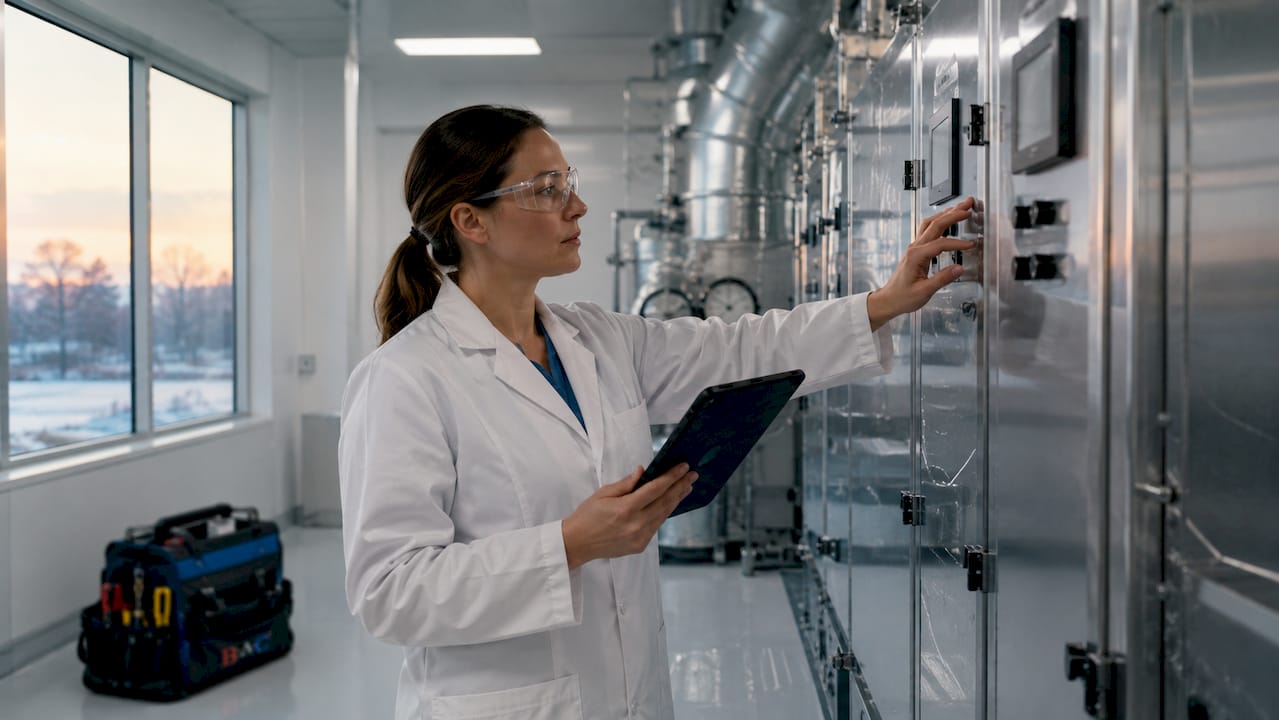
A cleanroom HVAC system is defined as the integrated mechanical infrastructure that controls airborne contamination, pressure differentials, temperature, and humidity within a classified environment to protect sensitive processes and products. The role of cleanroom HVAC system design extends far beyond basic ventilation. It is the primary compliance mechanism for ISO 14644 and GMP-regulated facilities, where a single pressure failure or filter bypass can compromise an entire production batch. HVAC performance is a fundamental pillar of cleanroom environmental control, directly linked to stable temperature, humidity, pressure, and particulate levels. Facility managers and engineers who treat cleanroom HVAC as a standard commercial system consistently face recertification failures and operational losses.
What is the role of cleanroom HVAC systems in contamination control?
Cleanroom HVAC systems control airborne contamination by filtering particles through HEPA and ULPA units, directing airflow away from critical zones, and stabilizing temperature and humidity for process integrity. This is not a passive function. Every component from the air handling unit (AHU) to the terminal filter is an active contamination barrier.
The filtration hierarchy matters enormously in practice:
- HEPA filters capture 99.97% of particles at 0.3 microns, used in ISO 6 through ISO 8 environments
- ULPA filters capture 99.9995% of particles at 0.12 microns, reserved for ISO 5 and stricter Grade A zones
- Pre-filters and intermediate filters protect HEPA/ULPA units from premature loading, extending service life and reducing replacement costs
Airflow design is the second contamination control lever. Unidirectional (laminar) flow pushes air in a single direction across a critical zone, sweeping particles away from the work surface. Turbulent flow, used in less critical areas, relies on dilution to reduce particle concentrations. Airflow velocity of 0.36 to 0.54 m/s is the primary design parameter for ISO 5 and Grade A unidirectional zones, not air changes per hour (ACH). This distinction matters because engineers who design to ACH targets alone in critical zones routinely miss velocity requirements during commissioning.
Cleanrooms require air change rates between 10 and 20 ACH for standard classifications, with the highest classifications demanding up to 600 ACH. That compares to general commercial ventilation at 0.5 to 2 ACH, which illustrates the scale of mechanical demand cleanroom HVAC places on a facility.
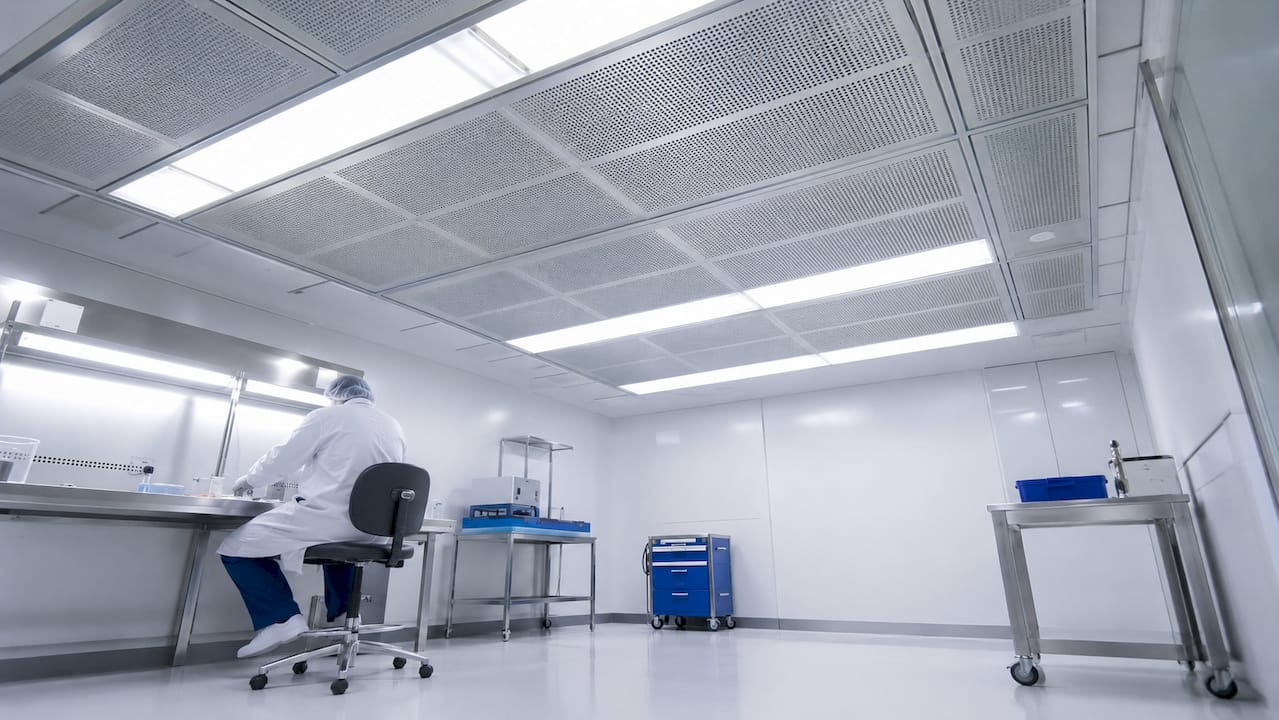
| Zone Classification | Airflow Type | Design Parameter |
|---|---|---|
| ISO 5 / Grade A | Unidirectional | Velocity: 0.36–0.54 m/s |
| ISO 6–7 / Grade B–C | Mixed/Turbulent | ACH: 20–60+ |
| ISO 8 / Grade D | Turbulent | ACH: 10–20 |
Pro Tip: Treat ACH as a verification metric in turbulent zones, but always specify and commission ISO 5 zones to velocity targets. Designing to ACH in a Grade A zone is one of the most common commissioning errors in pharmaceutical HVAC projects.
How does pressure cascade prevent cross-contamination between zones?
Pressure cascade is the controlled arrangement of differential air pressures across cleanroom zones, designed to direct airflow from the cleanest area toward less clean areas at all times. Pressure cascade design maintains the highest pressure in the cleanest zones, with typical differentials of +10 to +15 Pa between adjacent cleanroom grades. A breach in this gradient means contaminated air can migrate into a critical zone, and that risk is not theoretical. It is the mechanism behind most cross-contamination events in multi-product pharmaceutical facilities.
Implementing a reliable pressure cascade requires four coordinated steps:
- Map the zone hierarchy. Identify each ISO or GMP grade zone and assign target pressure setpoints before any ductwork is designed.
- Balance supply and exhaust airflows. Pressure cascade maintenance requires dynamic balancing of supply versus exhaust air, with allowance for leakage paths through doors, seals, and pass-throughs.
- Install interlocks on airlocks. Airlocks between zones must be interlocked so both doors cannot open simultaneously, preventing direct pressure equalization between grades.
- Automate with BMS or EMS. BMS and EMS systems modulate dampers and fan speeds dynamically to maintain pressure differentials despite disturbances like door openings or personnel movement.
The automation point deserves emphasis. A manually balanced system will hold its setpoints under static conditions but will drift during operational disturbances. A properly configured Building Management System (BMS) responds to pressure deviations in real time, logging every excursion for audit documentation.
Pro Tip: Specify pressure differential alarms at 80% of the minimum acceptable setpoint, not at the setpoint itself. This gives your operations team time to investigate before a deviation becomes a GMP event.
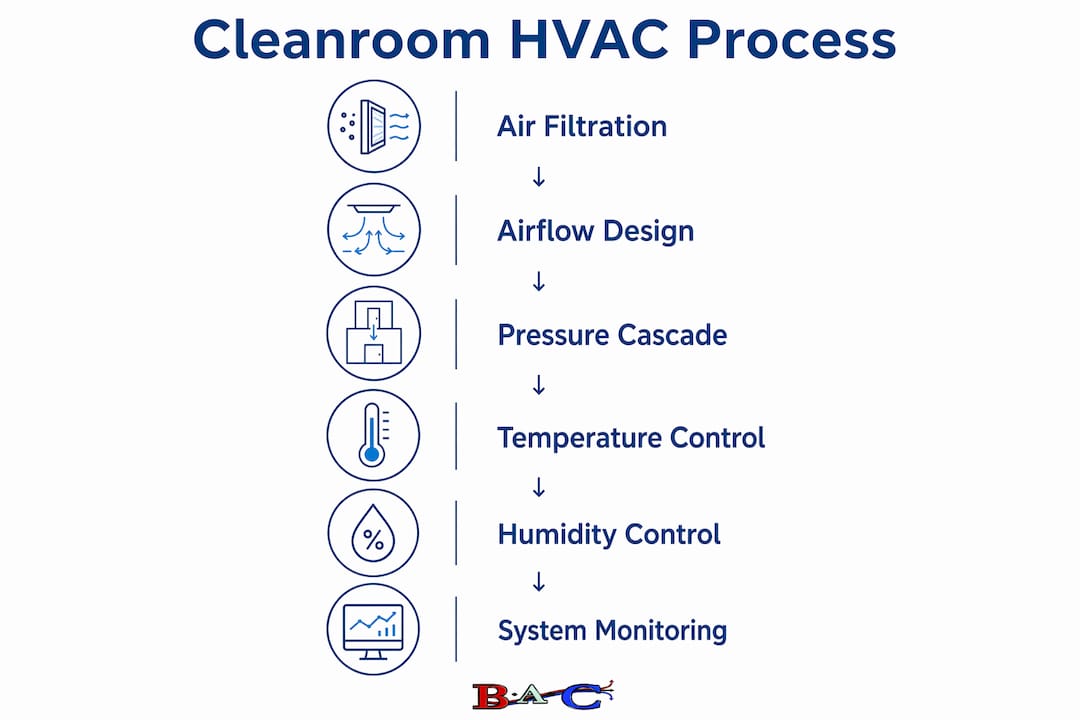
How do cleanroom HVAC systems maintain temperature and humidity stability?
Temperature and relative humidity (RH) control in pharmaceutical cleanrooms typically targets 18 to 22°C with RH between 30% and 65%, though specific processes may require tighter tolerances. These ranges are not arbitrary. Humidity above 65% promotes microbial growth on surfaces and in filters. Temperature swings affect the viscosity of liquid formulations and the dimensional stability of precision components.
The HVAC components responsible for this stability include:
- Air handling units (AHUs) with integrated cooling coils and heating elements that condition supply air before it enters the cleanroom
- Steam or ultrasonic humidifiers that add moisture to supply air during low-humidity periods, particularly in winter in New Jersey and similar climates
- Chilled water dehumidification coils that remove excess moisture during summer months without introducing temperature spikes
- Reheat coils downstream of dehumidification stages that restore supply air to the target temperature after moisture removal
The interaction between these components requires precise sequencing. Dehumidification followed by reheat is the standard sequence for maintaining both temperature and RH simultaneously, but it carries an energy penalty. Facilities that skip reheat to save energy often find their RH targets drifting upward during humid months, which creates compliance risk. The air handler unit is the central component that ties all of these conditioning stages together into a single controlled airstream.
What are the energy considerations and operational challenges of cleanroom HVAC?
Cleanroom HVAC accounts for more than 50% of energy consumption in bioprocess facilities, running up to 15 times higher per square meter than standard commercial buildings. That figure reframes the conversation about cleanroom operational costs. Energy is not a secondary concern. It is the dominant facility expense, and HVAC is where the majority of it goes.
Proven strategies for reducing that load without compromising classification include:
- Variable frequency drives (VFDs) on fans and pumps that reduce motor speed during lower-occupancy periods, cutting energy consumption proportionally to the cube of speed reduction
- Heat recovery systems that capture thermal energy from exhaust air and transfer it to incoming supply air, reducing the conditioning load on AHUs
- Zoning strategies that allow non-critical support areas to operate at reduced ACH during off-shift hours while maintaining full performance in critical zones
- Demand-controlled filtration monitoring that tracks filter pressure drop and schedules replacements based on actual loading rather than fixed calendar intervals
Operational factors compound the energy challenge. Every door opening between zones creates a pressure disturbance that the HVAC system must correct. Personnel movement generates heat and particles that increase the contamination load. Gowning rooms and airlocks act as buffer zones, but they add HVAC complexity and must be included in the pressure cascade design from the start.
Maintenance is the factor most often underestimated by facility managers. HVAC maintenance best practices for cleanroom systems include scheduled filter inspections, fan belt checks, coil cleaning, and BMS calibration. A single failed damper actuator can destabilize an entire pressure cascade without triggering an obvious alarm, making routine physical inspection non-negotiable alongside automated monitoring.
How are cleanroom HVAC systems validated and monitored for compliance?
Cleanroom HVAC validation follows ISO 14644-3 protocols, which require particle counting in both “at rest” and “in operation” states, HEPA filter integrity testing, pressure differential measurement, ACH calculation, and recovery time testing. HEPA filter integrity testing carries a maximum allowable leakage of 0.01%, with comprehensive scanning and traceable documentation required to prevent audit failures. That 0.01% threshold is strict by any standard, and it means a filter that passes visual inspection can still fail a DOP or PAO aerosol scan.
The validation sequence for a new or modified cleanroom HVAC system follows this structure:
- Installation Qualification (IQ): Confirm that all HVAC components are installed per design specifications, including duct materials, filter housings, and instrumentation.
- Operational Qualification (OQ): Demonstrate that the system operates within specified ranges for airflow, pressure, temperature, and RH under controlled conditions.
- Performance Qualification (PQ): Verify performance under actual operational conditions, including personnel occupancy and process activities.
- Ongoing monitoring: Deploy a continuous Environmental Monitoring System (EMS) that logs particle counts, pressure differentials, temperature, and RH with timestamped records.
ISO 14644 requires documented monitoring plans with recertification intervals of 6 to 12 months depending on cleanroom classification. This means validation is not a one-time event. It is a recurring operational commitment that requires dedicated resources, calibrated instruments, and a document control system that can produce complete records on demand during an FDA or EMA inspection.
Pro Tip: Build your EMS alarm thresholds into your change control procedure. Any modification to HVAC setpoints, filter specifications, or ductwork must trigger a documented impact assessment before implementation, not after.
Key takeaways
A cleanroom HVAC system is the single most critical infrastructure element for maintaining ISO and GMP compliance, controlling contamination through filtration, pressure, airflow, and environmental stability simultaneously.
| Point | Details |
|---|---|
| Filtration drives contamination control | HEPA and ULPA filters with max 0.01% leakage are the primary particle barrier in classified zones. |
| Velocity, not ACH, governs critical zones | ISO 5 and Grade A zones require 0.36 to 0.54 m/s airflow velocity as the design acceptance parameter. |
| Pressure cascade requires automation | BMS and EMS systems must dynamically balance supply and exhaust to hold +10 to +15 Pa differentials. |
| Energy cost is the dominant operational expense | Cleanroom HVAC consumes over 50% of facility energy, making VFDs and heat recovery non-optional for cost control. |
| Validation is a recurring commitment | ISO 14644 mandates recertification every 6 to 12 months with full documentation for audit readiness. |
What I’ve learned from watching cleanroom HVAC projects go wrong
The most consistent mistake I see in cleanroom HVAC projects is treating the HVAC system as a procurement item rather than an integrated engineering system. Teams specify filters and AHUs from a catalog, hand the design to a mechanical contractor, and then wonder why the facility fails its first ISO classification test. The problem is almost always in the interfaces: the connection between the pressure cascade design and the BMS programming, or the gap between the filter housing specification and the duct leakage rate.
The second pattern is underestimating the operational burden. A cleanroom HVAC system that passes validation on day one will drift over time if the maintenance program is not built to match the system’s complexity. I have seen facilities lose their GMP certification not because of a major failure but because of accumulated small deviations: a damper that was 15% out of calibration, a filter that was overdue for integrity testing, a BMS alarm that had been silenced and forgotten.
The technology is genuinely improving. Remote monitoring platforms now allow facility managers to review real-time pressure, temperature, and particle data from any location, and predictive maintenance algorithms can flag filter loading trends before they become compliance events. But technology does not replace a well-designed system. It amplifies whatever is already there, good or bad.
My advice to facility managers balancing compliance and cost: invest in the design phase. Every dollar spent on proper HVAC engineering before construction saves three to five dollars in commissioning corrections and recertification costs after. The role of HVAC engineers in new construction is to catch these integration gaps before they become physical problems. Use them early and use them often.
— John
How Brightonaircorp supports cleanroom HVAC design and compliance
Cleanroom HVAC systems demand a level of precision that standard commercial HVAC contractors are not equipped to deliver. Brightonaircorp brings over 30 years of HVAC expertise to complex controlled environment projects across New Jersey, covering system design, installation, commissioning, and ongoing maintenance for facilities that cannot afford classification failures.

Whether you are planning a new cleanroom build, upgrading an existing HVAC system to meet current ISO 14644 or GMP requirements, or need a structured maintenance program to support your next recertification audit, Brightonaircorp has the technical depth to deliver. Contact Brighton Air Corp today for a professional consultation and find out how the right HVAC partner protects your facility’s compliance and your bottom line.
FAQ
What does a cleanroom HVAC system actually do?
A cleanroom HVAC system controls airborne contamination, pressure differentials, temperature, and humidity to maintain a classified environment that meets ISO 14644 or GMP standards. It is the primary compliance mechanism in pharmaceutical, semiconductor, and biotech facilities.
What is the difference between HEPA and ULPA filters in cleanrooms?
HEPA filters capture 99.97% of particles at 0.3 microns and are used in ISO 6 through ISO 8 zones, while ULPA filters capture 99.9995% of particles at 0.12 microns and are required for ISO 5 and Grade A critical zones.
How often does a cleanroom HVAC system need to be recertified?
ISO 14644 requires recertification every 6 to 12 months depending on cleanroom classification, with full particle counting, HEPA integrity testing, and pressure differential documentation required for each cycle.
Why is pressure cascade important in a multi-zone cleanroom?
Pressure cascade maintains a positive pressure differential of +10 to +15 Pa between adjacent zones, directing airflow from the cleanest area to less clean areas and preventing contaminated air from migrating into critical production zones.
How much energy does a cleanroom HVAC system consume?
Cleanroom HVAC systems account for more than 50% of total energy consumption in bioprocess facilities, running up to 15 times higher per square meter than commercial buildings, which makes variable frequency drives and heat recovery systems a financial necessity.
Recommended
- Cranford Westfield Summit Scotch Plns Fanwood Kenilworth Clark Rahway Livingston AC Repair Install Service HVAC Contractor Emergency Heat Pump Repair HVAC System Installation
- Cranford Westfield Summit Scotch Plns Fanwood Kenilworth Clark Rahway Livingston AC Repair Install Service HVAC Contractor Emergency Heat Pump Repair HVAC System Installation
- Cranford Westfield Summit Scotch Plns Fanwood Kenilworth Clark Rahway Livingston AC Repair Install Service HVAC Contractor Emergency Heat Pump Repair HVAC System Installation
- Cranford Westfield Summit Scotch Plns Fanwood Kenilworth Clark Rahway Livingston AC Repair Install Service HVAC Contractor Emergency Heat Pump Repair HVAC System Installation