
Rooftop Unit Replacement Cost: A Property Manager's Guide
Rooftop Unit Replacement Cost: A Property Manager’s Guide
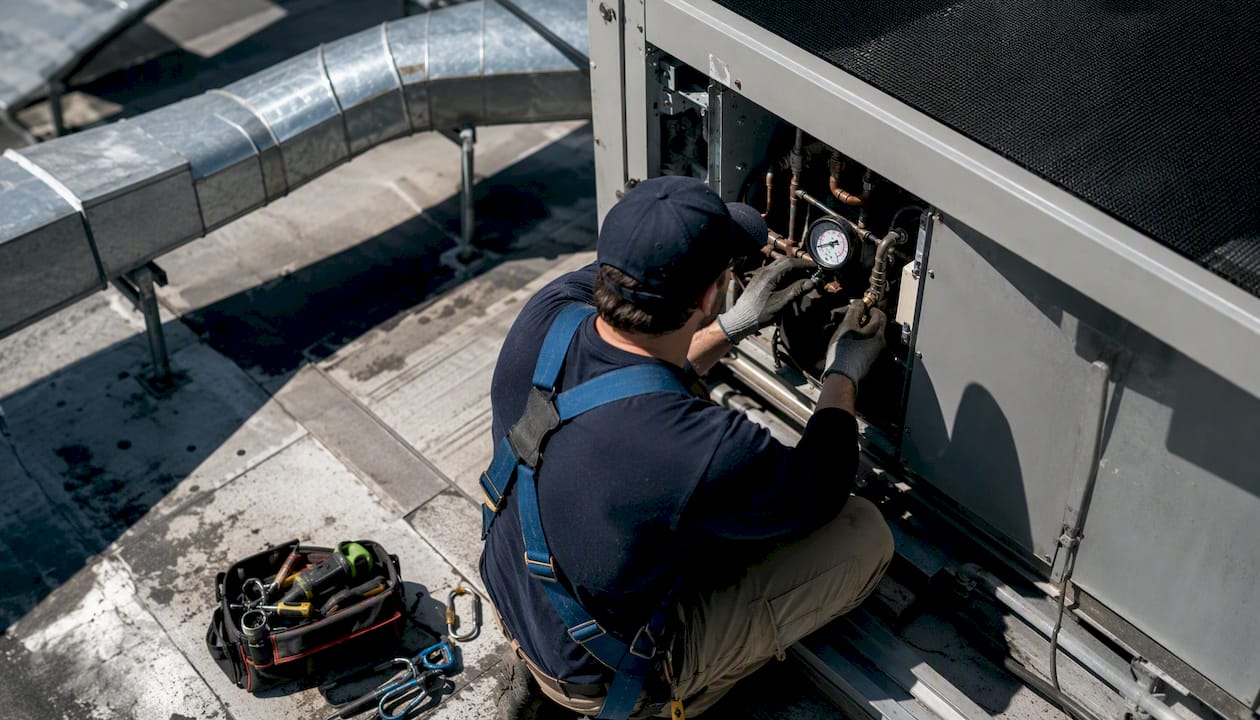
Replacing a commercial rooftop unit (RTU) typically runs $15,000–$75,000 installed for most light-commercial buildings, with per-ton installed costs ranging from roughly $1,800–$3,500 per ton depending on unit size, efficiency tier, and site complexity. Small 2–5 ton units land closer to $15,000–$25,000 all-in; mid-size 10–15 ton units typically run $30,000–$55,000; large 25–30 ton replacements can push $70,000–$120,000 or more once crane, structural work, and commissioning are factored in.
Three costs routinely blindside property managers budgeting from equipment-only quotes:
- Crane and rigging costs vary widely depending on roof height, access, and mobilization distance
- Curb adapters and structural work can add thousands of dollars when the new unit footprint doesn’t match the existing curb
- Electrical upgrades and permit fees also contribute significantly, depending on panel upgrades, disconnects, and local regulations
The only way to get a number you can actually budget against is a proper site survey. An estimator who hasn’t walked your roof, measured your curb, and reviewed your electrical panel is guessing. Schedule that survey before you compare bids.
Key Takeaways
Rooftop unit replacement costs vary widely from several thousand dollars for small light-commercial RTUs to significantly higher amounts for large industrial units, with crane, curb, electrical, and commissioning expenses frequently adding substantially to equipment-only estimates.
| Point | Details |
|---|---|
| Installed cost ranges | Small RTUs (2–5 ton): $15,000–$25,000; mid-size (10–15 ton): $30,000–$55,000; large (25–30+ ton): $70,000–$120,000+ |
| Per-ton pricing benchmark | Smaller units run $2,800–$3,500/ton installed; larger units drop to $1,800–$2,500/ton as fixed costs spread |
| Hidden costs to budget | Crane ($2,000–$10,000), curb adapters ($1,500–$6,000), electrical ($500–$5,000), and BMS integration are frequently omitted from initial quotes |
| 15-year TCO planning | ASHRAE’s median RTU service life of ~15 years means a higher-efficiency unit often saves $30,000+ over a baseline unit at typical energy rates |
| Brightonaircorp | Brighton Air Corp provides full-scope commercial RTU replacement in New Jersey, including site survey, crane coordination, permitting, and commissioning |
Table of Contents
- What does rooftop unit replacement cost by size?
- Key cost drivers that move a rooftop replacement quote
- What should a complete RTU replacement quote include?
- Does a higher-efficiency RTU actually pay off over 15 years?
- How do you get quotes you can actually compare?
- What’s a realistic timeline for a rooftop replacement?
- Three sample installed-cost estimates
- Financing, incentives, and budgeting tips
- Why the contractor you choose matters as much as the equipment
- Brighton Air Corp handles the full RTU replacement scope in New Jersey
- Sources
What does rooftop unit replacement cost by size?
Per-ton installed pricing is the fastest way to normalize quotes across vendors. Smaller units cost more per ton because mobilization, crane, and labor costs don’t scale down proportionally. Industry cost data shows this clearly across size tiers.
| Unit Size (Tons) | Typical Application | Installed Cost Range | Per-Ton Installed |
|---|---|---|---|
| 2–5 tons | Small retail, office suite | $15,000–$25,000 | $2,800–$3,500/ton |
| 8–10 tons | Mid-size office, restaurant | $25,000–$35,000 | $2,200–$3,000/ton |
| 15–20 tons | Large retail, school wing | $30,000–$55,000 | $1,800–$2,600 per ton |
| 25–30+ tons | Warehouse, industrial, anchor tenant | $70,000–$120,000+ | $1,800–$2,500/ton |
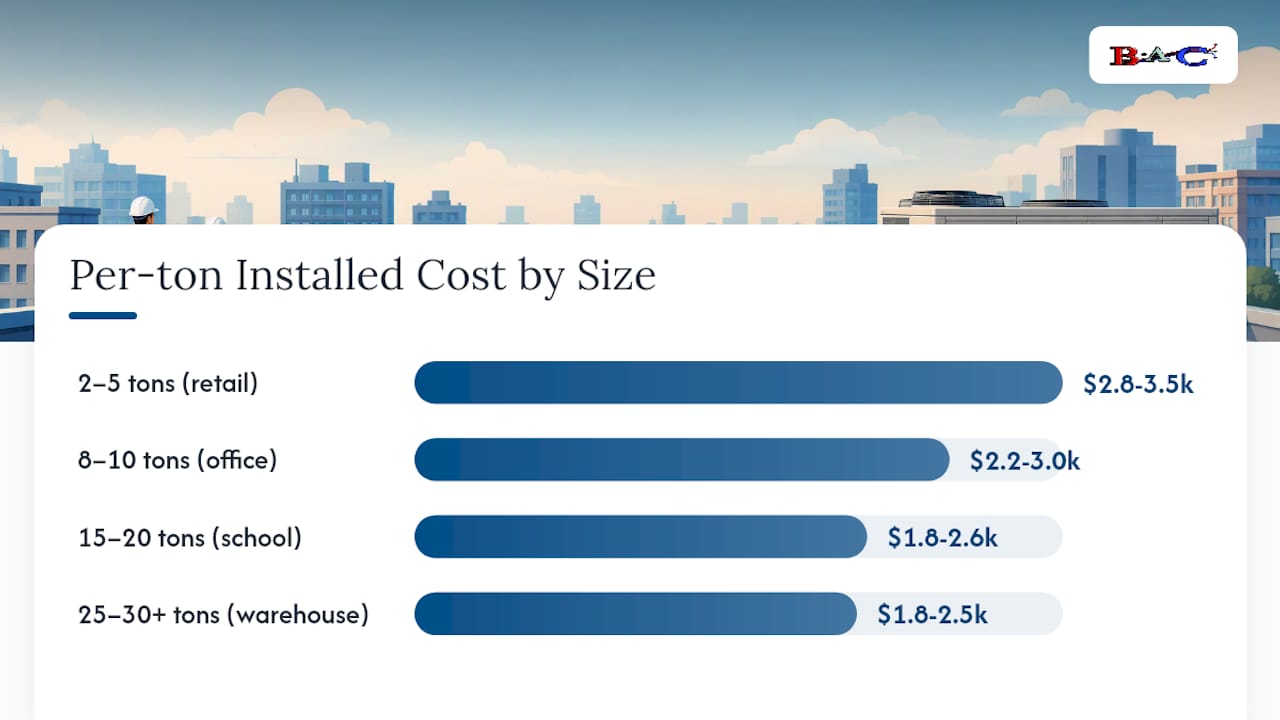
Ranges reflect typical U.S. installed costs including equipment, standard labor, crane, curb, permits, and commissioning. Site-specific conditions will move these figures.
Regional variance matters, particularly in dense urban markets. Equipment lead times have also stretched in recent years; high-efficiency models with specific controls packages can run 8–16 weeks from order to delivery, which affects project scheduling and temporary cooling costs.
Key cost drivers that move a rooftop replacement quote
Tonnage sets the floor. Everything else determines how far above that floor your final invoice lands.
Efficiency tier (SEER/IEER) is the first variable after size. That gap narrows considerably over a 15-year operating life, but it’s real money on day one.
Crane and roof access is where quotes diverge most dramatically. A ground-level unit swap on a single-story building with clear crane access might add $2,000–$3,000 in rigging costs. A five-story urban building with a tight alley, fall-protection requirements, and a half-day crane rental can add $6,000–$10,000 before the first bolt is turned. Structural reinforcement and crane logistics are among the most significant variables in any commercial RTU replacement.
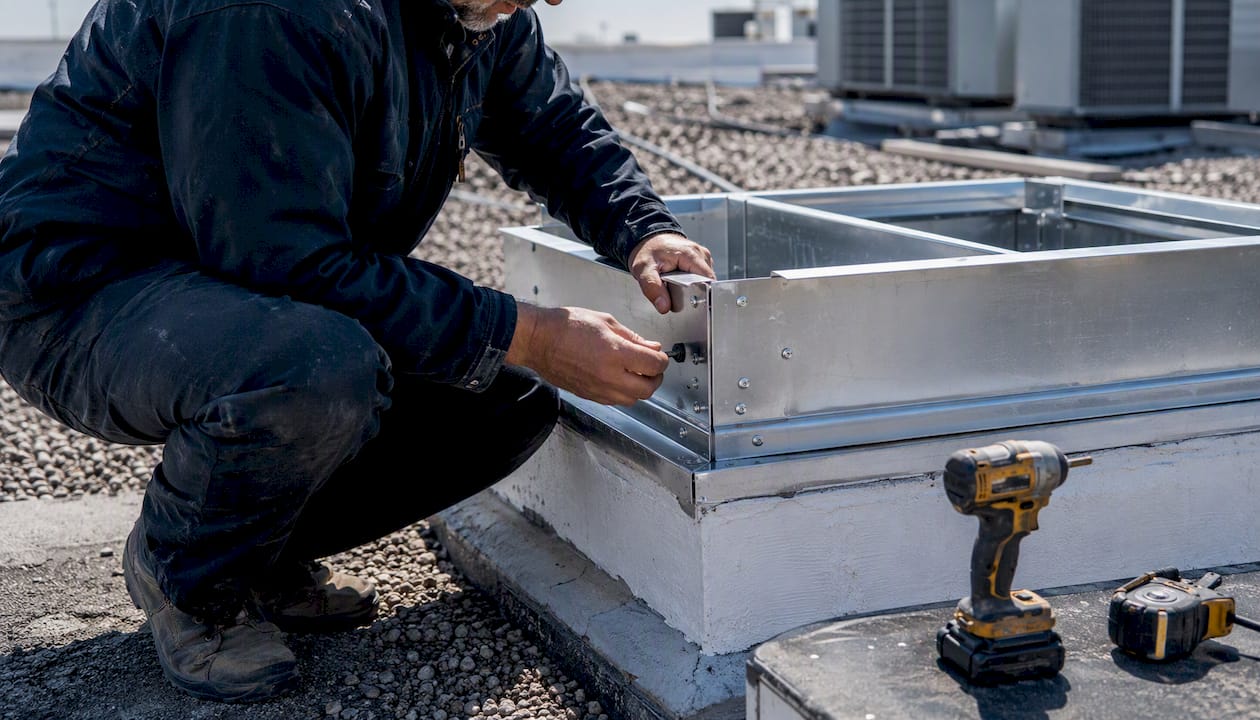
Curb and structural work catches owners off guard more than almost anything else. If the replacement unit has a different footprint than the existing curb, a custom curb adapter is required. Roof flashing repairs, decking reinforcement, and waterproofing around the new curb can add $1,500–$6,000 to a project that looked straightforward on paper.
Electrical upgrades are non-negotiable when a higher-capacity or higher-efficiency unit draws more amperage than the existing disconnect and panel circuit can supply. A simple disconnect swap runs $500–$1,500; a panel upgrade or new circuit run can reach $3,000–$5,000.
Ductwork modifications vary widely. A direct replacement with the same configuration may need only minor tie-in work. A unit with a different supply/return arrangement or a building that’s adding zones will require sheet metal fabrication, which adds labor and material costs that are difficult to estimate without an inspection.
Permits and inspections are mandatory for commercial RTU work in every U.S. jurisdiction. Fees range from a few hundred dollars in smaller municipalities to $1,500–$3,000+ in dense urban markets, and some jurisdictions require a licensed mechanical engineer’s stamp on the drawings.
Pro Tip: BMS integration is the most frequently omitted line item on mechanical-only quotes. Connecting a new RTU to an existing building management system often requires proprietary controllers, communication gateways, and software licenses that a mechanical contractor may not include unless you ask explicitly. Get that scope in writing before you sign.
What should a complete RTU replacement quote include?
A quote missing key line items isn’t a competitive bid — it’s an incomplete scope. When comparing proposals, verify that every item below appears explicitly. Vague line items like “miscellaneous labor” or “site work as needed” are red flags.
| Line Item | Typical Range | Notes |
|---|---|---|
| Equipment (RTU unit) | $8,000–$25,000 | Varies by tonnage and efficiency tier |
| Curb adapter / new curb | $1,500–$6,000 | Required when footprint differs |
| Crane and rigging | $2,000–$10,000 | Depends on roof height and site access |
| Labor (installation) | $3,000–$12,000 | Based on complexity and hours |
| Electrical work | $500–$5,000 | Disconnect, wiring, panel upgrades |
| Duct tie-in / modifications | $500–$1,500 | Sheet metal, sealing, balancing |
| Permit fees | $500–$3,000 | Jurisdiction-dependent |
| Refrigerant recovery / disposal | $500–$1,500 | Required for R-22 and older refrigerants |
| Removal and disposal of old unit | $500–$1,500 | Crane-assisted removal included |
| Commissioning and startup | $500–$2,000 | Functional testing, controls verification |
| Temporary cooling (if needed) | $500–$3,000/week | Spot coolers during installation window |
Ranges are illustrative. Your contractor should provide site-specific figures for each line item.
Reading a quote critically:
- Any proposal that bundles crane, labor, and electrical into a single “installation” line is hiding scope. Push for itemization.
- “Commissioning” listed as a checkbox rather than a line item with hours and a startup checklist is a warning sign.
- Contingency language like “additional work billed at time and materials” without a cap exposes you to open-ended cost overruns. Negotiate a not-to-exceed figure for contingencies.
- Verify that the quote explicitly states who pulls the permit. If it’s silent, assume you’re responsible and clarify before signing.
For a deeper look at how HVAC diagnostic and service fees are structured, that context helps when evaluating what’s reasonable in a contractor’s preliminary assessment charge.
Does a higher-efficiency RTU actually pay off over 15 years?
Short answer: usually yes, but the math depends on your energy rates and how long you plan to hold the building.
ASHRAE’s Service Life and Maintenance Cost Database puts the median service life for rooftop units at approximately 15 years, which is the standard planning horizon for lifecycle cost analysis. ASHRAE’s packaged DX rooftop data supports this benchmark across a broad equipment sample. Using 15 years as the window, here’s how a typical TCO comparison shakes out for a 10-ton unit:
-
Baseline unit (IEER ~11): Equipment + installation: ~$32,000. Estimated annual energy cost at $0.12/kWh and 2,000 operating hours: ~$8,400/year. 15-year energy cost: ~$126,000. Estimated maintenance over 15 years: ~$12,000. Total 15-year TCO: ~$170,000.
-
High-efficiency unit (IEER ~16): Equipment + installation: ~$38,000 (roughly 18% premium). Estimated annual energy cost at same conditions: ~$5,800/year. 15-year energy cost: ~$87,000. Estimated maintenance over 15 years: ~$10,000. Total 15-year TCO: ~$135,000.
-
Net savings from the premium unit: Approximately $35,000 over 15 years, before utility rebates or tax incentives. The $6,000 upfront premium pays back in roughly 2.5–3 years at these energy rates.
-
Utility rebates can further close the gap. Many New Jersey utilities offer per-ton rebates for qualifying high-efficiency commercial equipment. Ask your contractor to identify applicable programs before finalizing equipment selection — rebates are often processed at the contractor level and may not appear in your quote unless you ask.
-
Section 179D of the tax code allows commercial building owners to deduct the cost of qualifying energy-efficient HVAC improvements. Consult a tax advisor for current deduction limits and eligibility requirements.
As HVAC lifecycle analysis shows, focusing only on the sticker price routinely produces the more expensive outcome over a building’s operating life.
The 50% planning rule: When a repair quote exceeds roughly half the cost of replacement and the unit has passed 75% of its expected service life, replacement almost always wins on total cost. At that point, you’re spending significant money to extend equipment that’s already in its final years.
How do you get quotes you can actually compare?
The problem with most commercial RTU bids isn’t that contractors are dishonest — it’s that scopes differ. One contractor includes commissioning; another doesn’t. One prices a crane; another assumes you’ll arrange it. Normalizing bids requires a consistent scope document.
Site survey requirements to give every bidder:
- Roof access plan, including fall-protection requirements and any restricted hours
- Current curb dimensions and photos of the existing unit nameplate
- Electrical panel location, existing disconnect amperage, and available circuit capacity
- Ductwork layout drawings or field measurements if drawings don’t exist
- Equipment serial numbers and model numbers of the unit being replaced
- Any BMS or controls documentation
Minimum documentation to require in every proposal:
- Refrigerant recovery and SDS documentation (required by EPA Section 608)
- Clear statement of who pulls the permit and who is responsible for inspections
- Warranty terms for both equipment and labor (separate line items)
- Commissioning plan with startup checklist and functional test procedure
- Schedule with equipment lead time, crane date, and substantial completion date
Red flags that should stop a bid in its tracks:
- No site visit before submitting a price
- Crane and rigging listed as “if needed” rather than a confirmed scope item
- Warranty terms that reference only the manufacturer, with no contractor labor warranty
- No commissioning or startup work listed anywhere in the proposal
- Pressure to sign before the permit is pulled
Vetting a contractor’s credentials matters as much as reading the quote. Selecting a qualified HVAC subcontractor involves checking licensing, insurance, and references — not just price. The Better Business Bureau’s contractor verification tools can also help when you’re evaluating an unfamiliar firm.
Pro Tip: Ask every bidder to confirm in writing whether their quote includes BMS integration or excludes it. “Controls work” is not the same as full BMS integration. If your building runs a Siemens, Johnson Controls, or Honeywell BMS, get a separate scope and cost for the integration work before you award the mechanical contract.
What’s a realistic timeline for a rooftop replacement?
Plan for 6–14 weeks from decision to commissioning on a standard commercial RTU replacement. Here’s how that typically breaks down:
- Site survey and scope finalization: 1–2 weeks
- Equipment lead time: 4–10 weeks (standard efficiency); 8–16 weeks for high-efficiency or custom-configured units
- Permit application and approval: 2–6 weeks depending on jurisdiction; New Jersey commercial permits in urban municipalities often run 3–5 weeks
- Crane scheduling: 1–3 weeks advance booking; crane availability tightens in summer months
- Installation and duct tie-in: 1–3 days for a standard swap; up to a week for complex configurations
- Commissioning and inspection: 1–3 days; final inspection scheduling adds 1–2 weeks in some jurisdictions
Temporary cooling during the installation window is a real cost and a real tenant-relations issue. Spot coolers for a 5,000 sq ft space typically run $500–$1,500 per week in rental costs, plus delivery and setup. For multi-tenant buildings, notify affected tenants at least two weeks before the installation date and confirm the schedule in writing once the crane date is locked.
For warehouse and large industrial RTU projects, the sequencing gets more complex. Managing HVAC systems in warehouse environments requires additional coordination around inventory protection, dock operations, and phased shutdowns.
Three sample installed-cost estimates
These examples illustrate how the same basic task — swap a rooftop unit — produces very different invoices depending on building type and site conditions. They are illustrative; your actual costs will vary based on local labor rates, equipment selection, and site-specific factors.
-
Small retail suite, 4-ton RTU (single-story strip mall): Equipment: ~$9,500. Curb adapter: ~$1,800. Crane: ~$2,500. Labor: ~$3,500. Electrical disconnect: ~$800. Permit: ~$400. Removal and disposal: ~$600. Commissioning: ~$700. Total installed estimate: ~$19,800. This is a relatively clean project — good roof access, standard curb, no BMS. The crane is still required but straightforward.
-
Mid-size office building, 12-ton RTU (three-story, urban location): Equipment: ~$22,000 (high-efficiency IEER 15 unit). Curb adapter and structural reinforcement: ~$4,500. Crane and rigging (urban, restricted access): ~$7,500. Labor: ~$7,000. Electrical upgrade (new disconnect, 30-amp circuit extension): ~$2,800. Duct modifications: ~$2,200. Permit: ~$1,200. Refrigerant recovery: ~$500. Commissioning and BMS tie-in: ~$2,500. Total installed estimate: ~$50,200. The BMS integration and urban crane logistics account for roughly $10,000 of the premium over a simpler site.
-
Warehouse/light industrial, 28-ton RTU (large footprint, complex ductwork): Equipment: ~$48,000. New structural curb and roof reinforcement: ~$6,000. Crane (large-capacity, half-day): ~$9,500. Labor: ~$12,000. Electrical (new panel circuit, 3-phase): ~$4,500. Duct reconfiguration: ~$5,500. Permit and engineering stamp: ~$2,500. Refrigerant recovery and disposal: ~$800. Commissioning: ~$2,000. Temporary cooling (2 weeks): ~$2,400. Total installed estimate: ~$93,200.
These estimates are illustrative planning figures, not binding quotes. A site survey by a licensed commercial HVAC contractor is the only way to produce a number you can actually budget against. Hidden structural conditions, local permit requirements, and equipment availability all affect the final cost in ways no estimate can fully anticipate without a physical inspection.
Financing, incentives, and budgeting tips
A $50,000–$90,000 capital expenditure hits differently depending on how it’s structured. Most commercial property owners have more options than they realize.
- Equipment financing and leases: Many HVAC distributors and contractors offer equipment financing through third-party lenders, typically at 36–72 month terms. Leasing converts a CapEx event into a predictable OpEx line, which matters for properties with tight capital budgets or near-term sale plans.
- Utility on-bill financing: Some New Jersey utilities offer on-bill financing programs that let you repay equipment costs through your utility bill over time, often at below-market interest rates. Eligibility and program availability change annually — ask your contractor or contact your utility’s commercial energy efficiency desk directly.
- Section 179D deduction: Commercial building owners who install qualifying energy-efficient HVAC systems may be eligible for an immediate tax deduction. The deduction amount and eligibility rules are complex; a tax advisor familiar with commercial real estate should confirm applicability before you factor it into your budget.
- Utility rebates: Per-ton rebates for qualifying high-efficiency commercial RTUs are available through several New Jersey utility programs. Rebate amounts vary by program and equipment efficiency tier. Ask your contractor to identify applicable rebates before finalizing equipment selection — the rebate application is typically filed by the contractor at installation.
- Budget a contingency: Add 10–15% to any installed-cost estimate for unforeseen structural conditions, permit delays, or scope changes discovered during installation. This is especially important for buildings over 20 years old where roof decking condition is unknown.
- Lead-time buffer: High-efficiency units with specific controls packages can take 8–16 weeks to arrive. Order early, and if your existing unit is failing, have a temporary cooling plan in place before the equipment arrives.
Understanding HVAC efficiency ratings helps you evaluate whether a higher-efficiency unit qualifies for rebates and how to compare IEER ratings across equipment options.
Why the contractor you choose matters as much as the equipment
Most RTU replacement problems don’t come from the equipment. They come from installation.
A unit that isn’t properly commissioned — airflow balanced, refrigerant charge verified, controls calibrated — will underperform its rated efficiency from day one. That gap compounds over 15 years. An improperly flashed curb leaks. An undersized electrical disconnect trips breakers. A BMS integration done without the right gateway controller produces fault codes that no one can diagnose.
Brighton Air Corp has been handling commercial HVAC installations across New Jersey since 1993, with over 150 years of combined technician experience across the team. That’s not a marketing line — it means the technicians on your roof have seen the specific failure modes that show up in New Jersey’s building stock: aging curbs on flat-roof retail, undersized electrical in older office buildings, and BMS systems that require proprietary integration work most mechanical contractors don’t carry.
The services Brighton Air Corp covers for a commercial RTU replacement include equipment specification and sourcing, structural and curb evaluation, electrical assessment, crane coordination, permit handling, and full commissioning with functional testing. For property managers who want one contractor responsible for the complete scope rather than coordinating separate trades, that matters.
Request a free site survey and estimate at Brightonaircorp — the survey is the starting point for a binding, itemized quote.
Brighton Air Corp handles the full RTU replacement scope in New Jersey
Brighton Air Corp provides commercial rooftop unit replacement across New Jersey with a single-contractor scope that covers everything from the initial site survey through final commissioning. The concrete advantage: you get one point of contact for equipment specification, crane coordination, electrical work, permit filing, and startup testing — not a mechanical contractor who hands off electrical to a sub and commissioning to the manufacturer’s rep.
The free estimate includes a roof access assessment, curb measurement, electrical panel review, and equipment recommendation based on your building’s actual load requirements. Brighton Air Corp has managed RTU replacements for office buildings, retail centers, restaurants, and light-industrial facilities throughout New Jersey since 1993.
Schedule your site survey to get an itemized, binding estimate for your specific building.
Sources
These sources provide the technical benchmarks, cost data, and lifecycle guidance referenced throughout this article:
- ASHRAE: Service Life and Maintenance Cost Database
- ASHRAE public Service Life data (system query)
- Factors that Influence Commercial HVAC System Cost | CHINT global
- Commercial air-conditioning units price, cost ranges for buyers — Heating News Journal
- RTU Replacement Cost in 2026: Per-Ton Pricing, Install Labor & Hidden Costs | OxMaint