Save up to $7,500 on NJ HVAC in 2026 by Stacking Rebates
Save up to $7,500 on NJ HVAC in 2026 by Stacking Rebates
Yes, in 2026 New Jersey homeowners still have substantial rebate and financing options. The statewide Whole Home cash-back program pays up to $7,500, utility rebates add several hundred to several thousand dollars more, and 0% on-bill financing covers what rebates don’t. Federal 25C and 25D tax credits are not available for equipment installed after December 31, 2025.
TL;DR:
- The rebate for New Jersey’s Whole Home program depends heavily on projected energy savings, with more savings resulting in higher rebates up to $7,500.
- Utility rebates vary significantly by provider, with PSE&G offering up to $10,000 for decarbonization, while Atlantic City Electric and JCP&L have tiered and equipment-specific incentives.
- Income-qualified households can receive larger rebates and higher program caps, especially for low- and moderate-income applicants, and must verify eligibility early.
- The federal 25C and 25D tax credits are unavailable for equipment installed after December 2025, so current incentives are primarily state and utility-based.
- Proper documentation and an accurate energy assessment are critical, as missed paperwork or incorrect contractor participation can forfeit the entire rebate opportunity.
Table of Contents
- What Are the Main NJ HVAC Rebate Programs in 2026?
- How Does the NJ Whole Home Program Calculate Your Rebate?
- What Do PSE&G, JCP&L, Atlantic City Electric, and NJNG Pay for HVAC Upgrades?
- Do Low-Income Households Get Bigger NJ Rebates?
- What Financing Options Cover the Rest of the Cost?
- What Paperwork Do You Need to Qualify for a Rebate?
- How Much Can You Realistically Save by Stacking Rebates?
- What Should You Ask Your Contractor Before Signing?
- How Brighton Air Corp Helps NJ Homeowners Navigate Rebates
- Where to Verify Current NJ Rebate Details
- Get Help Claiming Your NJ HVAC Rebate
- An Editorial Take on NJ’s 2026 Rebate Landscape
- Sources
What Are the Main NJ HVAC Rebate Programs in 2026?
Three buckets make up most of what’s available under New Jersey’s 2026 energy efficiency programs. Knowing which one applies to your project determines how much paperwork you’ll file and how large your check ends up.
- New Jersey Whole Home Energy Efficiency Incentive Program: cash-back that scales with your home’s projected total energy savings, up to $7,500, plus 0% financing.
- Utility instant rebates: fixed dollar amounts per piece of equipment from PSE&G, JCP&L, Atlantic City Electric, or New Jersey Natural Gas, depending on your service territory.
- Income-qualified adders: extra cash and higher caps for low- and moderate-income (LMI) households layered on top of the first two.
PSE&G’s Building Decarbonization program stands out from the pack. Homeowners who convert a fossil-fuel system to all-electric heat pumps can see conversion rebates up to several thousand dollars, with modestly higher amounts available for LMI households. The federal side of the ledger is simpler to summarize: the IRS confirms 25C and 25D credits don’t apply to equipment placed in service after 2025, so any national tax-credit math you’ve seen from prior years no longer applies to a 2026 install.
How Does the NJ Whole Home Program Calculate Your Rebate?
The Whole Home program pays based on Total Energy Savings, or TES, a percentage that measures how much your projected energy use drops after the upgrade. The more efficient your retrofit, the bigger the check. According to Home Energy Basics, the formula works roughly like this:
- A home energy assessment establishes your baseline energy use and models the projected savings from your proposed upgrade.
- At 5% TES, you receive a base rebate of $2,000.
- Each additional percentage point of TES above 5% adds roughly $200, scaling up to $7,500 at 33% TES.
- Projects delivered through a BPI-certified participating contractor also qualify for 0% financing up to $25,000, repaid through your utility bill or a separate loan agreement.
The audit isn’t optional paperwork you can skip to save time. It’s the document that sets your entire rebate tier, so a sloppy or rushed assessment can cost you real money.
Pro Tip: Ask your contractor to show you the TES calculation before signing a contract. If they can’t explain how they arrived at your percentage, get a second opinion before committing to the scope of work.
What Do PSE&G, JCP&L, Atlantic City Electric, and NJNG Pay for HVAC Upgrades?
Utility territory changes everything about your rebate math. The same heat pump installed in Camden County under Atlantic City Electric pays differently than one installed in Newark under PSE&G, because each utility sets its own rebate schedule and efficiency thresholds.
- PSE&G: Building Decarbonization conversion rebates up to $10,000 (or $12,000 for LMI), plus separate decommissioning and re-ducting rebates up to $2,000 each.
- Atlantic City Electric: tiered rebates by equipment type, with a limited-time cold-climate heat pump adder running April through December 2026.
- JCP&L: rebates tied to ENERGY STAR-certified equipment and minimum SEER2/EER2/HSPF2 thresholds, verified through an AHRI certificate.
- New Jersey Natural Gas (SAVEGREEN): rebates for high-efficiency gas furnaces and boilers alongside heat pump water heater incentives.
Atlantic City Electric’s HVAC Efficiency Program publishes the clearest published tiers among the utilities, which makes it a useful benchmark even if you’re served by a different provider.
| Equipment / Tier | Rebate Amount | Notes |
|---|---|---|
| ASHP, Tier 1 | $500 | Standard SEER2/HSPF2 threshold |
| ASHP, Tier 2 | $750 | Higher efficiency tier |
| Cold-climate ASHP adder | Up to $2,000 | Limited-time, April to December 2026 |
| Smart thermostat | $150 | Paired with qualifying equipment |
Rules differ enough between utilities that assuming a neighbor’s rebate applies to your address is a common and costly mistake.
Do Low-Income Households Get Bigger NJ Rebates?
Income-qualified households get meaningfully better terms across nearly every program. PSE&G’s decarbonization rebate jumps from $10,000 to $12,000 for LMI applicants, and several utility programs add per-unit bonuses (often $300 or more) on top of the standard rebate.
- Eligibility typically ties to 80% or 150% of Area Median Income (AMI), verified through pay stubs, tax returns, or enrollment in an existing assistance program.
- LMI status can raise Whole Home program caps and reduce or eliminate the borrower’s share of 0% financing.
- Verification usually happens during the initial home energy assessment, not after installation, so gather documentation early.
What Financing Options Cover the Rest of the Cost?
Rebates rarely cover a full system replacement, so financing fills the gap. New Jersey’s 0% on-bill repayment options are worth understanding before you sign anything.
- Whole Home program financing caps out around $25,000, repaid through your utility bill over a set term.
- PSE&G’s decarbonization offers sometimes carry higher limits for full fossil-fuel-to-electric conversions.
- Some programs run credit checks; others don’t, but no-credit-check options often carry stricter equipment or contractor requirements.
On-bill repayment attaches to the meter, not always the person, so ask specifically what happens if you sell the house mid-loan. A practical financing breakdown can help you compare loan structures before committing.
Pro Tip: Get every financing term, including repayment length and transferability, in writing from the contractor or utility before signing. Verbal promises about “0% forever” don’t hold up if the fine print says otherwise.
What Paperwork Do You Need to Qualify for a Rebate?
Rebate applications get denied over missing paperwork far more often than over ineligible equipment. The ENERGY STAR Certified HVAC Equipment Rebate Application spells out what most NJ utilities require:
- An AHRI certificate confirming the matched indoor/outdoor set meets the required SEER2/EER2/HSPF2 or NEEP cold-climate COP rating.
- A paid invoice listing model numbers, serial numbers, and installation date.
- ENERGY STAR listing for the specific equipment combination, not just the individual components.
- Photos documenting old equipment removal for gas-to-electric conversion rebates.
- Proof your contractor participates in the utility’s program, often requiring BPI certification.
Most utilities require submission within a fixed window, commonly 120 days from installation. Miss that window and you may forfeit the rebate entirely, regardless of how qualified the equipment was.
How Much Can You Realistically Save by Stacking Rebates?
Whole Home cash-back and utility instant rebates generally stack, which is where the real savings show up. Federal 25C/25D credits don’t factor into 2026 math at all, so every dollar has to come from state or utility sources.
- Single heat pump replacement: Whole Home rebate (roughly $3,000 at 15% TES) plus a utility instant rebate ($500 to $750) can bring a $12,000 project down to $8,000 to $8,500 out of pocket.
- Whole-home cold-climate conversion: PSE&G’s $10,000 to $12,000 conversion rebate plus decommissioning and re-ducting rebates can turn a $28,000 gas-to-electric conversion into $14,000 to $16,000 net cost, before financing.
Real-world savings often land below the sticker examples utilities publish. According to Home Energy Basics, scope changes like added ductwork, electrical panel upgrades, or asbestos abatement routinely eat into projected net savings.
What Should You Ask Your Contractor Before Signing?
A qualified contractor should answer every question below without hesitation. If they can’t, that’s a signal to look elsewhere.
- Can you provide the AHRI reference number for the exact matched set you’re installing?
- Are you a participating or BPI-certified contractor under this utility’s program?
- What’s your rebate submission process, and who’s responsible for filing it?
- Can I see the financing paperwork and repayment terms before I sign anything?
Watch for red flags: a contractor who says “the rebate’s guaranteed” without showing paperwork, who asks you to delay the invoice date to hit a program deadline, or who can’t produce an AHRI certificate on request. Learn more about vetting an HVAC subcontractor before committing to a project.
Pro Tip: Request a written rebate plan and submission timeline before any work begins, not after the equipment is already installed.
How Brighton Air Corp Helps NJ Homeowners Navigate Rebates
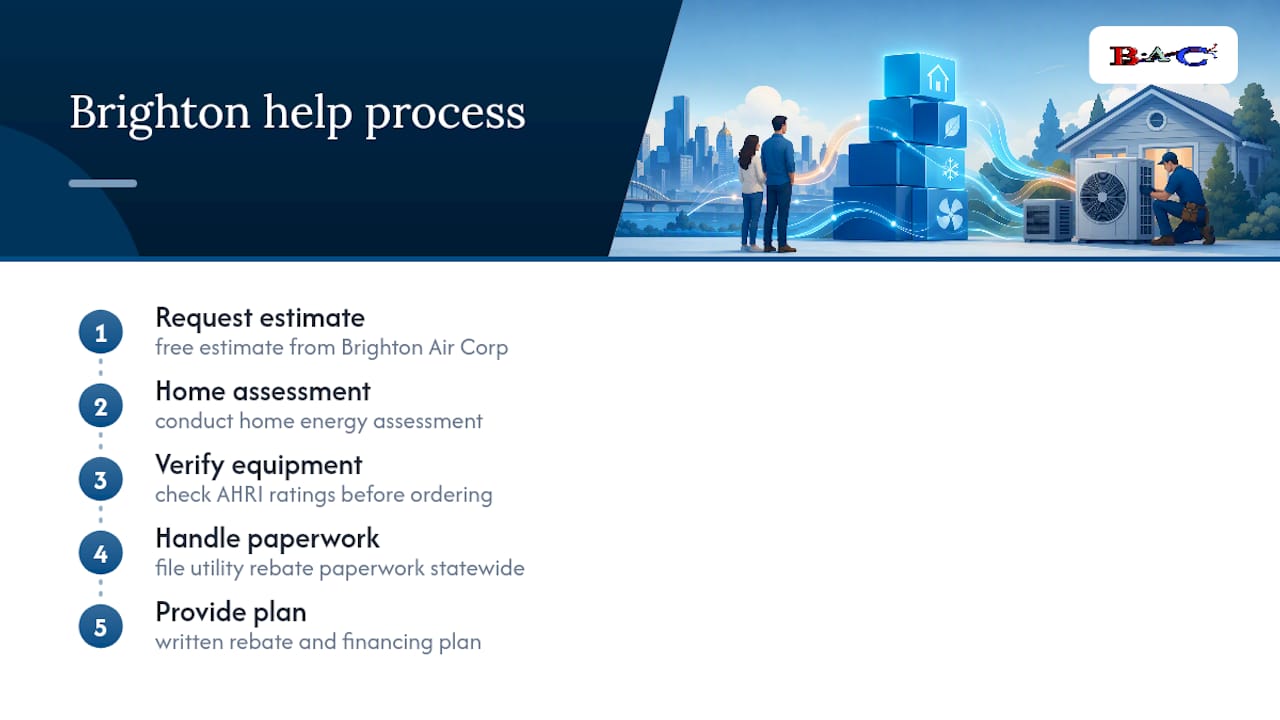
Brighton Air Corp has served New Jersey since 1993, with over 150 combined years of technician expertise across the team. That history matters when a rebate depends on getting the audit, the AHRI paperwork, and the utility submission right the first time. Our technicians handle the home energy assessment, confirm matched-set efficiency ratings, and file program paperwork as participating contractors. Before hiring anyone, verify their utility program status and request a written submission plan.
Where to Verify Current NJ Rebate Details
Program amounts and windows shift throughout the year, so confirm details directly with administrators before finalizing a project. Search DSIRE by ZIP code for active incentives, check ENERGY STAR for qualifying equipment, and review Atlantic City Electric’s HVAC program page for territory-specific rebate tiers.
Get Help Claiming Your NJ HVAC Rebate
Chasing rebate paperwork alone often means missing a submission window or ordering equipment that doesn’t qualify as a matched set. Brighton Air Corp handles the home energy assessment, verifies AHRI ratings before ordering equipment, and files utility paperwork as a participating contractor across New Jersey. Request a free estimate from Brighton Air Corp and get a written rebate and financing plan before any equipment gets ordered.
An Editorial Take on NJ’s 2026 Rebate Landscape
The conventional advice on HVAC rebates treats them like a single number you look up once. That’s the wrong mental model. New Jersey’s 2026 system is really three overlapping programs with different rules, different paperwork, and different timelines, and the homeowners who save the most are the ones who stack deliberately rather than accept whatever their contractor mentions in passing.
What’s overrated: the sticker-price rebate figures utilities publish. They’re real, but they assume a clean install with no ductwork changes, no electrical upgrades, and a contractor who files paperwork correctly the first time. What’s underrated: the audit. It sets your TES tier and your entire rebate ceiling, yet homeowners treat it as a formality.
If you do one thing differently, verify your contractor’s program participation status before you verify the rebate amount. A perfect rebate on paper is worthless if the person installing your system isn’t approved to submit for it.
— John
Sources
- New Jersey Heat Pump Rebates 2026: $7,500 Whole Home + $10,000 PSE&G Decarb | Home Energy Basics
- Frequently asked questions about energy efficient home improvements and residential clean energy property credits | IRS
- DSIRE