
15 Minute Makeup Air Unit Triage for Facility Managers
15 Minute Makeup Air Unit Triage for Facility Managers
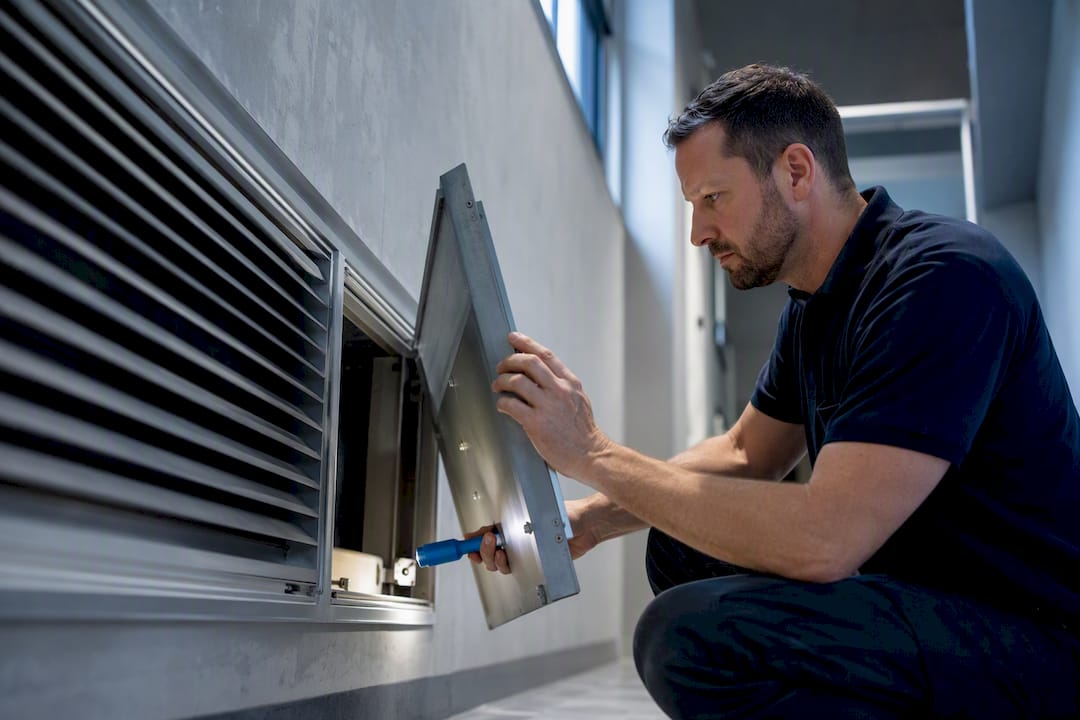
If your makeup air unit is underperforming, the most likely causes are a loaded filter, a slipping belt, a stuck damper, or a disabled interlock. Check power and the exhaust interlock first. Most of these are quick maintenance fixes; anything involving the motor, control board, or a lockout signal usually means a service call.
TL;DR:
- Most makeup air unit failures are caused by loaded filters and slipped belts, which reduce airflow despite the motor running normally.
- Accurate diagnosis relies on measuring supply and exhaust CFM imbalances beyond roughly 200 CFM during peak cooking conditions.
- Negative building pressure from faulty MAUs can pose serious safety risks, including backdrafting and carbon monoxide exposure, requiring urgent attention.
- Preventive maintenance such as monthly filter changes, quarterly belt checks, and damper exercises can significantly extend unit lifespan and reliability.
Table of Contents
- Makeup Air Unit Troubleshooting: A Quick Checklist To Run Now
- What Usually Causes Makeup Air Unit Failures?
- How Do You Diagnose a Makeup Air Unit Fault?
- When Does a Makeup Air Problem Become a Safety Issue?
- Should You Repair Or Replace A Failing Makeup Air Unit?
- What Preventive Maintenance Keeps Makeup Air Units Running?
- What Should You Budget For Makeup Air Repairs?
- Brighton Air Corp’s Approach To Diagnosing MAU Faults
- Get Your Makeup Air Unit Fixed Right The First Time
- Sources
Makeup Air Unit Troubleshooting: A Quick Checklist To Run Now
Before calling anyone, walk the unit with this sequence. It takes fifteen minutes and rules out the cheap fixes first.
- Confirm power and the interlock. Check the disconnect, breaker, and fuses, then verify the hood is actually commanding the makeup air unit (MAU) to run. A hood that fires exhaust with no MAU response is a control fault, not a mechanical one.
- Inspect filters and belts. A loaded filter chokes static pressure. A glazed or loose belt slips under load even while the motor sounds fine.
- Check intakes and panels. Look for debris, leaves, or pest nests blocking the outdoor air intake, and confirm access panels are seated and latched.
- Verify the fan is spinning the right direction. A reversed fan on a 3-phase system draws power and makes noise while moving almost no air.
- Check the airflow switch and damper travel. Confirm the damper opens fully and the switch registers airflow rather than sitting in a fault state.
- Record what you find. Log room pressure, supply and exhaust fan status, and filter pressure drop before anyone touches a wrench.
Stop immediately and call for emergency service if you smell gas, see a tripped pilot, or notice smoke or exhaust spilling back into the space. Those are backdraft and combustion risks, not maintenance items.
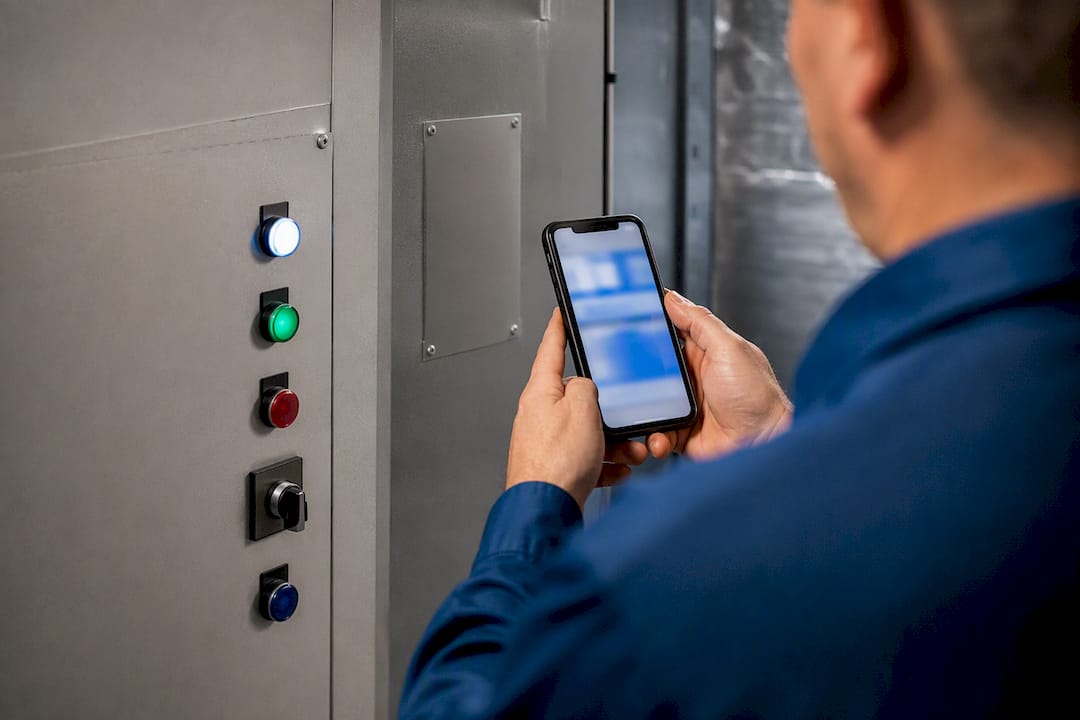
Pro Tip: Keep a phone photo of the nameplate and control panel before you start. A technician diagnosing makeup air unit issues remotely can often narrow the cause from those two photos alone.
What Usually Causes Makeup Air Unit Failures?
Most makeup air unit problems trace back to five recurring issues, and they rarely show up in isolation.
- Filter loading. As static pressure climbs, airflow drops even though the fan runs at full speed, which is why a “working” unit can still starve the kitchen of air.
- Belt slip. A worn belt bleeds RPM slowly, and because exhaust fans are often direct-drive, the mismatch grows unnoticed. This asymmetric drift is exactly what an ACHR News field study across 251 quick-service restaurant sites found at scale.
- Motor failure or reverse rotation. A three-phase motor wired backward pulls current and makes the right noise while delivering almost no airflow.
- Damper and actuator faults. A stuck damper or a misadjusted auxiliary switch can hold the unit in a false “closed” state even after a command to open.
- RTU pressed into MAU service. A rooftop unit retrofit to supply 100% outside air wears out faster because it was never built for that duty, unlike a dedicated makeup air unit designed for continuous outdoor-air conditioning.
The same field study found nearly half of tested units were not operational at the time of testing and balancing, and a large majority of sites were running net-negative pressure. That is not a rare fluke. It is closer to the norm in kitchens nobody has rebalanced since installation.
How Do You Diagnose a Makeup Air Unit Fault?
Diagnosing makeup air system failures starts with numbers, not guesswork. Pull a quick supply-versus-exhaust CFM inventory: total what the exhaust hoods pull, total what the MAU and any other supply sources deliver, and compare. A net imbalance beyond roughly ±200 CFM at peak cooking should trigger attention, a threshold drawn from commissioning and TAB field practice.
A handheld manometer measuring building differential pressure tells you fast whether the space is running negative. Beyond that:
- Inspect airflow switch tubing for insects or debris, a surprisingly common cause of nuisance lockouts flagged in Aerovent’s IM-875 troubleshooting manual.
- Confirm fan rotation and check the starter and overload relay before assuming the motor itself failed.
- Have a licensed technician verify phasing on 3-phase circuits with the power locked out first.
| What to log before calling a technician | Why it matters |
|---|---|
| TAB baseline CFM (if available) | Shows what “normal” looked like at commissioning |
| Current measured supply and exhaust CFM | Quantifies the imbalance |
| Filter pressure drop | Flags static-pressure-driven airflow loss |
| Observed alarms or lockout codes | Points a technician straight to the fault |
Handing a technician this data on arrival often cuts diagnostic time in half, because the guesswork is already done.
When Does a Makeup Air Problem Become a Safety Issue?
Any makeup air unit issue involving negative building pressure is a code and combustion-safety matter, not just a comfort complaint. Standards including ASHRAE 154 and NFPA 96 expect exhaust and makeup air to be interlocked and balanced. A hood that can run with the MAU offline is an active compliance gap.
Negative pressure pulls flue gas back into occupied space instead of letting it vent, which raises carbon monoxide risk around any gas-fired appliance. Treat these as urgent, stop-and-call situations:
- Flame spillage or a pilot that will not stay lit
- Visible or smelled combustion byproducts indoors
- Strong, sustained negative pressure across multiple zones
- Any lockout signal paired with a gas odor
Anyone accessing the unit’s electrical section should follow standard lockout/tagout practice: verify the disconnect is open and confirm zero energy before touching wiring or the motor.
Should You Repair Or Replace A Failing Makeup Air Unit?
Match the fix to the fault, not the symptom’s drama.
- Small fixes (filter swaps, belt replacement and tensioning, clearing blocked intakes) usually run under two hours and rarely require special parts.
- Medium repairs (motor replacement, blower wheel service, burner component swaps) can mean days of downtime waiting on parts, especially for older or less common models.
- Capital replacement makes sense when an RTU has been pressed into MAU duty for years, when repair costs approach a large share of replacement cost, or when the unit can no longer hit design airflow after service.
Document the imbalance, any lockout codes, and what you already checked from the troubleshooting checklist before the contractor arrives. It shortens the visit and often avoids a second trip. For a broader view of when repair spending stops making sense, this HVAC lifecycle cost analysis walks through the math.
What Preventive Maintenance Keeps Makeup Air Units Running?
A short, consistent maintenance rhythm prevents most of the failures above from ever reaching the “emergency” stage.
- Check filters monthly and replace on a fixed schedule rather than waiting for visible clogging.
- Inspect belt tension and condition quarterly.
- Clear airflow switch tubing of debris and insects during the same visit.
- Exercise dampers manually to catch a sticking actuator before it fails closed.
- Capture a net-imbalance baseline at commissioning and recheck it annually or after any hood or duct change.
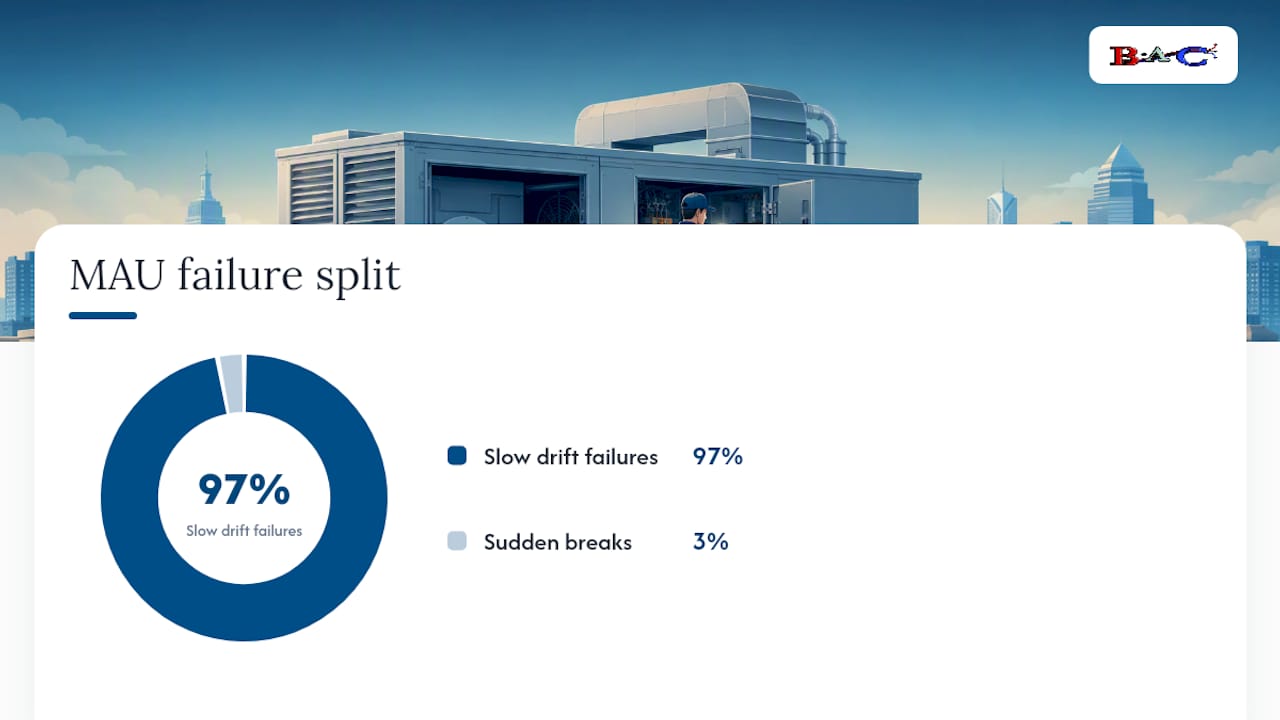
Continuous fault detection paired with demand-control kitchen ventilation keeps supply and exhaust coordinated in real time, catching the slow belt-slip drift toward negative pressure long before anyone notices a draft. That kind of ongoing monitoring matters more than any single repair, because the 231-of-238-site study found the failures were slow drift, not sudden breaks.
Pro Tip: Adapt a seasonal HVAC startup routine, like the one in this seasonal preparation checklist, into a quarterly MAU check. Most kitchen teams already do seasonal walkthroughs; folding MAU checks into that habit costs nothing extra.
What Should You Budget For Makeup Air Repairs?
Cost scales with what actually failed, so budget in three tiers rather than one number.
- Minor fixes (filters, belts, cleared intakes): parts and labor typically resolve same-visit.
- Component repairs (motors, blowers, burner parts): expect part lead time on top of labor, sometimes stretching a week for less common units.
- Replacement: the largest spend, but often justified by the energy waste of running a unit continuously out of balance, a cost the same field study modeled as substantial across the sample.
When you request service, include the unit’s make and model, observed symptoms, any measured CFM imbalance, and whether it’s a dedicated MAU or an RTU pressed into that role. That single detail changes what a technician brings on the truck.
Brighton Air Corp’s Approach To Diagnosing MAU Faults
A first truck roll on a makeup air complaint starts with the same sequence covered above: power and interlock, then filters and belts, then a CFM and pressure check before touching any component. Brighton Air Corp technicians prioritize safety and TAB verification over quick swaps, because a rebalanced fan is worthless if the interlock is still bypassed. Services include emergency response, planned maintenance agreements, TAB and commissioning, and burner and combustion testing.
— John
Get Your Makeup Air Unit Fixed Right The First Time
Brighton Air Corp handles makeup air unit repair, commissioning, planned maintenance, and 24/7 emergency response across New Jersey, backed by technicians who diagnose the interlock and pressure issues most contractors skip past.

When you request service, have the site address, observed symptoms, any measured CFM imbalance, and the unit type (dedicated MAU or RTU-as-MAU) ready. That information alone can cut a diagnostic visit down significantly, especially on commercial kitchen calls where a stuck damper and a failed motor look identical from the floor. Facility managers overseeing larger buildings can also see how supply and exhaust balance fits into overall building operations in this guide on managing HVAC systems for a warehouse. For a second contractor-side view on catching commercial HVAC failures early, see this overview of common commercial HVAC failures.
Request a free estimate through Brighton Air Corp and get a technician scheduled who already knows what to check first.
Sources
This article draws on the ACHR News field study on MAU failures, Aerovent’s IM-875 troubleshooting manual, and an EngineersUniverse primer on MAU design.