
Best InfiniteComfort.com Alternatives for HVAC in 2026
Best InfiniteComfort.com Alternatives for HVAC in 2026

What are the best InfiniteComfort.com alternatives?
If you’re searching for infinitecomfort.com alternatives, the short answer is that the US HVAC market offers plenty of credible options, from nationally recognized equipment brands to local contractors with verifiable credentials. The strongest alternatives share three traits: licensed technicians, transparent written quotes, and manufacturer-backed warranties.
Start your search by identifying what you actually need. Are you buying equipment directly, or hiring a full-service contractor for installation and maintenance? That distinction shapes which type of provider fits your situation.
Quick screening checklist before you contact anyone:
- Confirm an active state contractor’s license (verifiable through your state’s licensing board)
- Request proof of general liability insurance and worker’s compensation coverage
- Ask whether the company pulls permits for every installation
- Get at least three written, itemized quotes before committing
- Check whether technicians hold NATE or EPA Section 608 certifications
Direct Comfort HVAC deserves a mention here. Its equipment is manufactured by Goodman Manufacturing Company, a subsidiary of Daikin Industries, Ltd., assembled in US facilities. That manufacturing lineage matters when you’re evaluating product reliability and parts availability.
Reliable HVAC brands and service providers to consider
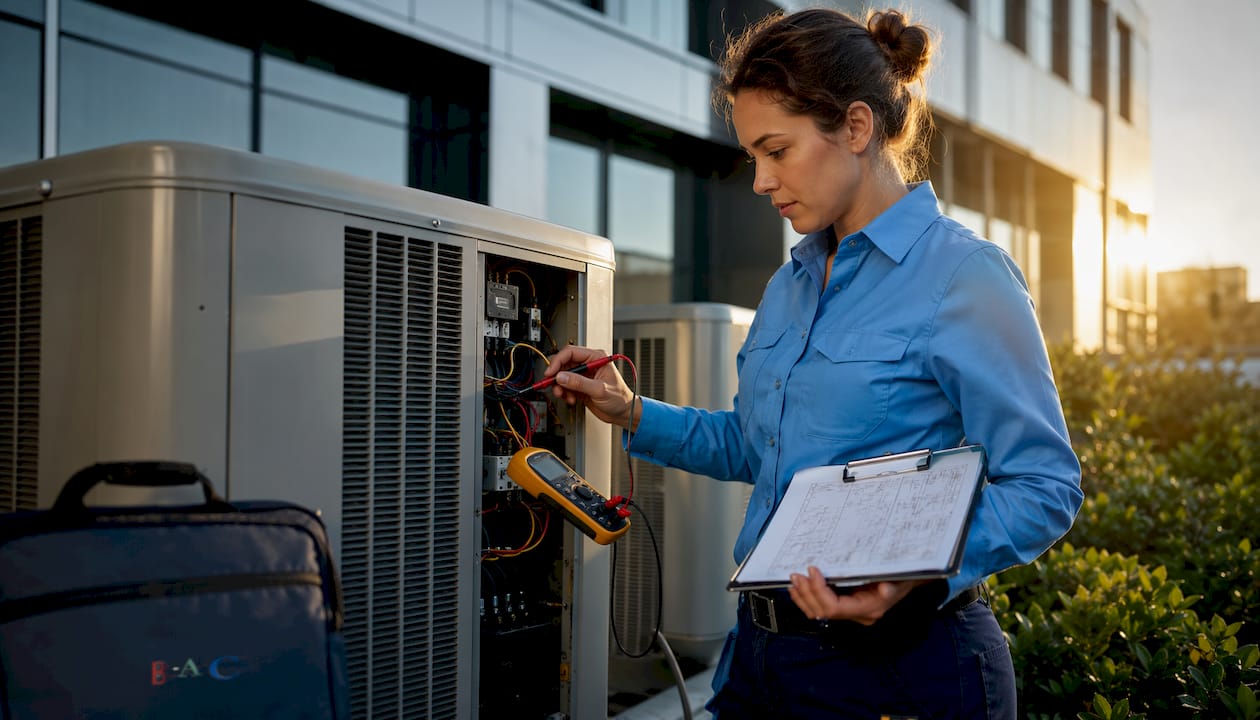
The US market has no shortage of options once you know where to look. The challenge is matching the right type of provider to your specific need.
1. Direct Comfort HVAC (equipment brand)
Direct Comfort products are made by Goodman Manufacturing Company, which operates as a subsidiary of Daikin Industries, Ltd. The assembly happens in the US, at what Goodman describes as the largest operational HVAC facility in the country. Units share production standards with Goodman’s own line but are distributed through a separate channel, often at lower price points. If you’re a homeowner comfortable sourcing equipment independently and hiring a local installer, Direct Comfort is worth pricing out.
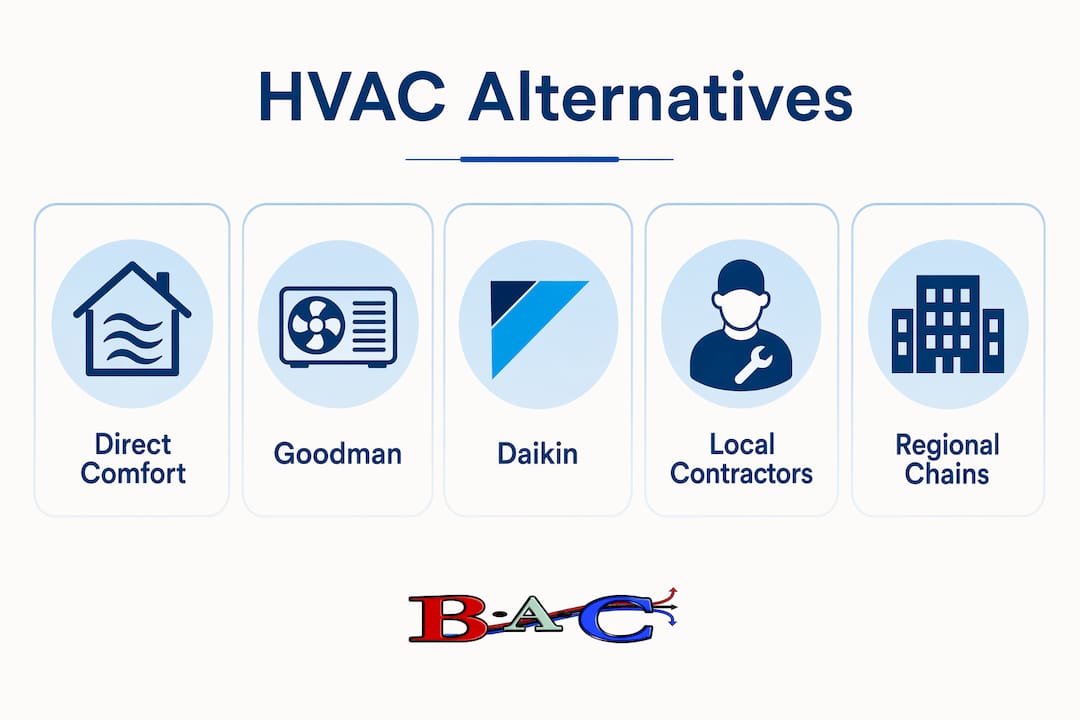
2. Goodman Manufacturing Company (equipment brand)
Goodman is one of the most widely distributed HVAC equipment brands in North America. Its units are available through thousands of licensed contractors, and parts are easy to source nationally. The brand sits in the value-to-mid-range tier, which makes it a practical choice for budget-conscious homeowners who still want a recognizable manufacturer warranty.
3. Daikin Industries, Ltd. (premium equipment)
As the parent company of Goodman, Daikin brings its own premium product line to the US market. Daikin equipment typically carries higher upfront costs but offers strong energy efficiency ratings and a global parts network. Property managers overseeing multiple units often find the long-term operating costs justify the initial investment.
4. Local licensed HVAC contractors
A local contractor with a clean license record, active insurance, and NATE-certified technicians will outperform any national brand on the installation quality side. Equipment is only as good as the installation behind it. Ask specifically whether the company uses in-house W-2 employees or sub-contracted crews, since sub-contracted teams often prioritize speed over precision, leading to problems like poor duct sealing and incorrect refrigerant charging.
5. Regional HVAC service chains
Regional chains typically offer more consistent service standards than solo operators, with dedicated dispatch systems and documented maintenance protocols. The tradeoff is that pricing tends to run higher than independent contractors. For property managers handling multiple properties, the consistency and accountability of a regional chain can be worth the premium.
6. Online HVAC equipment suppliers
Several online suppliers sell equipment directly to homeowners and contractors at wholesale-adjacent prices. This model works well if you already have a trusted installer and want to control equipment selection and cost. Verify that any equipment you purchase this way still qualifies for the manufacturer warranty when installed by a licensed contractor.
7. Full-service HVAC companies with maintenance plans
Some providers bundle installation, annual tune-ups, and priority emergency service into a single plan. These arrangements can reduce long-term costs and keep your system under a consistent maintenance record, which matters for warranty claims. Brightonaircorp, for example, offers this type of full-service model for New Jersey homeowners and businesses, covering everything from furnace repairs to 24/7 emergency calls. You can also explore reputable residential HVAC providers through vetted alternative listings.
Key credentials to verify when choosing an HVAC company
Credentials are not a formality. They are the single fastest way to separate legitimate contractors from operators who cut corners.
What to verify before signing anything:
- State contractor’s license: Ask for the license number and look it up directly on your state’s licensing board website. A legitimate contractor provides this within minutes.
- General liability insurance: The recommended minimum is $500,000 in coverage. This protects your property if something goes wrong during the job.
- Worker’s compensation insurance: If a technician is injured on your property and the company lacks this coverage, you could face liability.
- NATE certification: North American Technician Excellence certification confirms that a technician has passed independent competency testing, not just an in-house training program.
- EPA Section 608 certification: Required by federal law for any technician handling refrigerants. Its absence is a compliance red flag.
Pro Tip: Ask for insurance certificates and the license number before scheduling an in-home estimate. Any hesitation or delay in providing these documents is a signal to move on.
Understanding the $5,000 rule for HVAC repair vs. replacement
The $5,000 rule gives you a quick financial framework: multiply your system’s age in years by the estimated repair cost. If the result exceeds $5,000, replacement is generally the wiser financial move. If it falls below $5,000, repair may still make sense.
If an older system requires a moderate repair cost, replacement may be advisable; for younger systems with similar repair costs, repair may be more reasonable.
Where the rule has limits:
- It does not account for remaining warranty coverage on major components
- Refrigerant type matters: older systems using R-22 face higher repair costs due to phase-out supply constraints
- A system with a history of frequent failures may justify replacement even when the math says repair
- Energy efficiency gains from a new system can offset replacement costs over time, especially if your utility bills have been climbing
The rule is a starting point, not a verdict. Get a professional evaluation before committing either way, particularly for compressor or heat exchanger issues where repair costs can approach replacement territory.
How to evaluate HVAC companies beyond online reviews
Online reviews tell you what past customers experienced. They do not tell you whether a company will show up with the right equipment, pull permits, or stand behind their work two years later.
BBB ratings are more useful than star averages because they show how a company responds to complaints. A company with a few resolved complaints and documented responses is often more trustworthy than one with a perfect score and no history. Look for pattern, not just rating.
Transparency indicators that matter more than reviews:
- Itemized written quotes that include equipment model numbers, labor, permits, and any electrical upgrades
- Free initial consultations without pressure to sign on the spot
- Clear explanation of what the labor warranty covers and for how long
- Willingness to answer questions about the installation crew’s employment status
Permits deserve special attention. Permit costs typically run $100–$500, but unpermitted work can void your homeowner’s insurance and create problems at resale. Any contractor who suggests skipping permits to save money is not protecting your interests.
Pricing and service package differences among top alternatives
HVAC pricing varies widely depending on whether you’re buying equipment only, installation only, or a bundled service package. Equipment-only purchases through online suppliers or direct-from-manufacturer channels tend to carry the lowest upfront cost but shift installation responsibility entirely to you. Full-service contractors bundle equipment, installation, permits, and often a labor warranty into a single price, which is easier to compare but harder to break down.
When comparing quotes, look at the total installed cost, not the equipment sticker price. A contractor quoting a lower equipment price may add electrical upgrade costs, duct modification fees, or disposal charges as change orders after the project starts. Verify upfront that every quote includes permits, all labor, and any ancillary work identified during the site visit.
Contract terms and warranty differences across HVAC providers
Labor warranties vary more than most homeowners realize. The industry standard runs 1–3 years on labor, while top-tier contractors offer 5 years or more. Parts warranties come from the manufacturer and typically run 5–10 years depending on the brand and registration requirements. Read both carefully: a 10-year parts warranty means nothing if labor to install a covered part costs $1,500 out of pocket.
Watch for contracts that require you to use the same company for annual maintenance to keep the warranty valid. That clause is not inherently bad, but you should know it exists before signing. Also confirm whether the contract includes a cancellation clause and what the payment schedule looks like. Never pay 100% upfront; a standard deposit runs 10–30%, with the balance due after completion and inspection.
Customer service and support quality indicators to assess
Response time to after-hours calls is one of the clearest indicators of operational quality. Ask directly: does the company offer 24/7 emergency service, and is that handled by in-house technicians or a third-party answering service? The answer tells you a lot about how a breakdown at 11 PM on a Friday will actually go. You can also review emergency diagnostic fee structures to know what to expect before you’re in that situation.
Communication quality during the sales process predicts post-installation support. Companies that provide clear timelines, written confirmations, and proactive updates tend to maintain that standard after the check clears.
Red flags when choosing an HVAC company
Some warning signs are obvious; others are easy to miss until you’re already committed.
- Quotes a price over the phone without inspecting your home first
- Refuses to provide a license number or insurance certificate on request
- Pressures you to sign the same day with a “limited-time” discount
- Does not include permit costs in the written quote
- Cannot name the specific equipment model being installed
- Dismisses questions about Manual J load calculations, which determine correct system sizing per ACCA standards
- Asks for full payment before work begins
Any single one of these is worth walking away over. Combine two or more, and you’re looking at a contractor who will create problems you’ll spend years resolving.
Step-by-step guide to vetting and selecting an HVAC provider
- Build a shortlist of four candidates using Google reviews, the Better Business Bureau, and personal referrals from neighbors or local community groups.
- Verify licenses and insurance for each candidate before scheduling a visit. Use your state’s licensing board website and ask for insurance certificates directly.
- Schedule in-home estimates with at least three contractors. Any quote given without a site visit is not a real quote.
- Compare written quotes line by line, checking for equipment model numbers, permit inclusion, labor warranty duration, and payment terms.
- Ask about the installation crew. In-house W-2 employees generally deliver more consistent results than piece-rate sub-contractors.
- Confirm the Manual J load calculation will be performed. Skipping this step leads to oversized or undersized equipment, both of which shorten system life. You can also find local HVAC alternatives through vetted provider directories to expand your shortlist.
- Review the contract for cancellation terms, payment schedule, and warranty language before signing anything.
Key Takeaways
Choosing a reliable HVAC provider requires verifying credentials, comparing itemized quotes, and understanding both the $5,000 repair rule and contract warranty terms before committing.
| Point | Details |
|---|---|
| Verify four credentials | Confirm state license, general liability insurance ($500,000 minimum), worker’s compensation, and NATE or EPA Section 608 certification. |
| Use the $5,000 rule as a guide | Multiply system age by repair cost; results over $5,000 generally favor replacement, but always get a professional evaluation. |
| Demand itemized written quotes | Quotes must include equipment model numbers, permits ($100–$500), labor, and any electrical upgrades to avoid change orders. |
| Check labor warranty terms | Industry standard is 1–3 years on labor; top contractors offer 5 or more years, separate from the manufacturer parts warranty. |
| Red flags override good reviews | No license, phone-only quotes, full upfront payment demands, and skipped permits are disqualifying regardless of star ratings. |