
HVAC's Role in Green Building Certification: 2026 Guide
HVAC’s Role in Green Building Certification: 2026 Guide

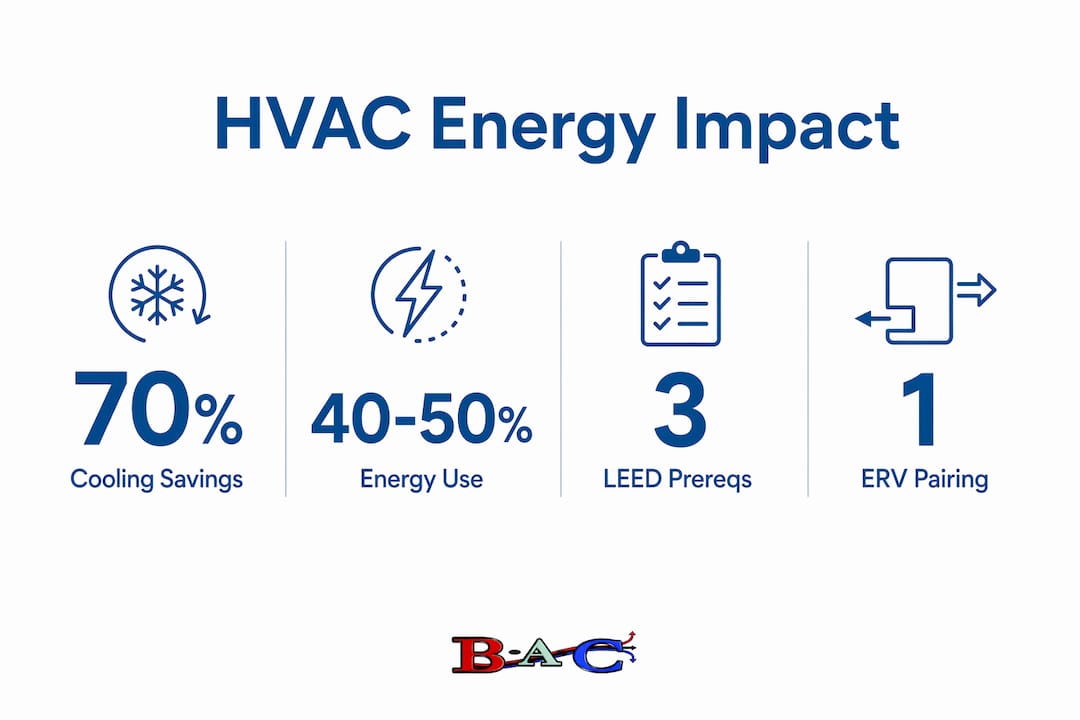
HVAC systems are the single largest determinant of green building certification outcomes, accounting for 40–50% of total energy consumption in U.S. buildings. The role of HVAC in green building certification goes far beyond temperature control. Frameworks like LEED base major credits directly on HVAC performance, requiring mandatory prerequisites in commissioning, refrigerant management, and energy efficiency benchmarks such as ASHRAE 90.1. For architects, builders, and sustainability consultants, understanding how heating, ventilation, and air conditioning systems drive certification outcomes is not optional. It is the foundation of every credible green building strategy.
What are the mandatory HVAC requirements for LEED certification?
LEED certification is not a checklist you complete after construction. It is a performance standard built into every design decision, and HVAC sits at its core. LEED’s Energy and Atmosphere category assigns foundational credits based on HVAC commissioning, minimum energy performance, and refrigerant management. These are prerequisites, meaning a project cannot earn certification without satisfying them first.
The mandatory HVAC requirements for LEED break down into five areas:
- Fundamental commissioning. The project must verify that HVAC systems are designed, installed, and operating as intended. This includes reviewing design intent documents, inspecting installation, and conducting functional performance tests before occupancy.
- Minimum energy performance. Systems must meet or exceed the ASHRAE 90.1 baseline. ASHRAE 90.1 sets the national standard for energy efficiency in commercial buildings and serves as the reference point for calculating energy savings above the baseline.
- Refrigerant management. Projects must use refrigerants with zero ozone depletion potential (ODP) and minimize global warming potential (GWP). Low-GWP refrigerants and leak reduction protocols are both required to satisfy this prerequisite.
- Duct leakage and system testing. Duct systems must be tested for air leakage. Excessive leakage wastes conditioned air, raises energy use, and undermines the efficiency calculations that support certification credits.
- Building-level energy metering. Projects must install metering systems that track whole-building energy consumption. This data supports ongoing performance verification and is required for LEED recertification under the LEED Operations and Maintenance pathway.
Pro Tip: Document every commissioning step with dated reports and equipment serial numbers. Certification reviewers look for a clear paper trail, and gaps in documentation are the most common reason LEED submissions get delayed.
How do advanced HVAC technologies improve energy efficiency in certified buildings?
Modern HVAC technology has moved well beyond conventional split systems and rooftop units. The efficiency gains available today are large enough to shift a project from LEED Silver to LEED Gold without changing the building envelope.
Key technologies driving these gains include:
- Variable refrigerant flow (VRF) systems. VRF systems reduce cooling energy use by approximately 70% compared to conventional cooling equipment. They do this by modulating refrigerant flow precisely to match the actual load in each zone, eliminating the on/off cycling that wastes energy in traditional systems.
- Smart controls with night purge and adaptive scheduling. Smart control strategies like night purge ventilation and adaptive scheduling reduce energy consumption by 17–26% versus conventional HVAC operation. Night purge uses cool outdoor air overnight to pre-condition the building, reducing the cooling load during peak hours.
- Geothermal heat pumps. These systems exchange heat with the ground rather than outdoor air, achieving efficiency levels that air-source equipment cannot match in climates with extreme seasonal swings.
- Thermal energy storage (TES). TES systems chill water or freeze ice during off-peak hours when electricity rates are lower, then use that stored cooling during peak demand. This reduces both energy cost and grid strain.
- IoT sensors and AI-driven predictive maintenance. Experts now position HVAC as an active sustainability agent rather than a passive energy consumer. IoT sensors feed real-time data to AI platforms that predict equipment failures before they happen, keeping systems at peak efficiency between scheduled maintenance visits.
| Technology | Primary benefit | Certification relevance |
|---|---|---|
| VRF systems | ~70% cooling energy reduction | Energy and Atmosphere credits |
| Smart controls | 17–26% energy savings | Optimization credits |
| Geothermal heat pumps | High seasonal efficiency | Renewable energy integration |
| Thermal energy storage | Peak load shifting | Demand response credits |
| IoT and AI controls | Predictive efficiency management | Ongoing performance verification |
Pro Tip: Pair VRF systems with an energy recovery ventilator (ERV) to capture heat from exhaust air. This combination addresses both the Energy and Atmosphere and Indoor Environmental Quality credit categories simultaneously.
Why does HVAC commissioning matter for maintaining certification?
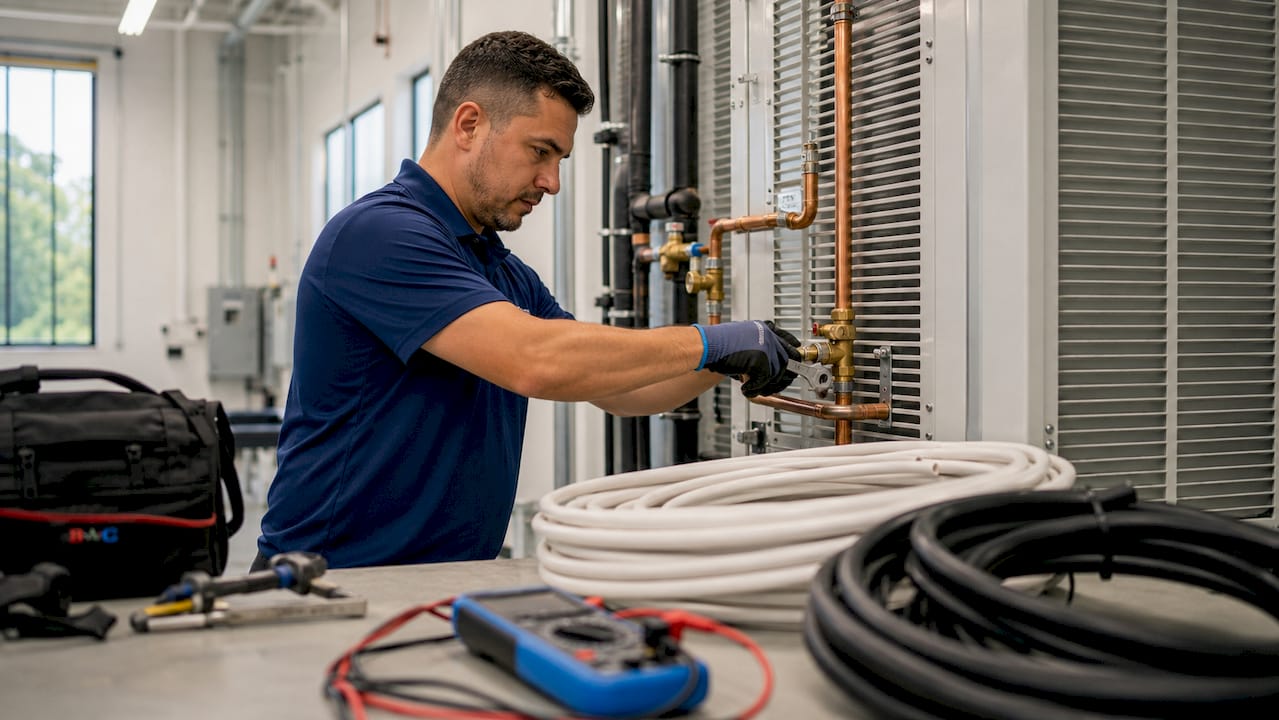
Commissioning is the quality assurance process that confirms your HVAC system actually performs the way the design documents say it will. Fundamental commissioning covers four stages: planning, installation review, functional performance testing, and final reporting. Each stage catches problems that would otherwise surface as energy waste, occupant complaints, or failed recertification audits.
The impact of commissioning extends across several certification credit categories:
- Indoor Environmental Quality (IEQ). Commissioning verifies that ventilation rates meet ASHRAE 62.1 minimums. Under-ventilated spaces accumulate CO2 and volatile organic compounds (VOCs), directly harming occupant health and triggering IEQ credit failures.
- Refrigerant verification. Commissioning confirms that installed refrigerants match the specified low-GWP, zero-ODP products. A substitution made during installation without documentation can void the refrigerant management prerequisite.
- Efficiency validation. Oversizing and poor installation degrade expected efficiency gains significantly. A system sized 30% too large for its load will short-cycle, wear out faster, and consume more energy than a properly sized unit, undermining the energy model that supported the original certification.
- Early deficiency correction. Commissioning during construction costs far less than retrofitting after occupancy. Finding a damper wired backward during testing takes an hour to fix. Finding it two years later after occupant complaints takes weeks of investigation.
Pro Tip: Budget for enhanced commissioning, not just fundamental commissioning. Enhanced commissioning adds a post-occupancy review 10 months after substantial completion, catching seasonal performance issues that functional testing during construction cannot reveal.
How can architects and builders integrate HVAC for the best certification outcomes?
The gap between a building that earns LEED Silver and one that earns LEED Platinum often comes down to how early the HVAC strategy entered the design conversation. Early MEP engineer involvement in the design phase correlates directly with higher certification success rates and lower retrofit costs. Waiting until schematic design is complete to bring in the mechanical engineer is one of the most expensive mistakes a project team can make.
A practical integration framework for architects, builders, and sustainability consultants follows these steps:
- Engage MEP engineers at project inception. The mechanical engineer needs to inform the building orientation, glazing ratios, and envelope insulation levels before those decisions are locked in. HVAC loads are a direct function of envelope performance.
- Model the building holistically. Use energy modeling software to test how envelope changes affect HVAC sizing. A better-insulated wall reduces the heating load, which allows a smaller system, which costs less and earns more efficiency credits.
- Specify occupancy-based controls from the start. Occupancy-based HVAC control saves over $7,000 annually in educational buildings by conditioning spaces only when occupied. The same principle applies to office buildings, retail spaces, and industrial facilities. Specify demand-controlled ventilation (DCV) with CO2 sensors in the design documents, not as a value-engineering add-on.
- Plan for refrigerant regulatory compliance over the building’s lifecycle. Refrigerant circularity and the transition away from high-GWP refrigerants are accelerating under EPA regulations. Specifying equipment that uses next-generation refrigerants now avoids costly retrofits when older refrigerants are phased out.
- Evaluate lifecycle cost, not just first cost. High initial capital costs for energy-efficient HVAC are offset by lower operating expenses over the building’s life. A geothermal heat pump system costs more upfront than a conventional rooftop unit but typically pays back the premium within 7–10 years through energy savings. LEED certification also supports higher lease rates and property valuations, improving the financial case further.
For commercial properties, a commercial HVAC service contract provides the ongoing maintenance documentation that certification bodies require for recertification audits. Treating maintenance as a one-time event rather than a continuous program is a common reason buildings lose their certification status at renewal.
Sustainability consultants working on warehouse or industrial projects should also review HVAC management strategies specific to large-volume spaces, where ASHRAE 90.1 compliance requires different approaches than standard commercial office design.
Key Takeaways
HVAC systems determine green building certification outcomes more than any other building system, making early design integration and rigorous commissioning non-negotiable for LEED success.
| Point | Details |
|---|---|
| HVAC dominates energy use | HVAC accounts for 40–50% of U.S. building energy consumption, making it the primary certification lever. |
| Prerequisites are non-negotiable | LEED requires commissioning, ASHRAE 90.1 compliance, and refrigerant management before any credits are earned. |
| Advanced technology multiplies savings | VRF systems cut cooling energy by ~70%; smart controls add another 17–26% reduction on top. |
| Commissioning prevents costly failures | Poor installation and oversizing degrade efficiency gains; commissioning catches these issues before occupancy. |
| Early MEP involvement is the highest-ROI decision | Bringing mechanical engineers in at project inception reduces retrofit costs and improves certification outcomes. |
HVAC as a sustainability driver, not a compliance checkbox
After working with HVAC systems across commercial, industrial, and institutional projects, the pattern I see most often is this: teams treat HVAC as something to specify late and commission quickly. Then they wonder why their energy model and their actual utility bills don’t match.
The buildings that earn and keep LEED Platinum treat HVAC as an active part of the sustainability strategy from day one. They model the system alongside the envelope. They specify IoT controls that generate real performance data. They commission thoroughly and review that data 10 months after occupancy. The indoor environmental quality outcomes in those buildings are measurably better, and occupant satisfaction scores reflect it.
The refrigerant transition is the issue I think gets the least attention relative to its financial risk. Facilities locked into high-GWP refrigerants face regulatory pressure that will only increase. Specifying next-generation refrigerants now is not just a certification strategy. It is asset protection.
Green HVAC design is a long-term investment that reduces operating costs and improves occupant health well beyond what any certification checklist captures. The certification is the proof of concept. The real value shows up in the energy bills, the lease renewals, and the occupant health outcomes over the building’s full life.
— John
Brightonaircorp’s HVAC expertise for your certification project
Achieving green building certification requires HVAC systems that are designed, installed, and maintained to a higher standard than conventional construction demands. Brightonaircorp has served commercial and industrial clients across New Jersey since 1993, with over 150 years of combined technician expertise in complex HVAC systems.

Brightonaircorp supports certification projects with expert system design, commissioning documentation, energy-efficient equipment selection, and ongoing maintenance programs aligned with LEED and ENERGY STAR requirements. Whether you are specifying a new VRF system for a LEED Gold target or need commissioning support for an existing building pursuing recertification, Brightonaircorp’s team provides the technical depth your project requires. Contact Brightonaircorp for a free project consultation and find out how the right HVAC strategy can drive your certification outcome.
FAQ
What percentage of building energy does HVAC consume?
HVAC systems account for 40–50% of total energy consumption in U.S. buildings. That share makes HVAC performance the single most influential factor in green building certification scoring.
What HVAC prerequisites does LEED require?
LEED requires three mandatory HVAC prerequisites: fundamental commissioning, minimum energy performance meeting ASHRAE 90.1, and refrigerant management using zero-ODP and low-GWP refrigerants. Projects cannot earn any certification level without satisfying all three.
How much energy can VRF systems save in certified buildings?
Variable refrigerant flow systems reduce cooling load energy use by approximately 70% compared to conventional cooling equipment. That efficiency gain directly supports Energy and Atmosphere credits under LEED.
Why does commissioning affect green building certification?
Commissioning verifies that HVAC systems perform as designed, confirming ventilation rates, refrigerant compliance, and efficiency levels that certification bodies require. Skipping or rushing commissioning is the most common cause of certification credit failures.
How does occupancy-based HVAC control support certification goals?
Occupancy-based control conditions spaces only when people are present, saving over $7,000 annually in educational buildings and reducing energy use in any building type. Demand-controlled ventilation with CO2 sensors satisfies both energy efficiency and indoor air quality credit requirements under LEED.