
HVAC Lifecycle Cost Analysis: A Property Owner's Guide
HVAC Lifecycle Cost Analysis: A Property Owner’s Guide

HVAC lifecycle cost analysis is defined as the total cost of purchasing, operating, maintaining, and disposing of a heating and cooling system over its full service life, typically 15 to 25 years. The industry standard term for this process is Life Cycle Cost Analysis, or LCCA, as established by the National Institute of Standards and Technology (NIST) and the U.S. Department of Energy (DOE). Property owners and facility managers who skip this analysis routinely fall into the lowest-bid trap, choosing equipment based on purchase price alone while ignoring the far larger costs that accumulate over decades. A thorough lifecycle cost assessment accounts for capital costs, energy consumption, maintenance, repairs, and end-of-life disposal to give you the complete financial picture.
What is HVAC lifecycle cost analysis and what does it include?
HVAC lifecycle cost analysis covers every dollar your system will cost from purchase to disposal, not just the sticker price. The cost categories fall into five distinct groups, each with a different financial weight.
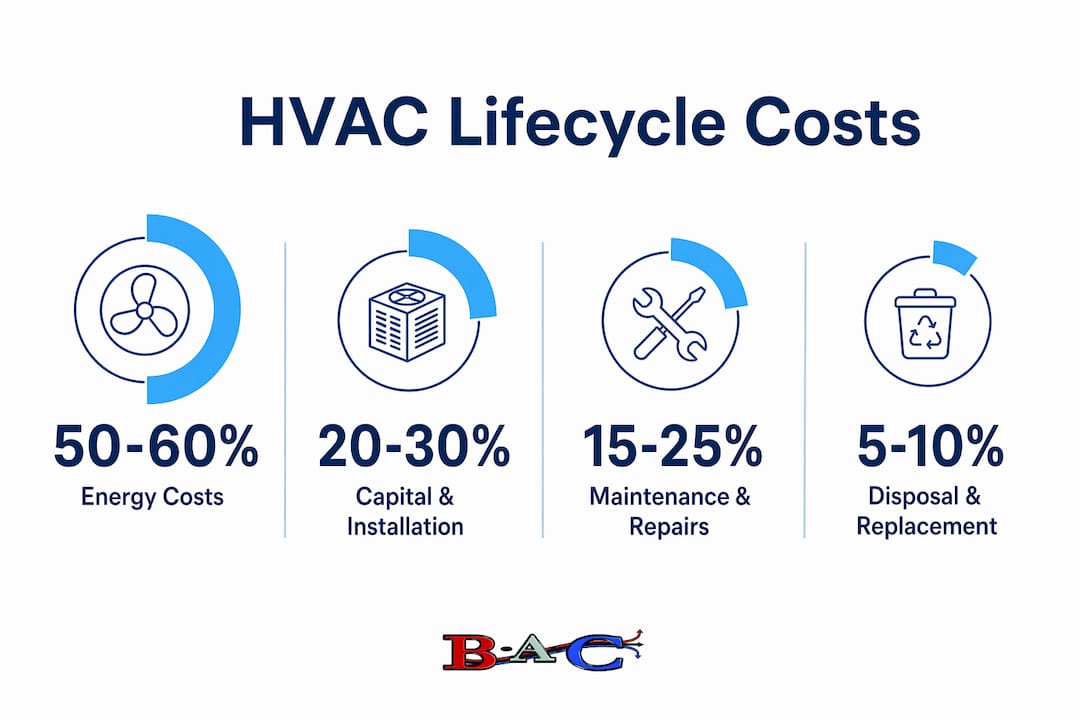
Capital and installation costs are the starting point. These include equipment purchase, delivery, installation labor, commissioning, and any building modifications required to fit the new system. Commissioning is a required line item, not optional. It verifies that the system performs as specified and that predicted efficiency savings are actually achievable.

Energy costs are the largest single expense in any HVAC lifecycle. Energy costs account for 50–60% of total lifecycle cost. For commercial rooftop units, energy spending over the service life runs 3 to 4 times the original purchase price. That ratio means a $50,000 rooftop unit will consume $150,000 to $200,000 in electricity before it is ever replaced. Choosing a system with a higher efficiency rating can cut that figure significantly, which is why HVAC energy efficiency deserves serious weight in any purchasing decision.
Maintenance and repair costs are the most underestimated category. Maintenance and repair costs can total 1 to 2 times the initial purchase price over a system’s service life. These costs must be tracked separately by parts and labor. Combining them into a single line item hides where money is actually going and makes it impossible to spot patterns that signal impending failure.
Replacement and disposal costs cover the eventual equipment swap and responsible disposal of refrigerants and components. These costs are predictable when you know the expected service life and plan reserves accordingly.
Indirect costs include tenant complaints, productivity loss during outages, and emergency service premiums. Most facility managers ignore these entirely, which means their cost models are always understated.
Pro Tip: Track maintenance costs at the asset level, not the building level. Grouping all HVAC repair invoices into one account makes it impossible to identify which unit is draining your budget.
How is HVAC lifecycle cost analysis conducted using industry standards?
The gold standard methodology for LCCA comes from NIST Handbook 135, published by the National Institute of Standards and Technology. The DOE’s Federal Energy Management Program (FEMP) also requires this approach for all federally funded energy projects. Following this framework gives your analysis credibility and protects your decisions from challenge.
A properly conducted LCCA follows these steps:
-
Define the analysis period. Align it with the expected equipment life, typically 15 to 25 years depending on system type and operating conditions. Using a shorter period artificially favors low-cost equipment.
-
Establish baseline data. Pull actual utility bills for at least 12 months, compile the full maintenance history, and document runtime schedules. Flat estimates produce flat results. Real data produces decisions you can defend.
-
Model multiple scenarios. Compare at least two options: repair and refurbish the existing system versus full replacement. A third scenario, such as a phased upgrade, often reveals a middle path that neither extreme shows. Understanding HVAC system management across different building types helps frame realistic scenarios.
-
Apply economic indicators. NIST Handbook 135 requires calculating Net Present Value (NPV), Net Savings (NS), Savings-to-Investment Ratio (SIR), and Simple Payback Period (SPP). The DOE’s BLCC (Building Life Cycle Cost) software calculates all four automatically. BLCC software calculates Net Savings, SIR, and SPP from a single data set, reducing calculation errors.
-
Account for energy price escalation. Energy prices do not stay flat. FEMP publishes annual energy price escalation rates by fuel type and region. Plugging in realistic escalation rates changes the NPV calculation materially.
-
Run sensitivity analysis. Stress-testing projections of energy prices and usage patterns is not optional. Small errors in energy price assumptions can flip a repair decision to a replace decision. Test your model at low, medium, and high escalation rates to understand the range of outcomes.
Pro Tip: Never use a manufacturer’s published efficiency rating as your baseline energy input. Measure actual system performance under your building’s real operating conditions. Published ratings assume ideal conditions that rarely exist in the field.
What pitfalls do property owners face in HVAC cost analysis?
The most common failure in HVAC financial analysis is incomplete data. Tracking invoices only misses 40–60% of true HVAC costs. That gap exists because invoices capture what was billed, not the full cost of labor time, diagnostic work, or the operational disruption that surrounds every repair event.
The specific pitfalls that undermine accuracy include:
- Ignoring indirect costs. A failed chiller in a data center or a broken rooftop unit in a retail store creates revenue loss that dwarfs the repair bill. These costs belong in your model.
- Using generic efficiency assumptions. A 20-year-old system running at 60% of its rated efficiency is not the same as a new unit. Using the nameplate efficiency figure overstates performance and understates energy costs.
- Underestimating cumulative maintenance spend. Facility managers often remember the big repairs and forget the dozens of small service calls that add up quietly over years. Without a maintenance management system capturing costs at the asset level, this spending is invisible.
- Relying on purchase price alone. A lower-bid unit that costs $10,000 less upfront but consumes $30,000 more in energy over ten years is not a bargain. LCCA makes that math visible before you sign the purchase order.
- Failing to separate parts from labor. Separating parts and labor costs improves decision accuracy because it reveals whether a unit is failing mechanically or simply aging out of efficiency. Those two diagnoses lead to different decisions.
- Skipping commissioning validation. Predicted efficiency savings must be verified after installation. Without commissioning, you have no way to confirm that the system is delivering what the model assumed.
Pro Tip: Implement a computerized maintenance management system (CMMS) that records every work order with parts cost, labor hours, and technician time separately. This data becomes the foundation of every future lifecycle analysis.
How does HVAC lifecycle cost analysis support smarter financial decisions?
LCCA converts a complex, multi-decade financial picture into a set of numbers you can act on today. The most direct application is the repair-versus-replace decision, which every facility manager faces repeatedly.
A system with a higher initial cost wins the lifecycle comparison when it reduces energy costs, fails less often, and lasts longer before replacement. Lifecycle thinking focuses on trade-offs between upfront costs, energy efficiency, maintenance profile, and asset lifespan. A unit that costs $15,000 more to purchase but saves $3,000 per year in energy pays back the premium in five years and continues generating savings for another decade.
LCCA also supports capital reserve planning. When your model tells you that a rooftop unit will reach end of useful life in year 8, you can begin setting aside reserves in year 1. That eliminates the budget shock of an emergency replacement and gives you time to evaluate options without pressure. Understanding commercial HVAC service contracts and their long-term cost impact feeds directly into this reserve planning process.
The analysis also protects against premature replacement. Replacing a system that still has useful life remaining wastes capital. LCCA quantifies remaining value and compares it against the cost of continued operation, giving you a defensible threshold for the replacement decision.
For facility managers overseeing multiple properties, LCCA creates a consistent framework for comparing systems across buildings. Without it, decisions default to whoever makes the loudest case in a budget meeting. With it, every decision rests on the same economic logic.
Avoiding common HVAC installation mistakes at the front end also protects the integrity of your lifecycle model. Installation errors inflate early maintenance costs and distort the baseline data that feeds every future analysis.
Key Takeaways
HVAC lifecycle cost analysis is the only method that reveals the true total cost of owning and operating a heating and cooling system, making it the foundation of sound facility financial planning.
| Point | Details |
|---|---|
| Energy dominates lifetime costs | Energy accounts for 50–60% of total lifecycle cost, often 3 to 4 times the purchase price for commercial units. |
| Maintenance costs are underestimated | Repair and maintenance spend can equal 1 to 2 times the initial purchase price over a system’s service life. |
| Invoice tracking misses half the cost | Tracking only invoices omits 40–60% of true HVAC costs; asset-level work order capture is required for accuracy. |
| NIST Handbook 135 sets the standard | Use NIST Handbook 135 and BLCC software to calculate NPV, Net Savings, SIR, and Simple Payback Period. |
| Stress-test every projection | Varying energy escalation rates and usage inputs prevents small assumption errors from flipping major decisions. |
Why most facilities get this wrong until it costs them
From what I have seen working alongside facility managers and property owners over many years, the single biggest mistake is treating HVAC cost analysis as a one-time event rather than an ongoing practice. A lifecycle model built on three-year-old utility data and rough maintenance estimates is not a financial tool. It is a guess dressed up in a spreadsheet.
The facilities that get this right share one habit: they capture cost data continuously, at the asset level, and they revisit their models annually. They also involve their financial planners in the conversation early, not after the equipment has already failed. Cross-functional collaboration between maintenance teams, finance, and HVAC contractors produces far more accurate models than any single department can build alone.
Adopting NIST Handbook 135 as your standard framework is not just about rigor. It is about having a methodology that holds up when a board member or a landlord asks why you spent $80,000 on a new system instead of repairing the old one. The answer needs to be grounded in documented economic analysis, not gut feel.
The most underrated step in the entire process is sensitivity analysis. I have watched facility managers present a single-scenario lifecycle model with complete confidence, only to have the decision collapse when energy prices moved differently than assumed. Running your model at three escalation rates takes an extra hour and saves you from that outcome.
— John
Brightonaircorp’s approach to long-term HVAC financial planning
Property owners and facility managers in New Jersey have a direct resource for putting lifecycle cost thinking into practice.

Brightonaircorp has served residential and commercial clients since 1993, with over 150 years of combined technician expertise across heating, cooling, and ventilation systems. The team supports repair-versus-replace evaluations, maintenance planning, and system performance assessments that feed directly into lifecycle cost models. Whether you manage a single commercial property or a portfolio of facilities, Brightonaircorp provides the technical data and service history documentation that makes accurate HVAC financial analysis possible. Visit Brightonaircorp to request a free estimate or schedule a consultation with a technician who understands the full cost picture of your HVAC system.
FAQ
What is the difference between LCCA and a simple repair estimate?
A repair estimate covers only the immediate cost of a single service event. LCCA calculates every cost over the full system lifespan, including energy, maintenance, and replacement, to support long-term financial decisions.
How long is a typical HVAC lifecycle cost analysis period?
The standard analysis period is 15 to 25 years, aligned with expected equipment service life. NIST Handbook 135 recommends matching the analysis period to the longest-lived system being evaluated.
What percentage of HVAC lifecycle costs come from energy?
Energy costs account for 50–60% of total HVAC lifecycle cost. For commercial rooftop units, energy spending over the service life typically runs 3 to 4 times the original purchase price.
Can property owners conduct HVAC lifecycle cost analysis without specialized software?
A basic analysis can be done with a spreadsheet, but the DOE’s BLCC software automates Net Present Value, Net Savings, SIR, and Simple Payback Period calculations and reduces the risk of manual errors.
Why do most facility managers underestimate HVAC costs?
Most facility managers track only invoices, which misses 40–60% of true HVAC costs. Accurate analysis requires capturing labor, parts, and indirect costs at the individual asset level through a maintenance management system.