
HVAC Financing Options for Homeowners: Compare Plans
HVAC Financing Options for Homeowners: Compare Plans

The main HVAC financing options for homeowners are contractor or manufacturer promotional offers, personal unsecured loans, home equity loans or HELOCs, PACE financing, lease-to-own programs, and utility or state on-bill programs. Your best first move: get a written estimate, then check DSIRE and your utility’s rebate page before you commit to any payment plan.
- Contractor/third-party promotions — often 0% APR for promotional periods lasting about a year to two years; read the fine print on deferred interest
- Personal loans — fast approval, no home equity required, but APR is typically higher
- Home equity loan or HELOC — lowest long-term rates for homeowners with equity; slower to close
- PACE financing — repaid through your property tax bill; availability varies by state and municipality
- Lease-to-own — no credit check versions exist, but total cost is usually the highest of any option
- Utility/state on-bill programs — repaid on your utility bill; limited by territory and funding availability
Brightonaircorp offers free estimates and assists with understanding available financing and rebate documentation before you sign anything.
Table of Contents
- What do HVAC financing options actually cover?
- How do these financing options compare side by side?
- How do lenders and contractors evaluate your application?
- How do you pick the right financing option for your situation?
- What is the 2026 status of federal tax credits and rebates?
- What do real payment scenarios look like?
- Key Takeaways
- What most homeowners get wrong about HVAC financing
- How Brightonaircorp helps you finance your HVAC system
- Authoritative sources to verify rebates and tax guidance
What do HVAC financing options actually cover?
HVAC financing is any payment arrangement that lets you spread the cost of a heating or cooling system purchase, installation, or major repair over time rather than paying the full amount upfront. Homeowners use it because a full system replacement for a 2,000 sq ft home commonly runs $4,800–$15,000, with ductwork and electrical upgrades often adding $2,100–$4,000 more, according to industry cost guides and calculators for 2026. Contractor or dealer financing is arranged directly through your HVAC contractor, often backed by a third-party lender like GreenSky or Synchrony. Approval can be instant, and promotional 0% APR periods are common. Best for homeowners who can pay off the balance before the promo window closes.
Personal unsecured loans come from banks, credit unions, or online lenders. No home equity is required, and funding can arrive in one to three business days. The tradeoff is a higher APR than secured options, especially for borrowers with fair credit.

Home equity loan gives you a lump sum at a fixed rate, secured against your home. A HELOC (home equity line of credit) works like a credit card against your equity, with a variable rate. Both require an appraisal and take longer to close, but they carry the lowest APRs of any option for most homeowners.
Credit cards (including 0% promotional APR) work for smaller repairs or as a bridge while a loan is processed. The risk is the same as contractor deferred-interest offers: miss the payoff deadline and you may owe retroactive interest on the full original balance.
Lease-to-own programs let you use the equipment immediately with no credit check in some cases. You pay a monthly fee and own the system at the end of the term. Total cost is typically the highest of any financing path.
PACE (Property Assessed Clean Energy) financing is repaid through your property tax bill over 5–25 years. It is available in select states and municipalities. Because it attaches to the property, it can complicate a home sale if the balance is not paid off first.
Utility or state on-bill programs let you repay a low-interest loan directly on your monthly utility bill. Availability depends entirely on your utility provider and whether your state has an active program. Getting multiple quotes and itemized pricing before choosing a financing path is worth the extra day or two it takes.
How do these financing options compare side by side?

Not all financing is created equal, and the option with the lowest monthly payment often costs the most over time. Here is how the main categories stack up.
| Financing Type | Typical Term | APR Range (varies by lender and credit profile) | Approval Speed | Common Fees |
|---|---|---|---|---|
| Contractor promo (0% deferred) | promotional period of about one to two years | 0% promotional rate with high deferred APR afterwards | Same day | None upfront; retroactive interest if unpaid |
| Personal loan | loan terms commonly range from a few years up to several years | APR varies widely based on credit and lender | 1–3 business days | Origination fees may apply |
| Home equity loan | typically medium- to long-term loans | APR generally lower than unsecured loans | 2–6 weeks | Closing costs may apply |
| HELOC | variable terms commonly around a decade for draw period and longer for repayment | variable APR dependent on market rates | 2–6 weeks | May include annual fees and closing costs |
| PACE | repayment terms vary from short to long term depending on municipality | interest rates vary by program | 1–2 weeks | Administrative and origination fees possible |
| Lease-to-own | terms vary, often similar to personal loans | effective interest rates often higher than other loans | Same day approval possible | Typically no upfront fees but higher overall cost |
| Credit card (0% promo) | promotional terms usually about one to two years | 0% promo then higher variable APR | Instant approval if existing card holder | No fees if paid before promo ends |
| Utility on-bill | terms vary with program, often mid-term duration | typically low APR | 1–4 weeks | Minimal fees |
Contractor promotional offers and utility on-bill programs tend to rank highest for cost-effectiveness when used correctly, according to financing overviews that compare HVAC payment options. HELOCs and home equity loans are competitive for larger projects when you have the equity and the time to close.
Personal loans hit a sweet spot for homeowners who need fast approval and do not want to tap home equity. The APR is higher, but there is no risk of losing your home if you fall behind.
Lease-to-own and “no credit needed” programs are worth scrutinizing carefully. They solve an immediate emergency, but balloon payments and deferred-interest triggers can make the effective cost far higher than the advertised monthly rate.
Pro Tip: With deferred-interest contractor offers, the 0% rate only holds if you pay the entire balance before the promotional period ends. Miss that deadline by even one day, and many lenders charge retroactive interest on the full original amount, not just the remaining balance. Set a calendar reminder 60 days before the promo expires.
How do lenders and contractors evaluate your application?
Credit score is the first filter for most personal loans and contractor financing. Scores above 680 typically unlock the best promotional terms; scores below 620 may limit you to higher-APR products or lease-to-own options. PACE financing is the main exception: approval is based on property equity and tax payment history, not your credit score.
Income and debt-to-income ratio (DTI) matter most for personal loans and HELOCs. Lenders generally want your total monthly debt payments to stay below 43% of gross monthly income. If you are close to that threshold, a smaller loan amount or a co-borrower can help.
Property eligibility applies to PACE and HELOCs. PACE requires the property to be in a participating municipality. A HELOC requires sufficient equity, typically at least 15–20% after the new loan is factored in, and the lender will order an appraisal.
Documents to have ready before you apply:
- Government-issued photo ID
- Two recent pay stubs or last two years of tax returns (self-employed)
- Most recent mortgage statement (shows current balance and equity)
- Written HVAC estimate with itemized line items (equipment, labor, permits, ductwork)
- Proof of homeowners insurance
Approval timelines vary widely. Contractor promotional financing can be approved in minutes at the point of sale. Personal loans from online lenders typically fund in one to three business days. A HELOC or home equity loan involves an appraisal and underwriting, which usually takes two to six weeks. PACE programs fall in between, often one to two weeks.
How do you pick the right financing option for your situation?
Use this decision sequence before you sign anything.
-
Get a professional estimate first. You cannot compare financing offers without knowing the exact project cost. Ask for an itemized quote that separates equipment, labor, permits, and ductwork. Vague lump-sum quotes hide the extras that most commonly blow up a budget.
-
Check rebates and incentives before you borrow. Utility rebates commonly range from $100–$1,500 depending on equipment and territory, and state programs can be larger for heat pumps. A rebate reduces the amount you need to finance, which cuts total interest paid.
-
Compare low-cost options first. If you have home equity and time, a home equity loan or HELOC will almost always beat a personal loan on total cost. If you can clear a contractor promo balance within the promotional window, that 0% offer is hard to beat. Only move to higher-APR options when the lower-cost ones are unavailable or too slow.
-
Think about how long you plan to stay in the home. PACE financing attaches to the property and must be disclosed to buyers. A HELOC with a 20-year repayment period makes less sense if you plan to sell in three years. Match the loan term to your realistic timeline.
-
Ask these exact questions before you sign:
- What is the APR after the promotional period ends?
- Is this deferred interest or true 0% interest?
- Is there a prepayment penalty?
- Are there balloon payments?
- Does the quote include ductwork, permits, and electrical upgrades?
Red flags to watch for: a contractor who cannot give you written disclosure of the post-promo APR, pressure to sign before you have seen the full written terms, or a quote that lists only a monthly payment with no total cost or term length. A legitimate lender will always give you a written loan agreement before you commit.
The repair vs. replacement decision also affects how much you need to finance. The industry sometimes uses a rule of thumb multiplying system age by repair cost to decide if replacement makes financial sense, with higher values indicating replacement is preferable. A 12-year-old system needing a $500 repair scores 6,000 on that scale — replacement financing starts to look smarter than a repair bill.
What is the 2026 status of federal tax credits and rebates?
The federal Section 25C Energy Efficient Home Improvement Credit and Section 25D Residential Clean Energy Credit do not apply to equipment placed in service after December 31, 2025. Both credits were terminated by the One Big Beautiful Bill Act signed July 4, 2025. If you installed qualifying equipment on or before December 31, 2025, you can still claim it on IRS Form 5695 with your 2025 return. For 2026 installations, there are no federal HVAC tax credits.
Many guides still reference the 25C credit as active; that information is outdated for any system installed in 2026.
What is still available in 2026:
The IRA-funded HOMES and HEAR rebate programs are administered by individual states and survived the legislative change. HOMES rewards whole-home efficiency retrofits with rebates up to $4,000 for standard households and up to $8,000 for low-to-moderate income households. HEAR targets individual appliance upgrades for households earning under 150% of area median income, with up to $8,000 for a heat pump HVAC system for households at or below 80% AMI. These are point-of-sale rebates, not tax credits, so the savings come upfront rather than at filing.
Utility rebates remain available to all income levels and typically range from $200–$2,500 depending on equipment type and efficiency rating. State programs can be larger, particularly for heat pumps.
How to find what applies to you:
- Visit DSIRE and enter your ZIP code to see active state and utility programs
- Check your electric and gas utility’s website directly for current rebate amounts and equipment requirements
- Contact your state energy office to confirm whether HOMES and HEAR are active and funded in your state
Pro Tip: Some rebate programs require pre-approval before work begins, and many operate on a first-come, first-served basis with limited funding. Ask your contractor to help you gather eligibility documentation and submit any pre-approval paperwork before the installation date.
What do real payment scenarios look like?
Typical costs for a full HVAC replacement for a home of about 2,000 sq ft vary widely depending on location and scope; prices commonly fall in the low to mid five-figure range. Using example project costs of approximately mid five figures for full replacement and lower four figures for repairs, here is how typical financing options compare.
Scenario A: $12,000 full replacement
- Personal loan at 12% APR, 5-year term: roughly $267/month, total paid approximately $16,000
- HELOC at 8% APR, 10-year term: roughly $146/month, total paid approximately $17,500 (lower monthly, more total interest over the longer term)
- Contractor promo 0% APR, 18 months: roughly $667/month, total paid $12,000 — only if paid in full before the promo ends
- PACE at 8%, 10-year term: roughly $146/month via property tax bill, total paid approximately $17,500
Scenario B: $3,000 repair or partial replacement
- Personal loan at 15% APR, 3-year term: roughly $104/month, total paid approximately $3,740
- Credit card 0% promo, 15 months: roughly $200/month, total paid $3,000 — only if cleared in time
- Contractor promo 0% APR, 12 months: roughly $250/month, total paid $3,000 — same caveat
| Financing Type | Project Size | Monthly Payment | Total Paid | Best For |
|---|---|---|---|---|
| Personal loan (12% / 5 yr) | $12,000 | ~$267 | ~$16,000 | Fast approval, no equity |
| HELOC (8% / 10 yr) | $12,000 | ~$146 | ~$17,500 | Lowest monthly, has equity |
| Contractor promo 0% / 18 mo | $12,000 | ~$667 | $12,000 | Can pay off in promo window |
| PACE (8% / 10 yr) | $12,000 | ~$146 | ~$17,500 | Property-tax repayment |
| Personal loan (15% / 3 yr) | $3,000 | ~$104 | ~$3,740 | Small repair, fast funding |
| Credit card 0% / 15 mo | $3,000 | ~$200 | $3,000 | Small balance, disciplined payoff |
One thing Brightonaircorp technicians flag regularly: quotes for New Jersey homes often exclude ductwork, permit fees, and electrical upgrades. In high-cost markets, those extras can add meaningfully to the financed amount. Always ask for a line-item breakdown before you calculate your monthly payment, and factor in the HVAC lifecycle cost when deciding between repair and full replacement.
Key Takeaways
The lowest monthly payment and the lowest total cost are rarely the same financing option — matching the right plan to your timeline and credit profile is what actually saves money.
| Point | Details |
|---|---|
| Federal credits expired | No Section 25C or 25D credit applies to HVAC equipment installed in 2026. |
| Check rebates first | Utility rebates of $200–$2,500 and IRA-funded HOMES/HEAR programs can reduce the amount you need to borrow. |
| Total cost beats monthly payment | A 0% promo clears at $12,000 total; a 10-year HELOC on the same amount can reach $17,500. |
| Ask the right questions | Confirm APR after promos, deferred-interest terms, prepayment penalties, and what the quote actually includes. |
| Brightonaircorp can help | Brightonaircorp provides free estimates, helps document rebate eligibility, and connects homeowners with financing options in New Jersey. |
What most homeowners get wrong about HVAC financing
The most common mistake I see on service calls is not the financing choice itself — it is the order of operations. Homeowners sign a financing agreement the same day they get one quote, before they have checked whether a utility rebate would cut the financed amount, and before they have asked whether ductwork and permits are included. By the time the invoice arrives with those extras, the loan is already locked.
The second mistake is treating a promotional 0% offer as free money without a plan to pay it off. I have seen homeowners reach month 18 of an 18-month promo with $4,000 still on the balance. The retroactive interest that hits at that point can equal several months of payments they thought they had avoided.
A third issue: homeowners who finance only the equipment cost and pay for permits and ductwork out of pocket on a credit card, then carry that balance at 24% APR. If you are going to finance, include everything in the financed amount from the start. Ask your contractor to itemize every line item — equipment, labor, ductwork, permits, electrical — and roll it into a single loan at the best rate you can get. That one conversation can save hundreds of dollars in interest.
How Brightonaircorp helps you finance your HVAC system
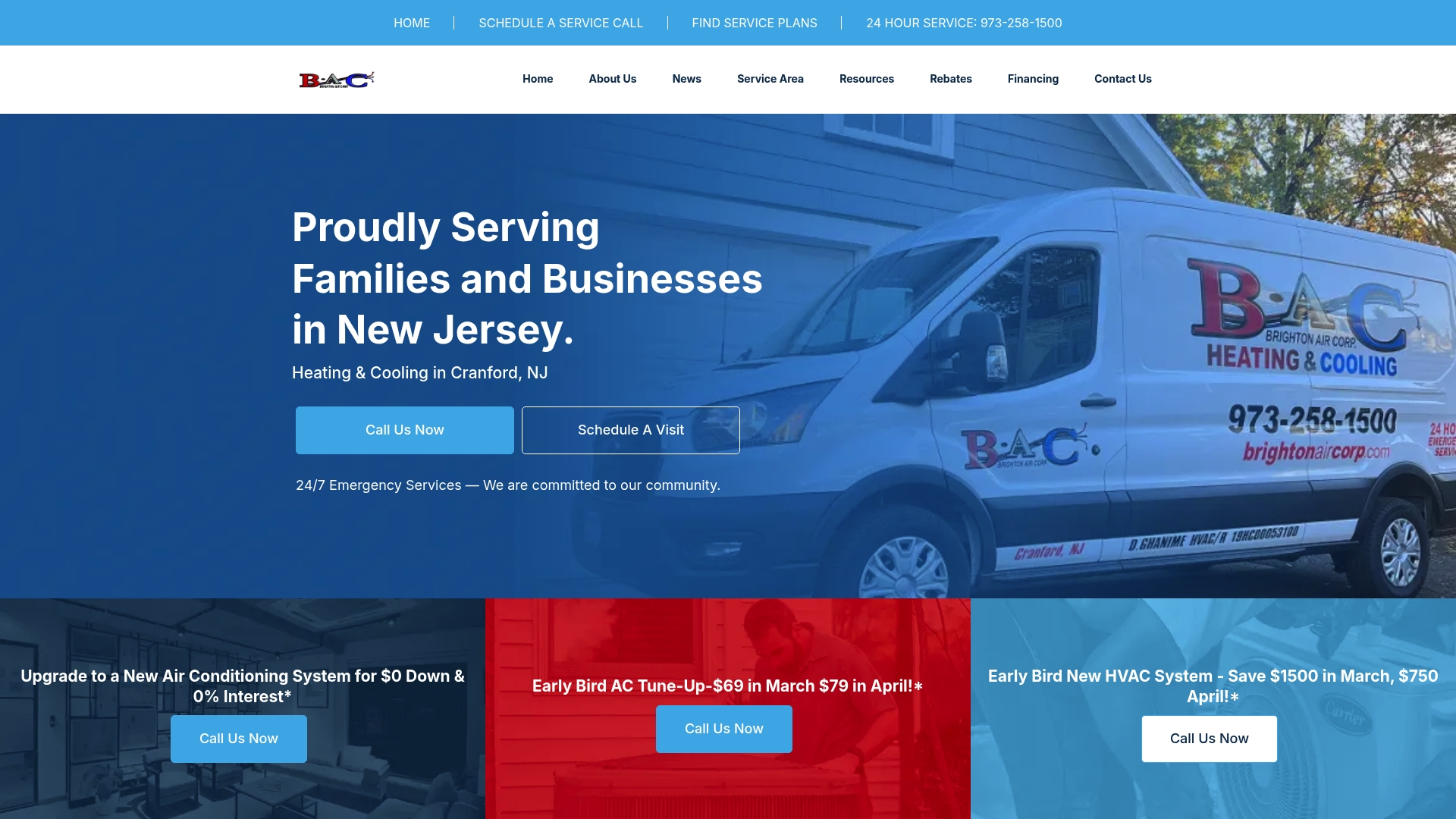
Replacing or repairing an HVAC system is one of the larger unplanned expenses a homeowner faces, and the financing decision matters as much as the equipment choice. Brightonaircorp has been serving New Jersey families and businesses since 1993, with over 150 years of combined technician expertise across installations, emergency repairs, furnace and AC replacements, and full system maintenance.
Beyond the technical work, Brightonaircorp helps homeowners navigate the financing side:
- Free written estimates with itemized line items so you know exactly what you are financing
- Rebate documentation support — technicians help identify utility and state programs and gather the paperwork required for pre-approval
- Contractor financing options and referrals to trusted lenders, so you can compare offers before committing
- 24/7 emergency service for situations where a fast-approval financing path is needed
Ready to get a clear number and explore your options? Contact Brightonaircorp for a free estimate and ask specifically about current financing terms and any rebates available in your area.
Authoritative sources to verify rebates and tax guidance
Before you finalize any financing decision, confirm current program status directly with primary sources. Programs change, funding runs out, and pre-approval requirements vary.
- IRS FAQ on Sections 25C/25D modification — official confirmation that federal HVAC credits expired for 2026 installations
- DSIRE (Database of State Incentives for Renewables and Efficiency) — search by ZIP code for active state, utility, and local programs
- IRS Energy Efficient Home Improvement Credit page — full rules for 2025 and prior-year claims, including Form 5695 instructions
- DOE Product Lookup Tool — verify whether specific equipment models meet CEE efficiency tiers required for rebate eligibility
- Your state energy office — search “[your state] energy office HVAC rebates 2026” or use the DOE’s state energy office directory to find HOMES and HEAR program status in your state
- Your electric and gas utility — call or check the website directly; utility rebates are independent of federal programs and often have their own application deadlines and pre-approval steps
One practical note: document everything before work begins. Some programs require pre-approval, and a few have been fully reserved within weeks of opening. Confirming eligibility and submitting paperwork before your installation date is the only way to guarantee you do not miss a rebate you qualify for.