
How to Select an HVAC Subcontractor for Projects
How to Select an HVAC Subcontractor for Projects

Selecting the right HVAC subcontractor for projects is defined by three non-negotiable factors: verified credentials, project-matched capacity, and documented scope alignment. In New Jersey, that means confirming a Master HVACR Contractor license under N.J.S.A. 45:16A, checking minimum general liability insurance of $500,000, and holding a $3,000 surety bond before any contract is signed. General contractors who skip these steps expose themselves to liability, permit failures, and costly work stoppages. The structured evaluation process covered here applies to both residential builds and commercial jobs across New Jersey.
What licenses, insurance, and bonding must New Jersey HVAC subcontractors have?
New Jersey HVAC requirements mandate that every HVAC subcontractor hold a Master HVACR Contractor license, carry $500,000 in general liability insurance, and maintain a $3,000 surety bond. Failure to verify all three can trigger project shutdowns and shift liability directly to the general contractor. These are not optional minimums. They are the legal floor for any HVAC work performed in the state.
The NJ Division of Consumer Affairs maintains a public board-certified list of active Master HVACR licenses. Check that list directly, not just a business registration or a certificate the subcontractor hands you. A general business registration does not confirm active HVACR licensure. These are separate records, and confusing them is one of the most common vetting mistakes general contractors make.
Beyond the license itself, verify that the insurance certificate names your company as an additional insured. A certificate that does not include that designation offers you no real protection if a claim arises on your job site. Request updated certificates at the start of every new project, not just at initial onboarding.
Key credential requirements at a glance:
- Master HVACR Contractor license (active, verified through NJ Division of Consumer Affairs)
- $500,000 general liability insurance minimum, with your company listed as additional insured
- $3,000 surety bond, current and confirmed
- Workers’ compensation coverage for all field technicians
- Proof of any specialty certifications required by the project scope
Pro Tip: Set automated calendar alerts at 30, 60, and 90 days before each subcontractor’s license, insurance, and bond renewal dates. This prevents last-minute lapses that can halt work mid-project.
How to implement a tiered prequalification system based on project scale
A tiered prequalification system matches your vetting depth to the actual risk level of each project. Not every job requires the same level of scrutiny, but every job requires some. The goal is consistent quality without creating unnecessary friction for smaller scopes.
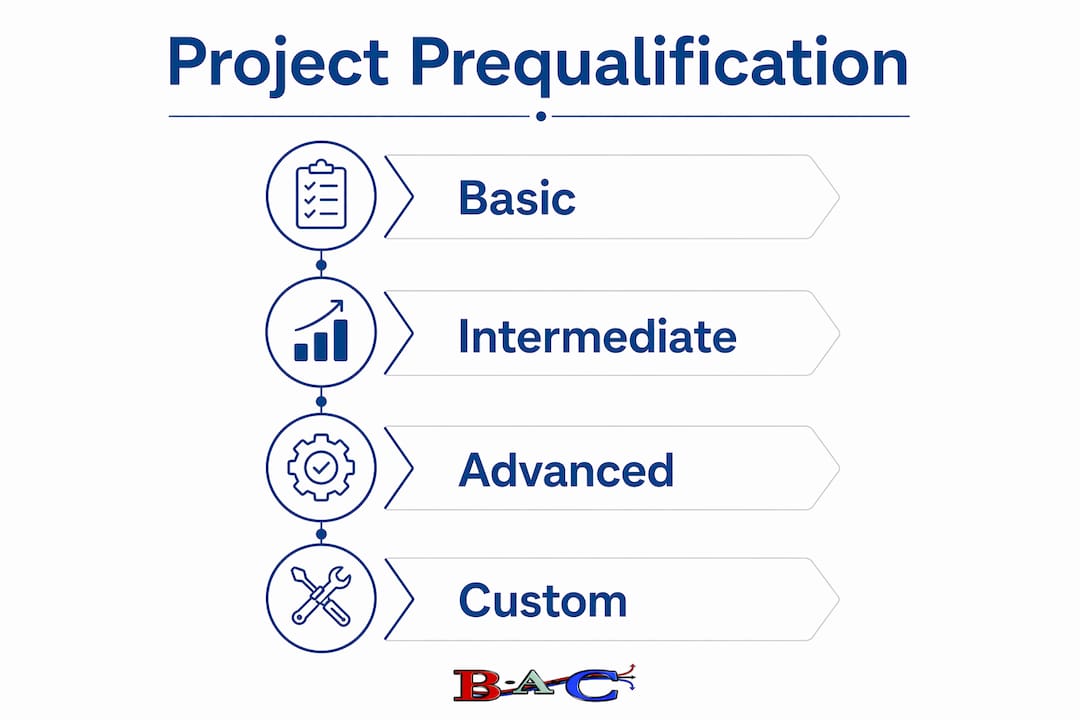
A tiered prequalification approach structures evaluation into three levels based on contract value:
-
Projects under $100K: Verify the Master HVACR license, confirm insurance and bond minimums, and check that the subcontractor has completed at least two comparable jobs in the past 24 months. This tier is straightforward but non-negotiable.
-
Projects from $100K to $500K: Add a review of the subcontractor’s business track record, including years in operation and financial stability. Require an Experience Modification Rate (EMR) at or below 1.0. An EMR above 1.0 signals a worse-than-average safety record, which translates directly to higher on-site risk for your project.
-
Projects over $500K: Require bonding capacity equal to the full contract value. Confirm that the subcontractor can assign a dedicated project manager to your job. Review their current workload to assess whether they have the bandwidth to deliver without overextension.
| Project tier | Contract value | Key requirements |
|---|---|---|
| Basic | Under $100K | License, insurance, bond, 2 recent references |
| Intermediate | $100K–$500K | Above plus EMR ≤ 1.0, business track record |
| Advanced | Over $500K | Above plus bonding at contract value, dedicated PM |
Pro Tip: Build a one-page prequalification questionnaire for each tier. Send it before you invite a subcontractor to bid. Subcontractors who refuse to complete it are telling you something important about how they will handle documentation on your project.
Evaluating the EMR as a safety proxy is one of the most underused tools in HVAC subcontractor selection. Most general contractors focus on price and license status. The EMR tells you whether a subcontractor’s crew actually works safely, which affects your insurance rates and OSHA exposure on every job they touch.
What are the best practices for bidding and scope alignment with HVAC subcontractors?
Most HVAC change orders come from undefined scope or unstated baseline equipment assumptions. Requiring line-item bids that include specific equipment models, efficiency ratings, and explicit exclusions prevents the most common sources of cost overruns. The lowest bid is rarely the most cost-effective option once delays and operating expenses are factored in.
What to require in every HVAC bid:
- Line-item breakdown separating equipment costs, labor, and materials
- Specific equipment models and SEER or AFUE efficiency ratings
- A written list of exclusions (what is NOT included in the bid)
- Stated assumptions about existing infrastructure, such as ductwork condition or electrical capacity
- Payment schedule tied to verified milestones, not calendar dates
Subcontractors often submit artificially low bids by excluding costs like scaffolding, crane access, or material supply. When those costs surface mid-project, they shift to the general contractor as change orders. Requiring a detailed exclusions list at bid submission closes that gap before the contract is signed.
Comparing bids across multiple subcontractors requires a common baseline. If one bid assumes new ductwork and another assumes reuse of existing ductwork, you are not comparing equivalent scopes. Standardize your bid request document so every subcontractor prices the same scope. This single step reduces bid spread and makes apples-to-apples comparison possible.

Commercial HVAC projects require different licensing and permit authority than residential jobs. A subcontractor with strong residential experience may not hold the commercial endorsements your project requires. Confirm the scope match before inviting them to bid, not after you receive their proposal.
How to evaluate recent performance, capacity, and compliance beyond credentials
Credentials confirm that a subcontractor is legally allowed to work. Performance data tells you whether they actually deliver. Structured, data-driven evaluation focused on recent project delivery outperforms relying on reputation or past familiarity. Ask for references from projects completed in the last 18 months, not a general portfolio.
Performance and compliance checks to run before awarding a contract:
- Contact at least two references from comparable recent projects and ask specifically about schedule adherence and punch-list completion
- Search for active liens or litigation involving the subcontractor through NJ court records
- Review OSHA inspection logs for any citations in the past three years
- Confirm current workload to assess whether they have capacity for your project timeline
- Verify that field technicians hold EPA Section 608 certification for refrigerant handling
Strict EPA refrigerant rules increase the importance of certified technicians and accurate refrigerant logging. If a subcontractor’s technician mishandles low-GWP refrigerants and lacks proper certification, fines can shift to the general contractor. This is not a theoretical risk. It is an active enforcement area.
Experienced contractors check active litigation, liens, and OSHA logs and set automated document expiry alerts to prevent work stoppages. A centralized digital hub for compliance documentation improves audit readiness and keeps every subcontractor’s records current. The industry is moving toward structured assessment tools that automate these tracking functions, reducing the manual burden on project managers.
Pro Tip: Ask subcontractors directly how many active projects they are running. A crew stretched across five simultaneous jobs will not give your project the attention it needs. Capacity is as important as capability.
What are common mistakes when vetting HVAC subcontractors?
The most expensive mistake general contractors make is selecting a subcontractor based on price alone or on a long-standing relationship without checking current capability. A subcontractor who performed well three years ago may have lost key technicians, taken on too much work, or let certifications lapse.
- Choosing the lowest bid without reviewing exclusions and assumptions
- Using residential-only subcontractors on commercial jobs with different code requirements
- Skipping scope documentation and relying on verbal agreements
- Failing to check for recent liens, litigation, or OSHA violations
- Not confirming that insurance certificates name your company as additional insured
When a subcontractor falls out of compliance mid-project, act immediately. Request updated documentation within 24 hours. If they cannot produce it, issue a stop-work notice until compliance is restored. Waiting creates legal exposure and signals to the subcontractor that your documentation standards are flexible.
“The biggest risk in HVAC subcontractor selection is not the subcontractor you reject. It is the one you accept without checking whether their current capacity and credentials match your current project.”
Early communication prevents most execution problems. Hold a pre-construction meeting with every HVAC subcontractor before work begins. Confirm scope, schedule, access requirements, and inspection milestones in writing. Problems identified before the first day of work cost a fraction of what they cost after walls are closed.
Key Takeaways
Selecting a qualified HVAC subcontractor for projects in New Jersey requires verified credentials, tiered prequalification matched to project scale, and detailed bid analysis that goes beyond price.
| Point | Details |
|---|---|
| Verify all three credentials | Confirm Master HVACR license, $500,000 liability insurance, and $3,000 surety bond before any contract. |
| Use a tiered prequalification system | Match vetting depth to project value, adding EMR checks and bonding capacity for larger jobs. |
| Require line-item bids with exclusions | Standardized bid documents prevent scope gaps and reduce change orders. |
| Check performance, not just credentials | Review recent references, OSHA logs, liens, and current workload before awarding a contract. |
| Automate compliance tracking | Set document expiry alerts at 30, 60, and 90 days to prevent mid-project lapses. |
What I have learned about HVAC subcontractor selection after years in New Jersey projects
The shift from relationship-based hiring to structured evaluation is the single biggest change I have seen in how general contractors approach HVAC subcontractor selection. Ten years ago, you called someone you knew and trusted their word. That still matters, but it is no longer enough. Supply chain disruptions and labor shortages have changed the reliability of even long-standing partners. A subcontractor who was fully staffed and compliant last year may be operating at reduced capacity today.
Early involvement during preconstruction is the practice I recommend most strongly. When you bring an HVAC subcontractor into the conversation before bidding closes, you get better pricing, clearer scope, and fewer surprises during execution. The subcontractors who engage seriously at that stage are almost always the ones who deliver on time. The ones who only show up at bid submission rarely have the depth of understanding the project needs.
Compliance to new EPA refrigerant regulations and NJ-specific licensing requirements is not a back-office concern. It is a project risk that sits directly on the general contractor’s desk. The contractors I have seen avoid the most costly problems are the ones who treat documentation as a core project management function, not an afterthought.
— John
Brightonaircorp: a verified HVAC partner for New Jersey contractors
General contractors who need a reliable, fully credentialed HVAC subcontractor for New Jersey projects have a direct option in Brightonaircorp.

Brightonaircorp has served residential and commercial clients across New Jersey since 1993, with over 150 years of combined technician expertise. The company holds active licensing, maintains full insurance compliance, and brings documented experience across office spaces, retail environments, and industrial facilities. For contractors managing complex scopes, Brightonaircorp offers warehouse HVAC management expertise that translates directly to large-scale project execution. Visit Brightonaircorp to request a consultation or free estimate for your next project.
FAQ
What license does an HVAC subcontractor need in New Jersey?
New Jersey requires a Master HVACR Contractor license for all HVAC subcontractors. Verify active status directly through the NJ Division of Consumer Affairs board-certified list.
What insurance minimum should an HVAC subcontractor carry?
New Jersey HVAC subcontractors must carry at least $500,000 in general liability insurance. Always confirm your company is listed as an additional insured on the certificate.
What is an EMR and why does it matter for subcontractor selection?
An Experience Modification Rate (EMR) measures a subcontractor’s safety record relative to industry averages. An EMR at or below 1.0 is the standard threshold for intermediate and large-scale project prequalification.
Can a residential HVAC subcontractor work on commercial projects?
Residential and commercial HVAC projects require different licensing and permit authority in New Jersey. Using a residential-only subcontractor on a commercial job risks inspector rejections and project delays.
How do I prevent HVAC change orders from inflating project costs?
Require line-item bids that include specific equipment models, efficiency ratings, and a written list of exclusions. Standardizing your bid request document across all subcontractors makes scope comparison accurate and reduces disputes.