
How after-hours HVAC pricing works and what to expect
How after-hours HVAC pricing works and what to expect
Most homeowners assume an after-hours HVAC call is simply double the normal hourly rate. That assumption leads to real sticker shock when the invoice arrives. The truth is that after-hours premiums can be structured as separate add-ons rather than a single hourly rate, meaning your final bill is actually built from several layers of fees, multipliers, and charges that each follow their own logic. Understanding how those layers work before you ever pick up the phone gives you a serious advantage when your furnace quits at midnight in January.
Table of Contents
- The basics of after-hours HVAC pricing
- Common pricing models: Which system will you encounter?
- How to read an after-hours HVAC invoice
- How to save on after-hours HVAC costs
- What most homeowners miss about after-hours HVAC pricing
- Looking for expert after-hours HVAC service in New Jersey?
- Frequently asked questions
Key Takeaways
| Point | Details |
|---|---|
| Layered fee structure | After-hours HVAC pricing often includes diagnostic, trip, and labor premiums—not just your hourly rate. |
| Two main pricing models | Providers either use a flat after-hours fee or an emergency pricebook with higher rates. |
| Importance of invoices | A line-item invoice helps you see and question each separate after-hours charge. |
| Cost-saving tips | Ask about discounts, wait for business hours if possible, and request written pricing first. |
| Transparency saves money | Demanding clarity prevents surprise charges and empowers better decision-making in emergencies. |
The basics of after-hours HVAC pricing
Most people picture HVAC pricing as a simple equation: hours worked multiplied by an hourly rate. After-hours service breaks that model immediately. Instead, companies typically build the bill from three distinct components, and each one carries its own after-hours adjustment.
The first component is the service call or diagnostic fee. This covers dispatch, travel time, and the initial inspection of your system. During normal business hours, this fee might run $70 to $150. After hours, that same fee commonly rises to $150 to $300 because the company is pulling a technician away from personal time and covering higher operational costs.
The second component is the labor charge for the actual repair work. This is where the emergency multiplier enters the picture. A common industry approach is to charge a service call fee for dispatch and inspection, then apply higher emergency labor pricing, often 1.5x to 2x the standard rate, or add a separate after-hours trip charge on top of normal labor. Both approaches are legitimate, but they produce very different totals depending on how long the repair takes.
The third component is parts. Parts pricing is usually fixed regardless of the time of day, though some companies do add a handling or after-hours parts sourcing fee if they need to pull from emergency stock.
Here is a quick summary of what drives after-hours costs:
- Diagnostic or service call fee, elevated for nights, weekends, and holidays
- Emergency labor multiplier (typically 1.5x to 2x standard labor rates)
- Separate after-hours trip charge, used by some companies instead of a multiplier
- Parts and materials, usually at standard cost
- Potential after-hours parts sourcing or handling fee
“The most important thing to understand is that after-hours pricing is rarely one number. It is a structure, and knowing each piece of that structure is how you stay in control of the conversation.”
That structure is exactly what separates a homeowner who feels confident about their bill from one who feels taken advantage of.
Common pricing models: Which system will you encounter?
Now that the individual components make sense, the next question is how different companies actually combine them. There are two dominant models in the industry, and knowing which one your provider uses changes how you read every number they quote you.
Model 1: Standard pricebook plus a flat after-hours trip fee
In this model, the company keeps its regular labor and parts pricing intact. The only change is a one-time after-hours trip fee added to the invoice. That fee might be $75 on a weeknight, $100 on a weekend, and $150 or more on a holiday. ReviewBook identifies this model as one of the two primary approaches used by HVAC companies for emergency and after-hours calls.
The advantage here is predictability. You know exactly what the premium is before the technician arrives. The disadvantage is that for long repairs, this model can actually be cheaper than Model 2 because the labor rate itself never changes.
Model 2: Premium pricebook with 1.5x to 2x pricing
Here, the company switches to an entirely separate price list after hours. Every line item, labor, diagnostics, and sometimes parts, gets multiplied by 1.5 or 2. There is no separate trip fee because the premium is already baked into every charge. This premium pricebook approach means a two-hour repair that costs $400 during the day could run $600 to $800 after hours.
The advantage for customers is that short, simple repairs may cost less than they would under Model 1 with a large trip fee. The disadvantage is that complex repairs become expensive fast, and the total can be harder to predict upfront.
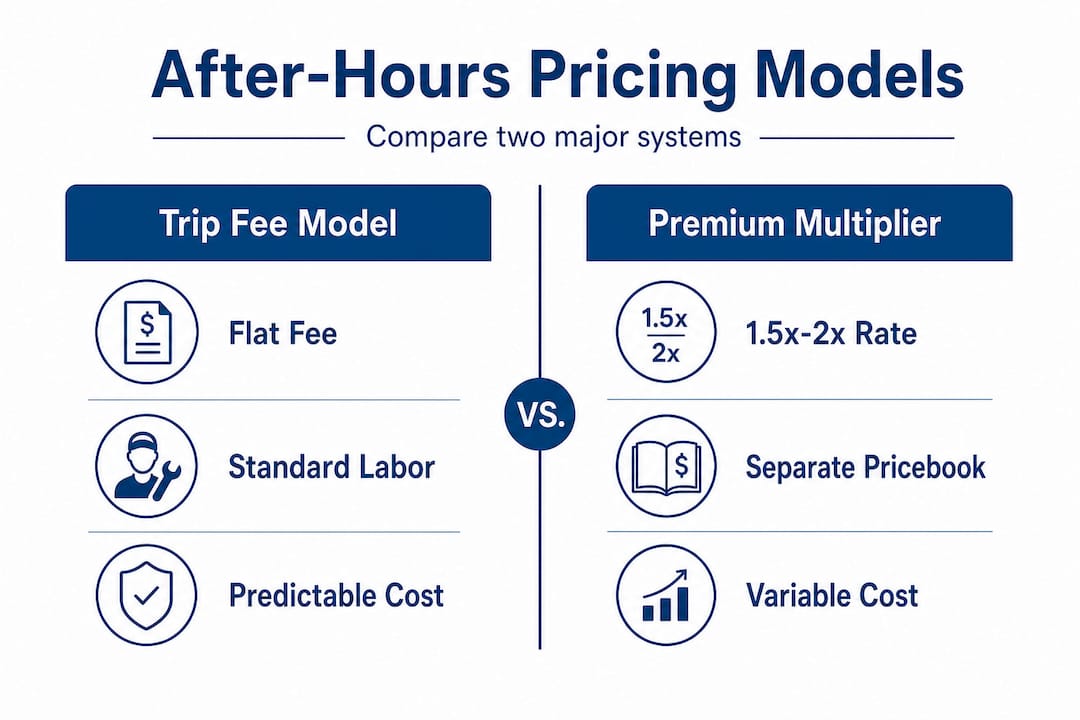
| Feature | Model 1: Flat trip fee | Model 2: Premium pricebook |
|---|---|---|
| Labor rate | Standard | 1.5x to 2x standard |
| After-hours fee | Separate flat charge | Built into all line items |
| Predictability | High | Moderate |
| Best for short repairs | Depends on trip fee size | Often yes |
| Best for long repairs | Often yes | No |
| Risk of double-charging | Higher | Lower |
Steps to identify which model your provider uses:
- Ask directly: “Do you charge a separate after-hours fee, or do you use a premium rate for all labor?”
- Request the specific dollar amount or multiplier before booking.
- Confirm whether the diagnostic fee is also adjusted after hours.
- Ask if parts pricing changes after hours.
“Always ask which model applies before you agree to service. A provider who cannot answer that question clearly is a provider worth questioning.”
How to read an after-hours HVAC invoice
Once you understand the model in use, it becomes much easier to read and validate the invoice you receive. After-hours bills can look confusing because they often contain more line items than a standard daytime invoice. That is actually a good sign. More line items mean more transparency.
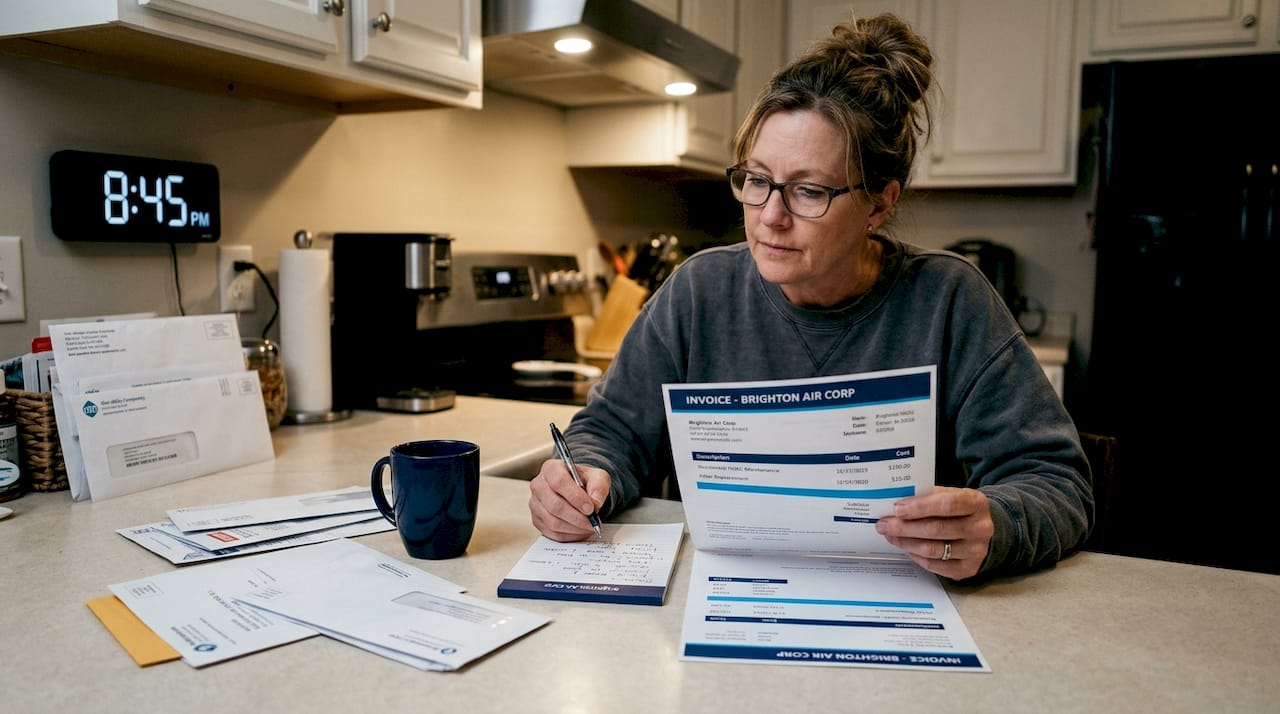
Here is what a well-structured after-hours HVAC invoice should look like:
| Line item | Description | Amount |
|---|---|---|
| Service call / diagnostic fee | Dispatch, travel, system inspection | $175.00 |
| After-hours trip charge | Weekend emergency surcharge | $95.00 |
| Labor (1.5 hrs at standard rate) | Repair labor, standard pricing | $180.00 |
| Parts: capacitor replacement | OEM capacitor, model-specific | $85.00 |
| Total | $535.00 |
Notice that this invoice uses Model 1: the standard labor rate stays the same, and the after-hours premium appears as a separate trip charge. If this company used Model 2 instead, the labor line would read $270 (1.5x of $180) and there would be no trip charge line at all.
The most important thing to check for is double-charging. This happens when a company applies both an after-hours trip fee AND a labor multiplier. That combination means you are paying the premium twice. It is not always intentional, but it does happen, and requesting a written line-item breakdown of every charge, including the diagnostic fee, the after-hours or emergency trip charge, the labor multiplier, and parts, is the only reliable way to catch it.
Here is how to review an invoice step by step:
- Identify the diagnostic or service call fee and confirm it matches the quoted amount.
- Locate any after-hours or emergency trip charge and note its exact dollar value.
- Check the labor line. Is it at standard rate or a multiplied rate?
- If both a trip charge and a multiplied labor rate appear, ask the company to explain why both are present.
- Verify parts pricing against any written estimate you received before work began.
- Add everything up yourself. Errors in totaling do occur.
Pro Tip: Before the technician starts any work, ask for a written estimate that lists every expected charge by line item. A reputable company will provide this without hesitation. If a company refuses or says they cannot estimate until after the work is done, that is a red flag worth taking seriously.
How to save on after-hours HVAC costs
Knowing how pricing works empowers you, but how can you keep costs low? Here is what savvy homeowners and property managers actually do when they face an after-hours HVAC situation.
Ask about overtime or multipliers before booking. This single step takes less than two minutes and can save you hundreds of dollars in surprise charges. When you call, simply say: “Can you tell me your after-hours fee structure? Do you charge a trip fee, a labor multiplier, or both?” A clear answer tells you what to expect. A vague answer tells you to keep asking.
Assess whether the issue can wait until morning. Not every HVAC problem is a true emergency. A system running slightly less efficiently on a mild night is very different from a complete heating failure during a cold snap with elderly family members in the house. Many HVAC companies will help you make this call over the phone at no charge. Describe the symptoms, and ask honestly whether waiting until normal business hours is safe and reasonable. That conversation could save you $150 to $300 in after-hours fees.
Compare diagnostic fees across providers. After-hours diagnostic fees vary significantly from company to company. Some charge $150, others charge $300, and the difference has nothing to do with the quality of the technician. Spending five minutes comparing minimum service call fees before you are in an emergency puts you in a much stronger position.
- Call two or three local providers and ask for their after-hours diagnostic fee.
- Ask whether that fee applies toward the repair cost if you proceed.
- Ask whether their technicians are available right now or if there is a wait time.
Look into maintenance plans. This is one of the most overlooked cost-saving strategies for homeowners and property managers alike. Many HVAC service plans specifically reduce or eliminate after-hours premiums for plan members. The most important cost-control step is still requesting a written line-item breakdown, but having a maintenance plan can dramatically reduce what those line items add up to.
Pro Tip: Some maintenance plans include priority scheduling for emergencies, which means your call goes to the front of the queue. In a situation where multiple households in your area have lost heat during a cold night, priority scheduling can be worth as much as the fee reduction itself.
What most homeowners miss about after-hours HVAC pricing
Here is something we have learned from decades of service in New Jersey: most homeowners focus on the wrong number. They ask “what is your hourly rate?” and treat the answer as the full story. It is not even close to the full story.
The hourly rate is just one variable in a pricing structure that includes dispatch fees, emergency multipliers, trip charges, and parts handling. A company with a lower hourly rate can easily produce a higher final bill than a company with a higher rate, simply because of how those other components are structured. Focusing only on the rate misses the entire picture.
What actually protects you is demanding granularity. Not a single number, but a breakdown. When you ask for a line-item estimate before work begins, you are not being difficult. You are being a responsible homeowner or property manager. Companies that operate with genuine transparency welcome that request because they have nothing to hide.
There is also a deeper issue here. When you compare providers based only on bottom-line cost, you lose the ability to understand why one bill is higher than another. Was it the trip fee? The labor multiplier? The parts sourcing? Without line items, you cannot know, and that means you cannot make a smarter choice next time. Homeowners who demand granular pricing are far less likely to feel surprised or taken advantage of, not because they always get the lowest price, but because they understand exactly what they paid for and why.
The real agency in this situation comes from comparing the structure of service calls across providers, not just the quoted total. Ask about the diagnostic fee. Ask about the multiplier. Ask about the trip charge policy. Those three questions will tell you more about a company’s pricing philosophy than any single number ever could.
Looking for expert after-hours HVAC service in New Jersey?
When your heating or cooling system fails outside of business hours, the last thing you want is to decode a confusing bill on top of an already stressful situation. Brighton Air Corp has been serving New Jersey homeowners and property managers since 1993, and we built our reputation on doing things the straightforward way, including clear, line-item pricing on every call, emergency or otherwise.
Whether you need urgent repair service tonight or want to set up a maintenance plan that reduces your after-hours exposure going forward, our team is ready to help. We offer 24/7 emergency HVAC service across New Jersey with technicians who explain every charge before work begins. No surprises. No double-charging. Just reliable service from a team with over 150 years of combined technician experience. Reach out today for a free estimate or to learn more about our service plans.
Frequently asked questions
How much does an after-hours HVAC service call usually cost in New Jersey?
Typical after-hours diagnostic fees range from $150 to $300, plus higher labor rates or emergency fees on top of that. Your total will depend on which pricing model the company uses and how long the repair takes.
Are after-hours HVAC costs just double the normal price?
Not always. Some companies use a 1.5x to 2x multiplier on all labor, while others add a flat after-hours trip charge to standard pricing instead. The structure varies by provider.
What’s the best way to avoid surprise charges with emergency HVAC calls?
Ask for a written line-item breakdown before any work begins so you can see every after-hours fee, multiplier, and parts charge listed separately before you commit.
Can I reduce after-hours charges with a service contract?
Many service contracts or maintenance plans lower or completely waive emergency fees for members. Check with your provider to see what their plan covers and whether priority scheduling is included.