
Heat Pump Tax Credit 2026: What Changed and What's Next
Heat Pump Tax Credit 2026: What Changed and What’s Next
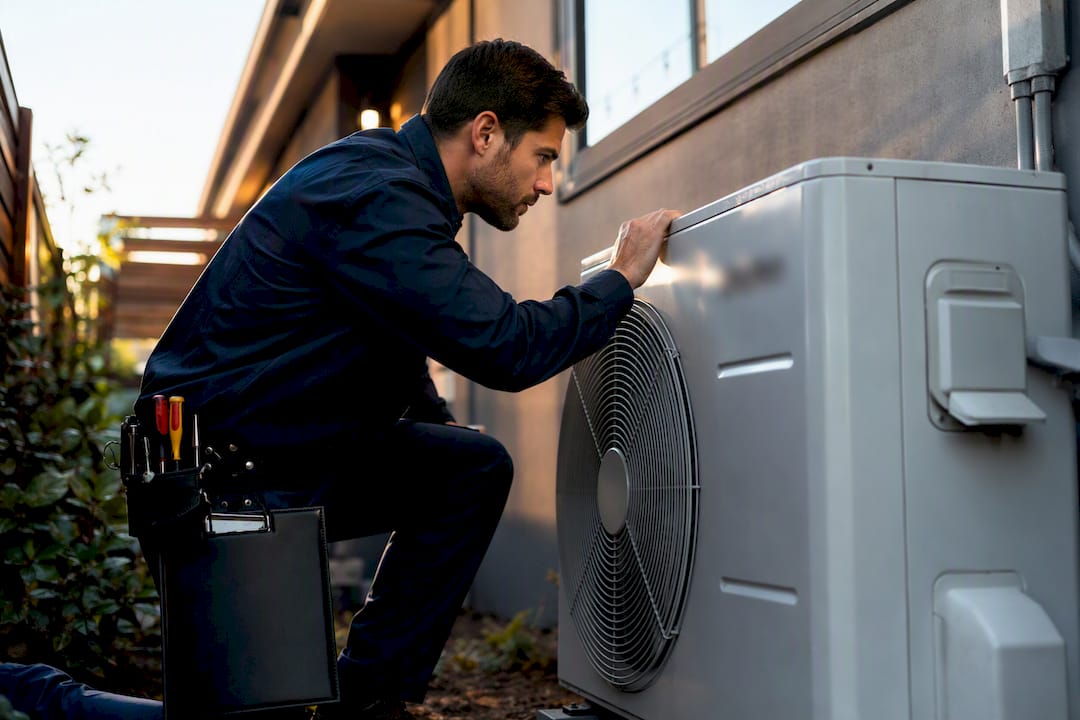
Short answer: no. The federal Section 25C heat pump tax credit does not apply to equipment placed in service in 2026. Congress ended it early through the One Big Beautiful Bill Act, and the cutoff is December 31, 2025. If your heat pump was placed in service on or before that date, you can still claim it on your 2025 tax return. If your install happens in 2026, that specific credit is off the table.
That doesn’t mean 2026 buyers are out of options. Several programs remain active:
- HEAR/HEEHRA rebates for income-qualified households, rolling out state by state
- HOMES rebates, based on measured energy savings rather than income
- State and utility rebates, which vary widely by location and program
- Geothermal (ground-source) credit under Section 25D, which follows a different, longer timeline than air-source heat pumps
Pro Tip: Don’t assume your 2025 contract date locks you into the 2025 credit. The IRS cares about when the system was actually placed in service, not when you signed paperwork or paid a deposit.
Key Takeaways
The federal 25C heat pump credit ended for installs placed in service after December 31, 2025, making documentation and state-level rebates the priority for anyone buying in 2026.
| Point | Details |
|---|---|
| 25C is closed for 2026 | Only installs placed in service by December 31, 2025 qualify for the 30%, up to $2,000 credit. |
| “Placed in service” is the legal test | Commissioning date matters more than purchase date, contract date, or deposit date. |
| Amended returns are still possible | Homeowners who missed claiming a qualifying 2025 install can file Form 1040-X within the standard window. |
| State and utility rebates remain active | HEAR, HOMES, and local utility programs vary by state and should be checked directly. |
| Documentation protects your claim | Commissioning reports, itemized invoices, and QMIDs are the proof points that back up any credit or rebate request. |
Table of Contents
- What Changed: OBBBA and the Effective “Placed in Service” Cutoff
- What 25C Required: Eligibility, Amounts, and Form 5695
- How to Verify Your Install and Claim the Credit for 2025 Installations
- Alternatives for 2026 Installs: HEAR, HOMES, and State Rebates
- Planning Your 2026 Purchase: Scheduling, Financing, and Paperwork
- How a Qualified HVAC Contractor Helps You Meet Deadlines
- The Real Lesson Homeowners Should Take From 25C’s Expiration
- Sources
What Changed: OBBBA and the Effective “Placed in Service” Cutoff
The One Big Beautiful Bill Act, signed into law on July 4, 2025, rewrote the timeline for dozens of energy tax credits. Section 25C, officially the Energy Efficient Home Improvement Credit, had originally been authorized through 2032. OBBBA accelerated that sunset by seven years, cutting it off after December 31, 2025.
The date that matters legally is “placed in service,” not purchase date, contract date, or deposit date. A heat pump is placed in service once it’s installed and operational, ready to actually heat or cool your home. This distinction has tripped up plenty of homeowners.
Homeowners routinely confuse the day they signed a contract or paid a deposit with the day their system actually went live. Many late 2025 installs missed the credit entirely because commissioning slipped into January.
If your installer couldn’t finish commissioning before New Year’s Eve, the credit isn’t available for that unit, even if you’d already paid in full months earlier. The rule change is prospective only. It doesn’t retroactively strip credits from anyone who legitimately placed a system in service during 2023, 2024, or 2025. Those claims stand.
What 25C Required: Eligibility, Amounts, and Form 5695
Through 2025, Section 25C rewarded homeowners who upgraded to efficient heat pumps with real money back at tax time. Here’s what the rules looked like:
- The credit covered 30% of installed project costs, capped at $2,000 annually for qualifying heat pumps and heat pump water heaters, separate from a $1,200 cap that applied to other efficiency upgrades like insulation, windows, and doors. A homeowner who installed a $10,000 heat pump and also replaced windows could potentially claim close to $3,200 total in the same tax year, per IRS guidance.
- Equipment had to meet the highest efficiency tier set by the Consortium for Energy Efficiency (CEE) at the time of installation, not a lower ENERGY STAR baseline tier.
- Labor costs for installation counted toward the qualifying expense, not just the equipment price.
- For 2025 installs, homeowners needed a Qualified Manufacturer Identification Number (QMID) from the equipment manufacturer, entered on Form 5695 alongside the installed cost.
Filing happened on Form 5695, with heat pump costs reported on lines 29a through 29h. The form walks through identifying your most expensive qualifying unit and calculating the credit against your tax liability. Rewiring America’s guide breaks down how the credit stacked with other improvements in a single filing year, useful reading if you’re reconstructing a claim from a prior installation.
How to Verify Your Install and Claim the Credit for 2025 Installations
If your heat pump went in before the end of 2025, don’t leave money on the table. Follow these steps in order:
- Confirm the placed in service date. Pull your commissioning report, installer sign-off sheet, and final invoice. All three should show a completion and startup date on or before December 31, 2025.
- Locate your QMID. This number comes from the manufacturer, not your installer, and usually appears on the equipment’s spec sheet or a certificate the contractor provides. Keep it with your receipts.
- Complete Form 5695, or hand your tax preparer the installed cost, QMID, and equipment model number so they can enter it correctly on lines 29a through 29h.
- If you already filed your 2025 return without claiming it, you can still fix the oversight. File Form 1040-X within the IRS’s standard amendment window, generally three years from the original filing date.
Pro Tip: Ask your installer for the commissioning date in writing before they leave the job site. That single document is the difference between a clean claim and a drawn-out dispute if the IRS ever asks for proof.
Borderline cases, where payment happened in 2025 but startup slipped into January, generally require operational logs from the contractor and a conversation with a tax professional before you file anything.
Alternatives for 2026 Installs: HEAR, HOMES, and State Rebates
Losing 25C stings, but it isn’t the end of federal support for heat pump buyers. A few programs are still very much alive in 2026, and they work differently from the credit you just lost.
HEAR (also called HEEHRA) targets low and moderate income households with point-of-sale rebates that can reach several thousand dollars for a qualifying heat pump. Availability depends entirely on your state’s rollout, since HEAR is state-administered rather than claimed on a federal return.
HOMES works differently. It’s performance-based, tied to measured or modeled energy savings rather than household income, so a higher earner can still qualify if the upgrade delivers real efficiency gains.
State and utility rebates remain the most reliable near-term savings for most 2026 buyers, though amounts and structures vary enormously by location:
| Program Type | How It Works | Who Typically Qualifies |
|---|---|---|
| HEAR/HEEHRA | Point-of-sale rebate | Low and moderate income households, state-dependent |
| HOMES | Rebate based on measured energy savings | Homeowners regardless of income, tied to performance |
| State/utility rebates | Instant discount or post-install application | Varies by state and utility provider |
| Geothermal 25D | Federal tax credit, longer timeline | Ground-source heat pump installs |
Several states, including Massachusetts, New York, Maine, Colorado, and New Jersey, have run rebate programs offering meaningful savings that stack with utility incentives where allowed. Check your state energy office directly, since program funding and rules shift throughout the year. Geothermal systems fall under Section 25D, a separate credit with a different phase-down schedule than the air-source 25C credit that just expired, so don’t assume the same cutoff applies if you’re considering ground-source equipment.
Planning Your 2026 Purchase: Scheduling, Financing, and Paperwork
With the federal credit gone for new installs, stacking whatever rebates remain becomes the priority. A few practical moves make a real difference:
- Ask installers directly whether they manage rebate paperwork and how long processing typically takes in your area.
- Sequence your financing around rebate timing. A point-of-sale rebate can shrink the loan amount you actually need, while an application-based rebate arrives after the fact and shouldn’t be counted as available cash upfront.
- Confirm whether a rebate affects your tax treatment. Some rebates reduce your basis in the equipment; others don’t touch your taxes at all.
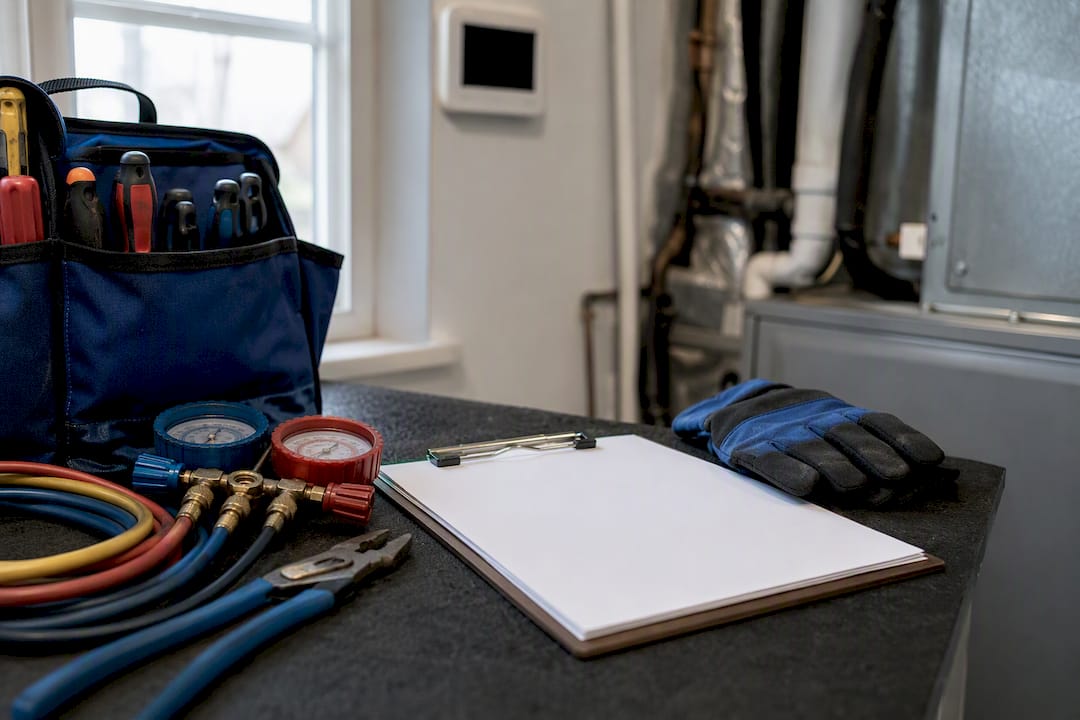
- Request specific documents from day one: the final invoice with a labor cost breakdown, commissioning confirmation, equipment model and serial numbers, and copies of any rebate applications submitted on your behalf.
Pro Tip: Get the rebate paperwork commitment in writing before you sign a contract, not after installation. Contractors who treat rebate filing as an afterthought often leave homeowners chasing missing documents months later.
Reviewing your home’s overall HVAC lifecycle costs before you commit to a system size and financing plan also helps you avoid overbuying capacity you don’t need.
How a Qualified HVAC Contractor Helps You Meet Deadlines
Brighton Air Corp has served New Jersey homeowners and businesses since 1993, with technicians who carry a combined 150 years of hands-on HVAC experience. That matters more than ever in an environment where a single missed commissioning date can cost a homeowner a rebate or a tax benefit entirely.
Correct paperwork and prompt commissioning aren’t paperwork for paperwork’s sake. They’re the proof points that stand between a homeowner and a denied claim. An installer who documents common installation mistakes and avoids them in the first place saves you from disputes down the road.
A contractor who schedules commissioning deliberately, rather than treating it as a formality, gives homeowners a real paper trail: a dated sign-off, a working system, and a clean invoice.
Keep these on file after any heat pump installation in San Antonio:
- Commissioning report with a dated sign-off
- Final invoice with a separate labor cost line
- Equipment model and serial numbers
- QMID documentation, if the install falls under an active federal credit
The Real Lesson Homeowners Should Take From 25C’s Expiration
The conventional advice floating around right now, “just wait for the next federal program,” misses the point. Congress can accelerate a sunset date with a single bill, as it just did with seven years’ worth of 25C eligibility erased overnight. Betting your renovation timeline on federal policy staying put is a mistake homeowners have now made twice in three years.
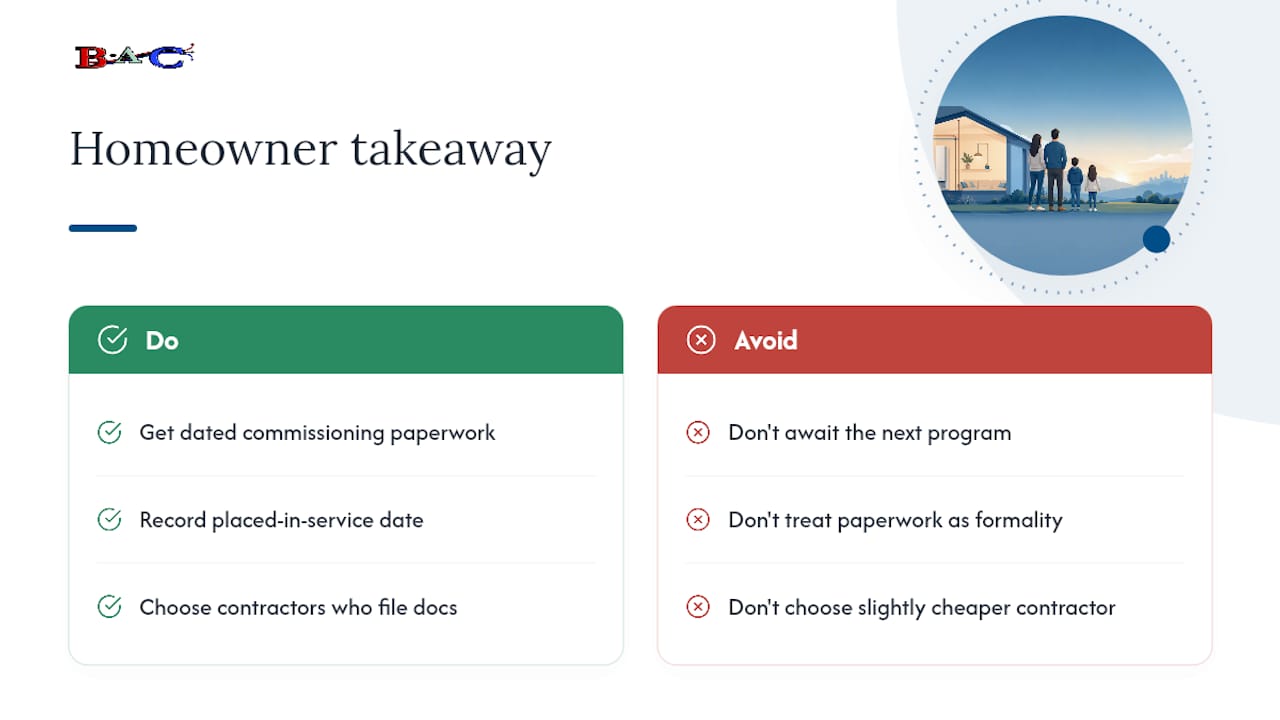
What actually matters is documentation discipline, regardless of which program you’re chasing. The “placed in service” test that just disqualified thousands of late 2025 installs will apply just as strictly to HOMES rebates and any future federal credit. Homeowners who treat commissioning paperwork as a formality are the ones who lose these fights.
Prioritize a contractor who manages that paperwork proactively over one who’s marginally cheaper. Rebate and credit disputes almost always trace back to a missing invoice line or an undated sign-off, not a policy technicality.
— John
Sources
Confirm every detail directly with primary sources before filing, since program rules and state rebate availability shift throughout the year.
- Energy Efficient Home Improvement Credit | Internal Revenue Service
- One Big Beautiful Bill Act implements significant tax package | Center for Agricultural Law and Taxation, Iowa State