
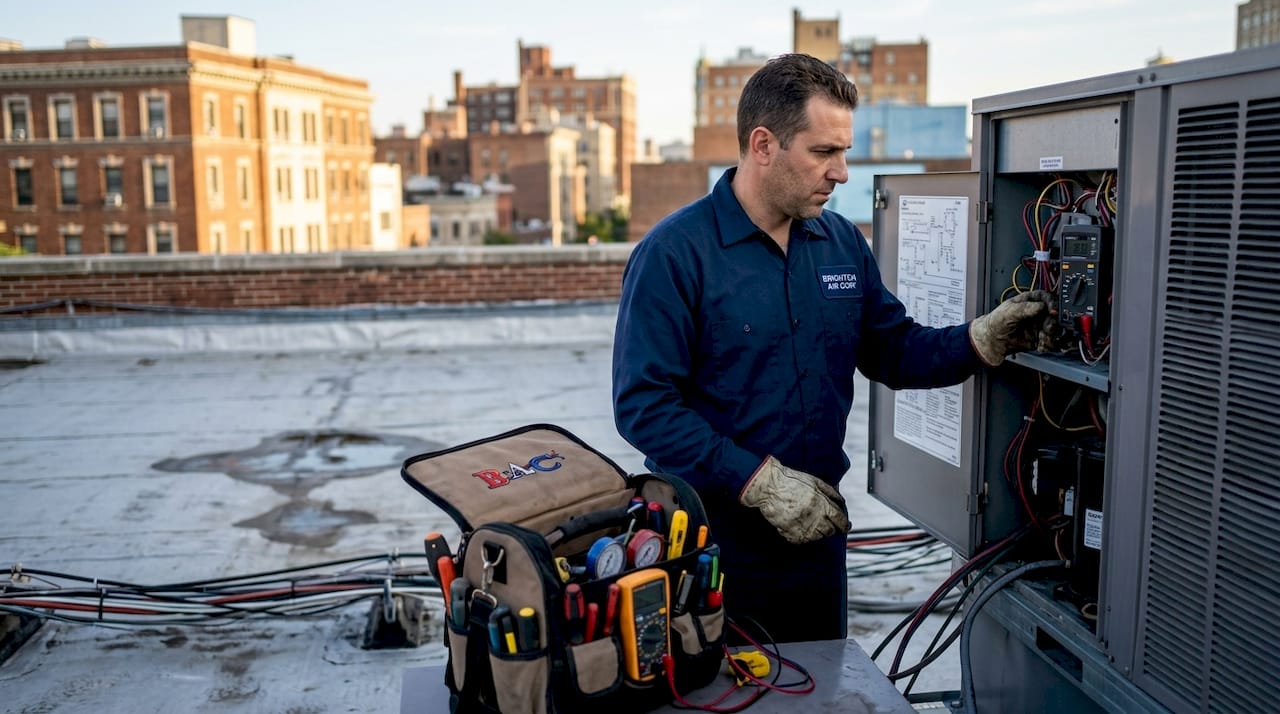
Essential Commercial AC Maintenance Checklist for NJ Buildings
Essential Commercial AC Maintenance Checklist for NJ Buildings
Skipping structured HVAC maintenance in a commercial building is not just an inconvenience. It is a direct path to emergency repair bills, compliance fines, and tenant complaints that erode your reputation fast. New Jersey property managers face a specific combination of climate demands, state permitting rules, and federal refrigerant regulations that make a generic checklist dangerously inadequate. Structured PM programs reduce emergency calls by 65% and extend equipment life by 30 to 40%, with well-maintained systems using 10 to 30% less energy. This guide gives you a practical, compliance-focused checklist built for NJ commercial properties, along with expert tips and clear regulatory direction.
Table of Contents
- What every commercial AC maintenance checklist must include
- Monthly and quarterly AC maintenance tasks
- Annual maintenance and in-depth diagnostics
- New Jersey HVAC regulations: What’s required and when
- Full commercial AC maintenance checklist: Downloadable and customizable
- What most maintenance checklists miss—and how to truly protect your buildings
- Get expert help with commercial AC maintenance in New Jersey
- Frequently asked questions
Key Takeaways
| Point | Details |
|---|---|
| Structured checklists matter | A consistent, documented AC maintenance program cuts emergencies, saves energy, and protects your investment. |
| Monthly, quarterly, annual tasks | Regular schedules keep HVAC systems efficient and compliant with New Jersey and federal requirements. |
| Regulations require documentation | ASHRAE, NJ UCC, and EPA rules demand maintenance records and certified refrigerant handling. |
| Digital tools boost reliability | Using CMMS or BMS systems for logging and trend analysis improves performance and reduces risk. |
What every commercial AC maintenance checklist must include
A reliable commercial AC maintenance checklist is not a single to-do list. It is a structured program organized by frequency, responsibility, and documentation standards. The difference between a property that runs smoothly and one that suffers repeated breakdowns usually comes down to whether maintenance is reactive or preventive.
Preventive maintenance (PM) means scheduling tasks before problems appear. Reactive maintenance means calling for repairs after something fails. The cost gap between those two approaches is significant. Emergency HVAC service calls in commercial settings can run two to three times the cost of scheduled maintenance visits, and that does not account for the productivity losses tenants experience during downtime.
A solid checklist covers multiple time horizons. Commercial HVAC checklists typically include monthly tasks such as inspecting and replacing air filters, checking belts and pulleys for wear, cleaning drain pans and lines, verifying refrigerant levels, and inspecting electrical connections for tightness and corrosion. Quarterly and annual tasks go deeper, covering coil cleaning, economizer testing, and full system diagnostics.
Here are the core elements every commercial AC maintenance checklist must address:
- Air filters: Inspect and replace monthly, or more often in high-traffic or high-dust environments
- Belts and pulleys: Check for wear, cracking, and proper tension monthly
- Drain pans and condensate lines: Clear monthly to prevent water damage and mold
- Refrigerant levels: Verify quarterly and document pressure readings
- Electrical connections: Inspect quarterly for tightness, corrosion, and signs of overheating
- Evaporator and condenser coils: Clean quarterly to maintain heat transfer efficiency
- Thermostat calibration: Test and calibrate annually
- Safety controls: Test annually to confirm proper shutoff behavior
Documenting actual measured values matters as much as completing the tasks. Recording amperage draws, refrigerant pressures, and airflow rates gives you a trend line over time. A reading that looks acceptable in isolation can signal a developing problem when compared against six months of prior data. Pass/fail checkboxes alone will not protect you in a warranty dispute or a compliance audit.
“A checklist that only records pass/fail is a liability. Measured values create the audit trail that protects your building, your tenants, and your budget.”
Using a CMMS (Computerized Maintenance Management System) transforms your checklist from a paper form into a living record. CMMS platforms let you schedule tasks automatically, assign them to specific technicians, and store historical data that is instantly retrievable during inspections. For buildings subject to NJ HVAC code requirements, that documentation can be the difference between a clean inspection and a costly citation.
Pro Tip: Even if you use paper checklists today, photograph the actual gauge readings and meter displays during each visit. Those images create a timestamped record that is far more defensible than a handwritten number.
Monthly and quarterly AC maintenance tasks
With the essentials defined, let’s get specific. Here are the monthly and quarterly AC tasks to schedule and track, along with guidance on which require a licensed technician and which your in-house staff can handle.
Monthly tasks (can often be handled by trained in-house staff):
- Inspect all return and supply air filters. Replace any filter that is visibly dirty or has reached its rated service interval, whichever comes first.
- Check belts on air handling units for fraying, cracking, or glazing. A belt that looks slightly worn today can snap under peak summer load.
- Inspect condensate drain pans for standing water, algae growth, or debris. Flush drain lines with a diluted bleach solution to prevent biological buildup.
- Visually inspect unit cabinets and access panels for signs of moisture intrusion or physical damage.
- Check thermostat setpoints and scheduling to confirm they match current occupancy patterns. An incorrectly programmed thermostat can waste thousands of dollars annually in a mid-size office building.
- Listen for unusual sounds during operation. Rattling, squealing, or grinding noises are early warning signs that deserve attention before they become failures.
Quarterly tasks (require a licensed HVAC technician):
- Clean evaporator and condenser coils. Dirty coils force the compressor to work harder, increasing energy consumption and wear.
- Check refrigerant charge using manifold gauges. Document suction and discharge pressures alongside ambient temperature for accurate trend analysis.
- Test and tighten all electrical connections. Loose connections cause arcing, which is both a fire hazard and a source of premature component failure.
- Measure and record motor amperage draws. A motor drawing more amps than its nameplate rating is telling you it is working too hard.
- Verify economizer operation if your system uses one. Quarterly inspections cover economizer function, safety controls, and airflow measurements that confirm the system is delivering conditioned air where it is needed.
- Inspect and lubricate fan bearings and motor shafts per manufacturer specifications.
Pro Tip: Ask your technician to record airflow measurements at representative supply registers during each quarterly visit. Declining airflow is one of the earliest indicators of coil fouling or duct leakage, and catching it early avoids expensive repairs later.
Annual maintenance and in-depth diagnostics
Routine tasks keep things running, but deeper annual checks ensure you stay compliant and avoid major failures. Annual maintenance is where the technical complexity increases significantly, and where the regulatory stakes are highest.
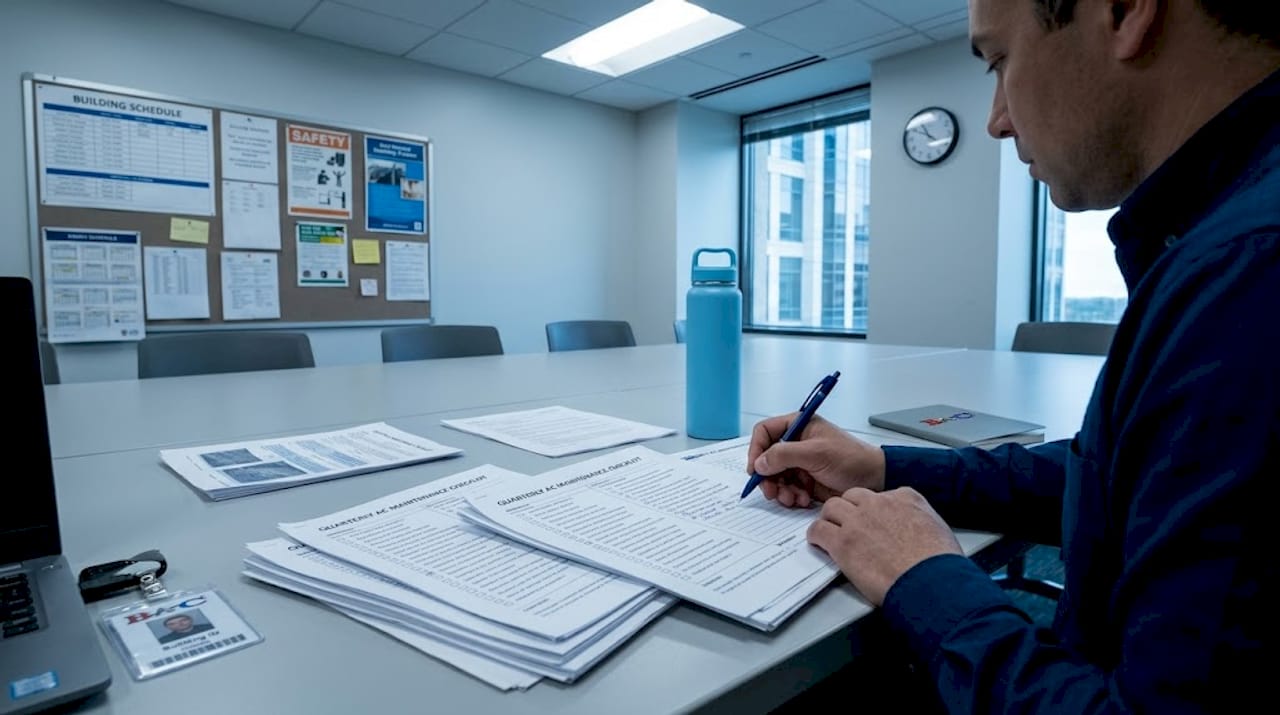
ASHRAE Standard 180 (the American Society of Heating, Refrigerating and Air-Conditioning Engineers standard for commercial HVAC inspection and maintenance) sets the minimum requirements for energy efficiency, indoor air quality (IAQ), and thermal comfort in commercial buildings. ASHRAE 180 compliance requires that records be retained for at least five years, making annual documentation not just good practice but a legal obligation for many NJ commercial properties.
EPA 608 (the Environmental Protection Agency’s refrigerant handling regulation) adds another layer of obligation for systems with large refrigerant charges. Both standards should directly shape your annual maintenance scope.
| Task | Monthly | Quarterly | Annual |
|---|---|---|---|
| Filter inspection/replacement | ✓ | ✓ | ✓ |
| Belt and pulley check | ✓ | ✓ | ✓ |
| Drain pan and line cleaning | ✓ | ✓ | ✓ |
| Coil cleaning | ✓ | ✓ | |
| Refrigerant level check | ✓ | ✓ | |
| Electrical connection tightening | ✓ | ✓ | |
| Economizer function test | ✓ | ||
| Safety control testing | ✓ | ||
| Thermostat calibration | ✓ | ||
| Full system diagnostics | ✓ | ||
| Combustion analysis (gas units) | ✓ | ||
| Leak check and refrigerant log review | ✓ |
Annual visits should also include a full refrigerant leak check for all systems, with results logged against EPA 608 thresholds. For rooftop units and large chillers, a combustion analysis on any gas-fired components confirms safe and efficient operation. Thermostat calibration during annual service ensures the control system is accurately reading and responding to building conditions, which directly affects both comfort and energy bills.
Key statistic: Well-maintained commercial HVAC systems use 10 to 30% less energy than neglected ones. For a mid-size NJ office building spending $60,000 annually on energy, that represents up to $18,000 in potential savings from disciplined maintenance alone.
New Jersey HVAC regulations: What’s required and when
Compliance is critical. Here’s what New Jersey property managers must address for legal peace of mind.
One of the most common questions we hear from property managers is whether routine maintenance requires permits. The answer is straightforward. Routine HVAC maintenance such as filter replacement, coil cleaning, and refrigerant recharge does not require permits under the New Jersey Uniform Construction Code (UCC). Permits are triggered by alterations, replacements, or new installations, not by maintenance activities.
That distinction matters because it affects your scheduling, your budget, and your contractor relationships. Maintenance tasks can be performed without the lead time and cost associated with permit applications.
However, refrigerant handling is a different matter entirely. EPA Section 608 requires certified technicians for all refrigerant handling. For systems with 50 or more pounds of refrigerant, property managers must track leak rates. The thresholds are 20% annually for comfort cooling equipment and 30% for industrial process refrigeration. If a system exceeds those thresholds, it must be repaired, and records must be maintained for three years.
Here is a summary of the key NJ and federal compliance requirements:
| Regulation | Applies to | Key requirement | Record retention |
|---|---|---|---|
| NJ UCC | All commercial HVAC | Permits for alterations, not maintenance | Per project |
| EPA Section 608 | Systems with refrigerant | Certified tech required, leak tracking for 50+ lb systems | 3 years |
| ASHRAE Standard 180 | Commercial buildings | Minimum maintenance standards and documentation | 5 years |
Key compliance obligations for NJ property managers:
- Verify that every technician handling refrigerants holds a current EPA 608 certification
- Maintain a refrigerant log for each system showing charge amounts, leak checks, and any additions
- Keep ASHRAE-compliant maintenance records for five years, organized by system and building
- Confirm that any equipment replacement or system modification triggers a UCC permit application before work begins
- Review NJ permit rules for HVAC annually, as code interpretations can shift with new state guidance
“Documentation is your first line of defense. In any inspection or tenant dispute, the property manager who can produce five years of organized maintenance records is in a fundamentally stronger position than one who cannot.”
Full commercial AC maintenance checklist: Downloadable and customizable
You’ve learned the what and why. Now use this checklist as your ready-to-implement tool.
A master checklist for NJ commercial properties should be organized into four sections: monthly tasks, quarterly tasks, annual tasks, and compliance and documentation. Each entry needs columns for the date completed, the name of the person who performed the task, the actual values recorded (not just a checkmark), and notes for any follow-up items.
Monthly checklist items:
- Inspect and replace air filters as needed
- Check and document belt condition on all AHUs (air handling units)
- Clear condensate drain pans and flush drain lines
- Verify thermostat setpoints match current occupancy schedule
- Listen for abnormal operating sounds and document findings
- Visually inspect unit exteriors for damage or moisture
Quarterly checklist items:
- Clean evaporator and condenser coils on all units
- Check refrigerant pressures and document suction/discharge readings with ambient temp
- Tighten and inspect all electrical connections
- Measure and record motor amperage against nameplate ratings
- Test economizer damper operation and document position range
- Lubricate bearings and motor shafts per manufacturer specs
- Measure and record supply airflow at representative registers
Annual checklist items:
- Full system diagnostic including thermostat calibration
- Safety control testing (high pressure, low pressure, freeze protection)
- Refrigerant leak check with results logged against EPA 608 thresholds
- Combustion analysis on all gas-fired components
- Economizer functional test and calibration
- Full electrical inspection including disconnect switches and contactors
- Review and update equipment inventory and refrigerant charge records
Compliance and documentation section:
- Confirm all technicians hold current EPA 608 certification
- Verify refrigerant logs are current and stored securely
- Confirm ASHRAE 180 records are organized and retained for five years
- Review any upcoming permit requirements for planned equipment changes
Structured PM programs that follow this kind of organized framework reduce emergency calls by 65% and extend equipment life by 30 to 40%. Those numbers translate directly into lower capital expenditure and more predictable operating budgets.
Adapt this checklist to your specific equipment mix. A building with rooftop package units has different coil access requirements than one with a central chiller plant. Your software platform, whether a CMMS or a simple shared spreadsheet, should reflect those differences so that every task is assigned to the right person with the right tools.
What most maintenance checklists miss—and how to truly protect your buildings
Here is a perspective built from over three decades of commercial HVAC work in New Jersey: most checklists fail not because they are incomplete, but because they are treated as compliance theater rather than operational intelligence.
A generic checklist downloaded from the internet does not know that your rooftop units on the south exposure run 15% harder than those on the north side. It does not account for the fact that your building’s kitchen exhaust creates negative pressure that accelerates filter loading. One-size-fits-all lists create a false sense of security in large or complex facilities, because they check the boxes without capturing the building-specific trends that actually predict failures.
The biggest missed step we see consistently is the failure to capture trend data. Expert guidance is clear that technicians should document measured values like amps and pressures, not just pass/fail results, for warranty and compliance purposes. But trend data goes further. When you plot refrigerant pressures over 12 months, a slow drift toward low charge becomes visible months before the system starts struggling. That is the difference between a $200 refrigerant recharge and a $4,000 compressor replacement.
Digital PM tracking also changes your audit readiness entirely. When an inspector walks in or a tenant files a complaint about air quality, a property manager with a CMMS can pull up every filter change, every coil cleaning, and every airflow measurement in under two minutes. That capability is not just convenient. It is a legal and reputational asset.
The contrarian take worth considering: compliance standards like ASHRAE 180 and EPA 608 should not be treated as the ceiling for your maintenance program. They are the floor. The most effective programs use regulatory requirements as the structural backbone and then build upward with building-specific data, predictive indicators, and technician expertise. Designing your checklist around convenience or tradition rather than compliance requirements is how properties end up with expensive surprises.
Get expert help with commercial AC maintenance in New Jersey
Managing a commercial property in New Jersey means juggling tenant demands, budget pressures, and a regulatory environment that does not pause for summer heat waves. A well-designed checklist is essential, but it only delivers results when it is backed by technicians who know what they are looking at and can act on what they find.
Brighton Air Corp has been serving commercial properties across New Jersey since 1993, with over 150 years of combined technician expertise across our team. We build custom maintenance programs around your specific equipment, occupancy patterns, and compliance obligations, so you are never guessing about what needs to happen next. From rooftop units to chiller plants, our commercial HVAC services cover the full scope of what NJ property managers need, including 24/7 emergency response when something cannot wait. Contact us for a free consultation and let us help you build a maintenance program that protects your building, your tenants, and your bottom line.
Frequently asked questions
How often should commercial AC filters be replaced?
Replace commercial AC filters monthly or more frequently in high-use settings for optimal efficiency and air quality. Monthly filter inspection is a standard requirement in commercial HVAC preventive maintenance programs.
Who is allowed to handle refrigerants during AC maintenance in New Jersey?
Only EPA Section 608 certified technicians may handle refrigerants in any commercial setting. EPA 608 regulations also require owners of systems with 50 or more pounds of refrigerant to track leak rates and maintain service records for three years.
Does routine AC maintenance in New Jersey require a permit?
No, standard maintenance tasks like filter changes and coil cleaning do not require a permit. NJ UCC rules distinguish routine maintenance from alterations, which do trigger the permit process.
What records must property managers keep for HVAC compliance?
Keep inspection, service, and refrigerant leak records for at least three to five years to satisfy both EPA and ASHRAE requirements. ASHRAE Standard 180 requires five years of records, while EPA Section 608 mandates three years for refrigerant-related documentation.