
Commercial HVAC Load Balancing: What Facility Managers Must Know
Commercial HVAC Load Balancing: What Facility Managers Must Know

Commercial HVAC load balancing is defined as the controlled distribution of heating and cooling output across multiple building zones to achieve even temperatures, minimize energy waste, and extend equipment life. The industry term most commonly used by engineers is “system balancing,” which covers both air balancing and hydronic balancing as distinct but related disciplines. Large commercial buildings routinely experience hot and cold spots, negative pressure areas, and uneven airflow that make certain zones uncomfortable and drive up operating costs. For property managers and facility engineers in New Jersey and across the country, understanding this process is the first step toward running a building that performs as designed.
What is HVAC load balancing in commercial buildings?
HVAC load balancing in commercial buildings is the process of measuring, adjusting, and verifying that conditioned air and chilled or heated water reach every zone at the correct flow rate and temperature. Without it, the system operates as a collection of competing demands rather than a coordinated network. Some zones receive too much airflow and overcool, while others receive too little and overheat. Both outcomes waste energy and generate occupant complaints.
The two primary branches of commercial HVAC load balancing are air balancing and hydronic balancing. Air balancing addresses ductwork, dampers, and fan-coil units. Hydronic balancing addresses the chilled water or hot water loops that feed terminal units throughout the building. Standards from ASHRAE, specifically ASHRAE Standard 111 for testing and balancing air and water systems, define the acceptable tolerances and procedures that commissioning agents follow during both new construction and retrofit projects.

HVAC systems account for 30% to 60% of total commercial building energy use, with peak demand charges representing 30% to 50% of the monthly electricity bill in regulated markets. That single statistic explains why load balancing is not a luxury. A building that wastes conditioned air through poor distribution is paying for energy it never delivers to occupants.
How does load balancing improve energy efficiency and comfort?
Proper load balancing produces measurable results on both the energy bill and the occupant experience. Hydronic and air balancing in large commercial plants can reduce chiller and pump energy consumption by 15% to 25% by allowing chillers to operate closer to design conditions and enabling variable frequency drive (VFD) pumps to reduce speed. That reduction translates directly to lower utility costs and reduced wear on the most expensive equipment in the building.
The comfort side of the equation is equally significant. Most building hot and cold spots stem from poor ductwork design or unbalanced hydronic loops rather than malfunctioning chillers. This means a chiller replacement will not fix a comfort complaint caused by an unbalanced loop. Diagnostics must start with the distribution system, not the central plant.
The benefits of a properly balanced system include:
- Even zone temperatures across all occupied floors and spaces
- Reduced equipment cycling because the system meets load without overshooting
- Extended component lifespan for chillers, pumps, air handlers, and terminal units
- Lower demand charges by preventing simultaneous peak draws from multiple zones
- Improved indoor air quality through consistent ventilation rates in every zone
“Load balancing eliminates temperature inconsistencies, reduces energy consumption, and extends HVAC system lifespan.” — The Severn Group
What techniques and tools are used for commercial load balancing?
Air balancing
Air balancing requires measuring actual airflow at every supply and return register, then adjusting dampers and fan speeds until each zone receives the volume specified in the design documents. Technicians use flow hoods to measure supply air volume at diffusers and manometers to measure static pressure across duct sections. Airflow systems must operate within 80% to 120% of design flow. If readings fall outside that range, fan speed adjustments through VFDs are required before any damper work begins. Attempting to fix a flow deficit with dampers alone will simply redistribute an existing shortage rather than correct it.
Hydronic balancing
Hydronic balancing addresses the water-side distribution network. Hydronic balancing valves prevent hydraulic short-circuiting by ensuring proper distribution of chilled water flow throughout the system, which is critical in large chilled water loops where the path of least resistance will always steal flow from distant branches. Without these valves, terminal units near the pump receive excess flow while units at the end of the loop receive almost none.
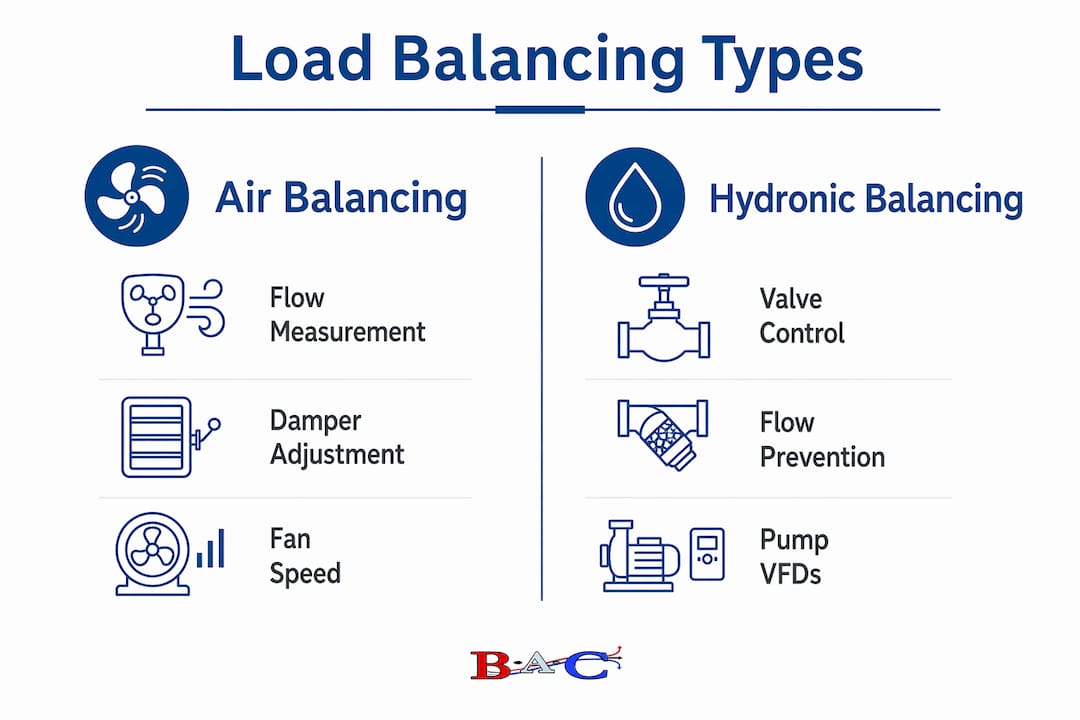
The table below compares the two primary balancing methods:
| Method | Primary tool | What it corrects | When to apply |
|---|---|---|---|
| Air balancing | Flow hood, manometer | Uneven airflow, pressure imbalances | After installation, after layout changes |
| Hydronic balancing | Balancing valves, ultrasonic flow meter | Short-circuiting, uneven water distribution | During commissioning, after loop modifications |
VFDs for pumps and air handler fans are the most cost-effective controls for maintaining balance as loads shift throughout the day. Rather than running at full speed and throttling output with dampers or valves, VFDs reduce motor speed to match actual demand. This approach cuts energy use far more than any fixed-speed system can achieve.
Staggering rooftop unit startups by five-minute intervals smooths the electrical load and reduces peak demand charges. Starting all units simultaneously creates large in-rush current spikes that trigger demand ratchet clauses in utility contracts.
Pro Tip: Before any balancing work begins, verify that all filters are clean and all dampers are fully operational. A clogged filter or stuck damper will produce false readings that send technicians chasing problems that do not exist in the distribution system.
How is load balancing different from HVAC load management?
Load balancing focuses on uniform spatial air and water distribution within building zones, while demand response adjusts overall HVAC output in reaction to grid signals. The distinction matters because the two strategies operate on different timescales and address different problems.
Load balancing is a physical and mechanical process. It corrects how conditioned air and water move through the building. Demand response, by contrast, is a control strategy. It modulates how much total energy the HVAC system consumes based on utility pricing signals or grid stress events.
Effective demand response can involve raising cooling setpoints by 1 to 3°F over a minimum of three hours during peak periods, or reducing HVAC capacity to 60% of installed capacity without significant impact on occupant comfort. Pre-cooling, which involves chilling the building’s thermal mass during off-peak hours and then allowing setpoints to drift upward during peak periods, is one of the most effective load management strategies available to facility engineers.
The two approaches work best together. A building with poor load balancing will not respond well to demand response events because uneven distribution means some zones will overheat quickly when capacity is reduced. A properly balanced system can tolerate setpoint adjustments and capacity reductions without generating comfort complaints.
| Strategy | Scope | Primary goal | Key tool |
|---|---|---|---|
| Load balancing | Spatial distribution | Even temperatures across zones | Balancing valves, VFDs, dampers |
| Demand response | Temporal output | Reduce peak energy consumption | BAS setpoint controls, pre-cooling |
What steps should facility managers take to implement load balancing?
Implementing effective commercial HVAC load management starts with a systematic audit rather than reactive repairs. Follow this sequence to build a durable balancing program:
- Conduct a baseline airflow audit. Use flow hoods and manometers to measure actual airflow at every supply and return register. Compare readings against the original design documents to identify zones that are over- or under-served.
- Audit the hydronic system. Map the chilled water and hot water loops, identify all balancing valves, and verify that each valve is set correctly. Look for branches that consistently run warmer than design temperature, which signals short-circuiting.
- Engage a commissioning agent. For buildings over 50,000 square feet, a certified commissioning agent from an organization like AABC (Associated Air Balance Council) or NEBB (National Environmental Balancing Bureau) brings the instrumentation and documentation standards that in-house staff rarely have.
- Program the building automation system (BAS). A properly configured BAS monitors zone temperatures, airflow rates, and water temperatures in real time. It can trigger alerts when a zone drifts outside acceptable limits, allowing corrective action before occupants notice.
- Schedule re-commissioning every three to five years. Load balancing is an ongoing process that must adapt to tenant turnover, interior layout changes, and system aging. A balance achieved at occupancy will drift as the building evolves.
- Stagger equipment startups. Program the BAS to start rooftop units and air handlers in sequence rather than simultaneously to avoid demand spikes at building opening time.
Pro Tip: Tenant buildouts are one of the most common causes of balance drift. Any time a floor is reconfigured, treat it as a trigger for a partial re-balance of the affected zones, not just a visual inspection.
Key takeaways
Effective commercial HVAC load balancing requires both air and hydronic system correction, ongoing re-commissioning, and integration with demand response controls to deliver lasting energy savings and occupant comfort.
| Point | Details |
|---|---|
| HVAC energy share is significant | HVAC uses 30% to 60% of commercial building energy, making balance critical to cost control. |
| Two disciplines, one outcome | Air balancing and hydronic balancing must both be addressed to eliminate hot and cold spots. |
| Energy savings are quantifiable | Proper balancing can cut chiller and pump energy by 15% to 25% in large commercial plants. |
| Balance drifts over time | Tenant changes and system aging require re-commissioning every three to five years. |
| Load balancing and demand response complement each other | A balanced system tolerates demand response events without generating comfort complaints. |
Why load balancing deserves more attention than it gets
Most facility engineers I speak with treat load balancing as a commissioning checkbox. It gets done at project handover, filed in a binder, and rarely revisited until complaints pile up. That approach costs buildings real money every year.
The counterintuitive truth is that the buildings with the most sophisticated central plants are often the worst offenders. A high-efficiency chiller running at peak performance cannot compensate for a hydronic loop that short-circuits 30% of its flow back to the pump before it reaches the far end of the building. The chiller looks fine on the BAS dashboard. The problem is invisible until someone walks the building with a flow meter.
What I find most compelling about the current moment is the integration of AI-powered building controls with traditional balancing work. Platforms that continuously model zone loads and adjust VFD speeds and valve positions in real time are making static balance settings less relevant. But those platforms still require a physically balanced system as their starting point. You cannot software your way out of a hydraulic short-circuit.
My recommendation for any facility engineer managing a building over 100,000 square feet: treat load balancing as a recurring line item in your maintenance budget, not a one-time project cost. The 15% to 25% energy reduction available from proper hydronic and air balancing pays for re-commissioning many times over. The buildings that perform best over a 20-year horizon are the ones where someone made that decision early.
— John
How Brightonaircorp supports commercial HVAC performance

Brightonaircorp has served commercial clients across New Jersey since 1993, with over 150 years of combined technician expertise across office buildings, retail centers, and industrial facilities. The team handles the full scope of commercial HVAC load balancing work, from initial airflow and hydronic audits through system commissioning, VFD calibration, and BAS integration. For property managers who need a trusted partner to assess balance drift after a tenant buildout or schedule a full re-commissioning, Brightonaircorp’s commercial services cover every step of the process. Free estimates are available, and emergency support runs 24/7 for critical system issues.
FAQ
What is HVAC load balancing in a commercial building?
HVAC load balancing is the process of adjusting airflow rates and water distribution across all building zones so that each space receives conditioned air at the volume and temperature specified in the system design. It covers both duct-side air balancing and water-side hydronic balancing.
How much energy can load balancing save?
Proper hydronic and air balancing can reduce chiller and pump energy consumption by 15% to 25% in large commercial buildings by allowing equipment to operate closer to design conditions and enabling VFD pumps to run at lower speeds.
How often should a commercial HVAC system be re-balanced?
A commercial HVAC system should be re-commissioned every three to five years, and any time a significant tenant buildout or interior reconfiguration occurs, since layout changes directly alter airflow patterns and loop pressures.
What is the difference between load balancing and demand response?
Load balancing corrects the physical distribution of air and water within the building. Demand response adjusts total HVAC output based on utility grid signals, typically by raising setpoints or reducing capacity during peak pricing periods. Both strategies work together but address different problems.
What tools do technicians use to balance commercial HVAC systems?
Technicians use flow hoods and manometers for air balancing, ultrasonic flow meters and hydronic balancing valves for water-side work, and VFDs to adjust fan and pump speeds. Building automation systems provide ongoing monitoring after the physical balance is set.
Recommended
- Cranford Westfield Summit Scotch Plns Fanwood Kenilworth Clark Rahway Livingston AC Repair Install Service HVAC Contractor Emergency Heat Pump Repair HVAC System Installation
- Cranford Westfield Summit Scotch Plns Fanwood Kenilworth Clark Rahway Livingston AC Repair Install Service HVAC Contractor Emergency Heat Pump Repair HVAC System Installation
- Cranford Westfield Summit Scotch Plns Fanwood Kenilworth Clark Rahway Livingston AC Repair Install Service HVAC Contractor Emergency Heat Pump Repair HVAC System Installation
- Cranford Westfield Summit Scotch Plns Fanwood Kenilworth Clark Rahway Livingston AC Repair Install Service HVAC Contractor Emergency Heat Pump Repair HVAC System Installation