
How to Choose Energy Efficient HVAC for New Developments
How to Choose Energy Efficient HVAC for New Developments

For new residential construction, inverter-driven air-source heat pumps and geothermal systems deliver the best combination of efficiency, comfort, and long-term operating cost savings. The decision comes down to four factors: climate zone, building envelope quality, lot constraints, and budget. Get those right before you pick a system, and the rest of the selection process follows a clear path.
Here is what every builder needs to prioritize:
- System type: Inverter-driven heat pumps suit most new homes; geothermal leads in efficiency where land and budget allow.
- Sizing: Run ACCA Manual J for loads, then Manual S for equipment selection. Skipping this step causes short cycling, poor humidity control, and wasted energy.
- Performance metrics: Target SEER2 ratings above the 2025 federal minimums, AFUE of 92%+ for any gas backup, and understand where Total System Performance Ratio (TSPR) fits into your local code.
- Building envelope first: A tighter envelope shrinks your required HVAC capacity, which cuts both equipment cost and operating cost.
- Incentives: ENERGY STAR Single Family New Home Version 3.2 compliance unlocks the Section 45L tax credit, worth up to $2,500 per qualifying dwelling.
What types of energy-efficient HVAC systems work best for new construction?
New construction gives you a rare advantage: you can design the HVAC system from scratch rather than retrofit around existing constraints. That means the system type you choose should match the home’s load profile, not just what the local supply house stocks.
Central ducted heat pumps
A central ducted air-source heat pump handles both heating and cooling through a single system, replacing the traditional furnace-plus-AC pairing. Modern units with inverter-driven variable-speed compressors modulate output continuously rather than cycling on and off at full capacity. The result is steadier temperatures, better humidity control, and lower energy draw during mild weather, which is when most homes run their systems most of the time. For builders designing homes in climate zones 2 through 5, this is the default recommendation.
Ductless mini-split heat pumps
Mini-splits work without ductwork, making them ideal for open floor plans, additions, or homes where running ducts would compromise the building envelope. Each indoor air handler serves a zone independently, so unoccupied rooms draw no conditioning at all. The tradeoff is upfront cost per zone and the need for multiple indoor units in larger homes. For a 2,500-square-foot home with four distinct zones, the installed cost can exceed a central system, though the zoning flexibility often justifies it.
Geothermal (ground-source) heat pumps
Geothermal systems pull heat from stable underground temperatures rather than fluctuating outdoor air, which is why they outperform air-source systems in extreme cold. Geothermal systems can reduce annual HVAC energy use by 30% to 60%, and the ground loops last 50+ years while indoor equipment runs 25+ years. The catch is installation: drilling or trenching adds significant cost and requires adequate land. For a development with larger lots and buyers who plan to stay long-term, the return on investment is strong.
Hybrid and dual-fuel systems
A hybrid setup pairs an air-source heat pump with a gas furnace. The heat pump handles most of the heating season efficiently; the furnace kicks in only when outdoor temperatures drop below the heat pump’s economic balance point. Consumer Reports notes that heat pump savings are most consistent when replacing fuel oil, propane, or electric resistance heating, while natural gas economics depend heavily on local utility rates. In colder climates where gas is cheap, a hybrid system often delivers the best combination of efficiency and operating cost.
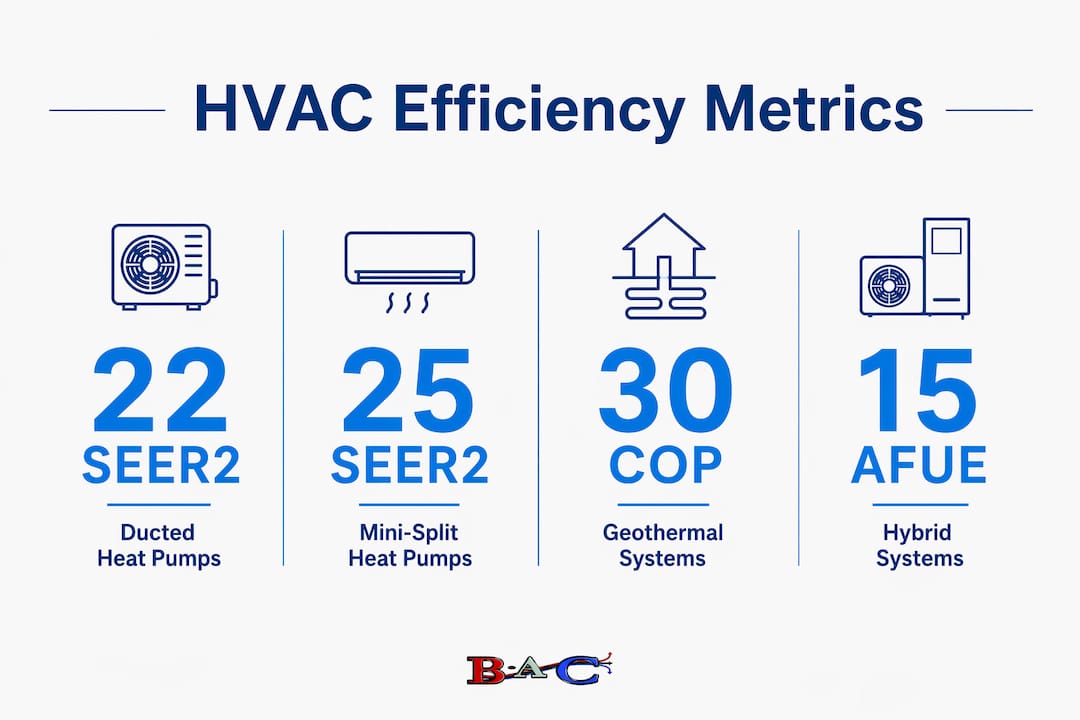
System efficiency comparison
| System Type | Key Metric | Typical Rating | Best Climate Fit |
|---|---|---|---|
| Central ducted heat pump | SEER2 / HSPF2 | SEER2 above federal minimums, HSPF2 varies | Zones 2–5 |
| Ductless mini-split | SEER2 | SEER2 above federal minimums | All zones, zoned loads |
| Geothermal heat pump | COP | 3.0–5.0 heating COP | All zones, adequate land |
| Hybrid (heat pump + gas) | SEER2 + AFUE | SEER2 above federal minimums, AFUE 92%+ | Zones 5–7 |
| Gas furnace + central AC | AFUE + SEER2 | AFUE 80–98%, SEER2 14–18 | Zones 5–7, gas-dominant |
How home-specific factors shape your HVAC system choice
Picking a system type is only half the work. The other half is matching that system to the specific home, and that requires numbers, not guesswork.
Load calculations: Manual J and Manual S
ACCA Manual J calculates the actual heating and cooling loads of a home based on square footage, insulation levels, window area, infiltration rates, and local design temperatures. Manual S then uses those load numbers to select equipment that meets the load without oversizing. Oversized equipment short-cycles, meaning it reaches setpoint quickly and shuts off before it can dehumidify the space properly. In humid climates, that is a comfort problem that no thermostat setting can fix.

Equipment selection and duct design are iterative processes. You may select a unit, design the duct system, and find that the airflow requirements push you toward a different unit capacity. Builders who skip this loop and size by rule of thumb routinely end up with systems that are 20%–40% oversized, which wastes money on both the equipment and the energy bill.
Pro Tip: In high-performance homes with aggressive air sealing and insulation, the Manual J load may fall below the smallest available equipment capacity. In those cases, consider multi-speed or variable-capacity equipment, which can run at a lower stage to match the reduced load without short cycling.
Climate zone and heat pump performance
Heat pump performance varies by outdoor temperature. In climate zones 6 and 7, an air-source heat pump needs a cold-climate rating (often called a “hyper-heat” or H2C specification) to maintain adequate output below 0°F. In zones 2 and 3, almost any modern inverter-driven unit performs well year-round. Matching the unit’s rated performance at the local design temperature, not just its SEER2 rating, is what separates a well-specified system from one that struggles in January.
Ductwork decisions
New construction lets you design ductwork correctly from the start, but that advantage disappears if the ducts are poorly sealed or run through unconditioned attic space. Sealing duct leaks and insulating ducts reduces energy loss by 20%–30%. For new builds, the better answer is to route ducts inside the conditioned envelope entirely, which eliminates attic duct losses without relying on sealing quality.
Building envelope and HVAC capacity
Downsizing HVAC capacity yields the greatest efficiency gains when paired with aggressive envelope improvements: air sealing, high-R insulation, and low-U windows. A home that needs 3 tons of cooling because of poor insulation could need only 2 tons with a tight envelope, and that smaller system costs less to buy, install, and run. Prioritize the envelope before finalizing equipment selection, not after.
- Floor plan and zoning: Open floor plans favor central systems; multi-story or compartmentalized layouts benefit from zoning via mini-splits or variable-air-volume ducted systems.
- Lot orientation: South-facing glass increases cooling loads; factor this into the Manual J before sizing.
- Ventilation requirements: Tight homes need mechanical ventilation (typically an energy recovery ventilator or heat recovery ventilator) to meet ASHRAE 62.2 standards. Size the HVAC system to handle the added latent load from ventilation air.
Energy efficiency standards, codes, and incentives for new construction in 2026
The regulatory environment for new construction HVAC shifted meaningfully in 2025, and builders who stay current on these standards avoid costly redesigns and capture available incentives.
ENERGY STAR Single Family New Home Version 3.2
ENERGY STAR Single Family New Home Version 3.2 sets the current benchmark for new residential construction efficiency. Certification requires third-party verification of the building envelope, HVAC installation quality, and duct leakage. Builders who meet Version 3.2 requirements qualify for the Section 45L New Energy Efficient Home Tax Credit, which offers up to $2,500 per qualifying dwelling. For a larger development, that can translate into substantial direct tax credits, which meaningfully offset the cost of higher-efficiency equipment.
The Air Conditioning Contractors of America (ACCA) QA New Homes Program supports ENERGY STAR certification by providing a contractor accreditation pathway. More than 1,000 contractors have qualified nationwide, and working with a QA-certified installer is one of the clearest ways to protect your ENERGY STAR application from failing on installation quality grounds.
Updated minimum efficiency metrics: SEER2, HSPF2, and AFUE
The shift from SEER to SEER2 in 2023 changed how efficiency is measured by using a more realistic external static pressure in testing. SEER2 ratings are slightly lower than equivalent SEER ratings for the same equipment, so comparing across the old and new scales requires care. Current federal minimums vary by region, but high-performance new construction should target SEER2 ratings well above the minimum, particularly in cooling-dominant climates. For gas furnaces used in hybrid systems, an AFUE of 92%+ is the practical threshold for high-efficiency classification.
Total System Performance Ratio (TSPR)
TSPR evaluates overall system efficiency by comparing a building’s annual heating and cooling load to the total annual energy consumed by the HVAC system. Unlike SEER2 or AFUE, which rate individual components, TSPR captures how the whole system performs together, including duct losses, controls, and equipment interaction. According to Pacific Northwest National Laboratory, a base TSPR requirement can deliver 20% to 58% HVAC energy savings compared to a low-efficiency prescriptive system, and an advanced TSPR requirement adds another 12.5% savings on top of that.
TSPR savings range: A base TSPR code requirement saves 20% to 58% in HVAC energy compared to minimum-efficiency prescriptive systems. An advanced TSPR tier adds 12.5% more savings above that baseline.
TSPR is already embedded in the Washington State Energy Code and is under review for ASHRAE Standard 90.1. Builders in states with aggressive energy codes should expect TSPR compliance requirements to expand. Designing to TSPR from the start, rather than retrofitting to meet it, is the lower-cost path.
Incentives and rebates
- Section 45L tax credit: Up to $2,500 per dwelling for ENERGY STAR-certified new homes.
- Inflation Reduction Act provisions: Various equipment-level tax credits for heat pumps and heat pump water heaters remain available through the residential clean energy credit structure; verify current status with a tax advisor, as provisions have shifted.
- Utility rebates: Many utilities offer rebates for heat pumps, smart thermostats, and high-efficiency equipment. Programs vary by state and utility; check the ENERGY STAR rebate finder for current offerings in your market.
- State energy programs: States including New York, Massachusetts, and California run supplemental programs that stack with federal incentives.
Long-term value, maintenance, and smart technology integration
A well-chosen HVAC system loses its efficiency advantage quickly without proper maintenance and controls. Builders who educate buyers on maintenance expectations, and who specify systems with good serviceability, protect both the home’s performance and their own reputation.
Equipment lifespan and maintenance cycles
Well-maintained heat pumps run for 15–25 years with consistent performance and fewer breakdowns. The maintenance schedule for a heat pump is more frequent than for a gas furnace: professional tune-ups twice yearly (spring and fall) rather than once. Filter changes every 1–3 months, coil cleaning, and refrigerant checks are the core tasks. Builders who include a first-year maintenance plan in the home sale give buyers a concrete reason to stay on schedule, which protects the warranty and the system’s rated efficiency.
Geothermal systems carry a different maintenance profile. The ground loops require virtually no attention over their 50-year lifespan. The indoor heat pump unit follows a standard heat pump schedule. The higher upfront cost of geothermal spreads over a very long service life, and the HVAC lifecycle cost math often favors geothermal in developments where buyers plan to hold the property long-term.
Inverter-driven variable-speed technology
Inverter-driven compressors are the single most impactful technology shift in residential HVAC over the past decade. A conventional single-stage compressor runs at 100% capacity or not at all. An inverter-driven unit modulates between roughly 30% and 100% of capacity, matching output to the actual load at any given moment. The practical effect is that the system runs longer at lower intensity, which keeps temperatures and humidity levels steadier than a system that blasts on and off. For builders, this translates directly into fewer comfort complaints after move-in.
Smart thermostats and controls
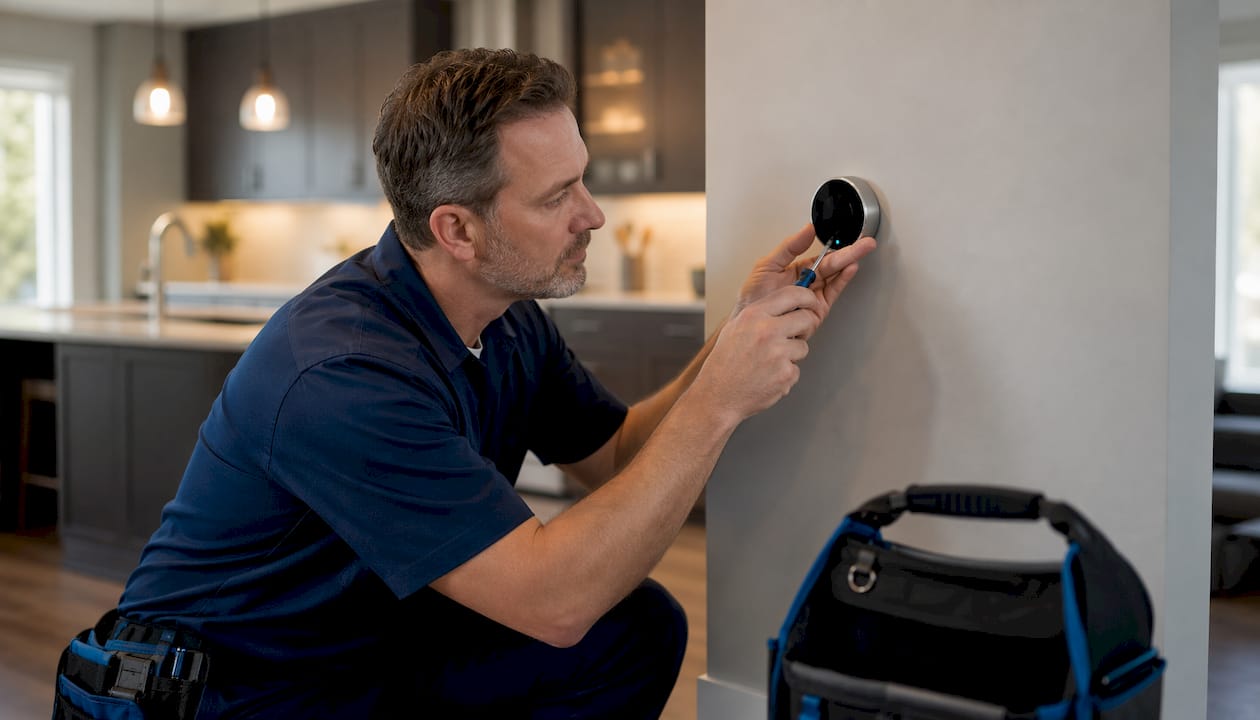
Smart thermostats reduce energy consumption by adjusting HVAC operation based on occupancy, time of day, and learned schedules, without sacrificing comfort. Devices like the Ecobee SmartThermostat and Google Nest Learning Thermostat integrate with most modern heat pump systems and qualify for utility rebates in many states. For new construction, specifying a compatible smart thermostat at installation is far easier than retrofitting one later, particularly for systems with communicating controls.
Indoor air quality and ventilation
- Energy recovery ventilators (ERVs): Transfer heat and moisture between outgoing and incoming air streams, maintaining fresh air exchange without large energy penalties. Required in tight new construction to meet ASHRAE 62.2.
- MERV-13 filtration: Captures fine particles including PM2.5 without excessive pressure drop on properly sized systems. Specify this at installation rather than leaving it to the buyer.
- UV-C air purification: Effective against biological contaminants in the air handler; increasingly specified in health-conscious developments.
- Humidity control: Standalone dehumidifiers or whole-home dehumidifiers integrated with the HVAC system prevent moisture problems in tight homes, particularly in climate zones 1–3.
Pro Tip: Specify a dedicated whole-home dehumidifier in climate zones 2 and 3 even when the heat pump has a dehumidification mode. The heat pump’s dehumidification is a byproduct of cooling; a dedicated unit handles humidity independently when the cooling load is low.
What research says about HVAC performance metrics and practical system selection
The gap between a system’s rated efficiency and its real-world performance is where most builders get surprised. Understanding what the research actually shows helps you make selections that hold up in practice, not just on the spec sheet.
TSPR and the shift to performance-based evaluation
Pacific Northwest National Laboratory’s technical brief on HVAC System Performance makes a point that changes how you should think about equipment selection: individual component ratings like SEER2 and AFUE do not capture how a system actually performs as a whole. A high-SEER2 unit installed with leaky ducts in an unconditioned attic can perform worse than a lower-rated unit with well-designed, interior-routed ductwork. TSPR addresses this by measuring the ratio of the building’s annual load to the system’s annual energy consumption, capturing duct losses, controls behavior, and equipment interaction in a single number.
The national weighted savings potential is substantial. Adopting TSPR as a minimum efficiency standard can save 23%–37% of national HVAC energy use. That is not a marginal improvement; it reflects the difference between specifying a system that looks good on paper and one that actually performs in the field.
Inverter-driven heat pumps versus geothermal: the practical comparison
Geothermal systems lead in raw efficiency, but inverter-driven air-source heat pumps offer the best practical performance for most new homes, balancing cost, comfort, and climate adaptability. The installed cost difference between a geothermal system and a high-efficiency inverter-driven air-source heat pump is often $15,000–$30,000 or more, depending on lot conditions and drilling requirements. For developments where lot size, soil conditions, or budget make geothermal impractical, a well-specified inverter-driven system with a tight envelope closes most of the efficiency gap.
For homes replacing oil, propane, or electric resistance heating, the heat pump economics are clear: households can save up to $1,500 annually by switching to an appropriate heat pump. In new construction, where you are not replacing anything, the comparison is against the alternative system you would have specified, typically a gas furnace and central AC. The math depends on local gas and electricity rates, but in most markets, an inverter-driven heat pump wins on total cost of ownership over a 15-year horizon.
Pro Tip: Before finalizing system selection, run a simple 15-year lifecycle cost model comparing your top two system options using local utility rates. Include equipment cost, installation, maintenance, and projected energy use from the Manual J load. The result often surprises builders who assumed gas was always cheaper.
Proper sizing as a performance multiplier
ACCA Manual J and Manual S are not bureaucratic checkboxes. They are the mechanism by which a correctly sized system delivers its rated efficiency in practice. Oversized systems can short-cycle, fail to dehumidify properly, and consume more energy than properly sized units, even if the oversized unit carries a higher SEER2 rating. The research is consistent on this: mis-sized equipment reduces comfort and increases energy use, and the problem compounds over the system’s lifespan.
For builders working on high-performance homes with superior envelopes, the Manual J loads may fall below standard equipment capacity increments. In those cases, multi-speed or variable-capacity equipment is the answer, not accepting an oversized single-stage unit. The seasonal HVAC preparation and ongoing maintenance that follows installation also depends on the system being correctly sized from day one.
Key Takeaways
Choosing energy-efficient HVAC for new developments requires matching system type to climate zone and building envelope quality, then sizing precisely with ACCA Manual J and Manual S to avoid the oversizing that undermines even high-rated equipment.
| Point | Details |
|---|---|
| Inverter-driven heat pumps lead for most homes | Variable-speed compressors deliver consistent comfort and efficiency across climate zones 2–5. |
| Geothermal cuts energy use by 30% to 60% | Best for developments with adequate land and budget; ground loops last 50+ years. |
| TSPR saves 20% to 58% over prescriptive minimums | Base TSPR compliance outperforms low-efficiency prescriptive systems by a wide margin. |
| Section 45L credit reaches $2,500 per dwelling | ENERGY STAR Single Family New Home Version 3.2 compliance unlocks this builder tax credit. |
| Envelope improvements reduce required HVAC capacity | Tighter insulation and air sealing lower Manual J loads, enabling smaller and cheaper equipment. |