
Bipolar Ionization HVAC: What the Evidence Actually Shows
Bipolar Ionization HVAC: What the Evidence Actually Shows
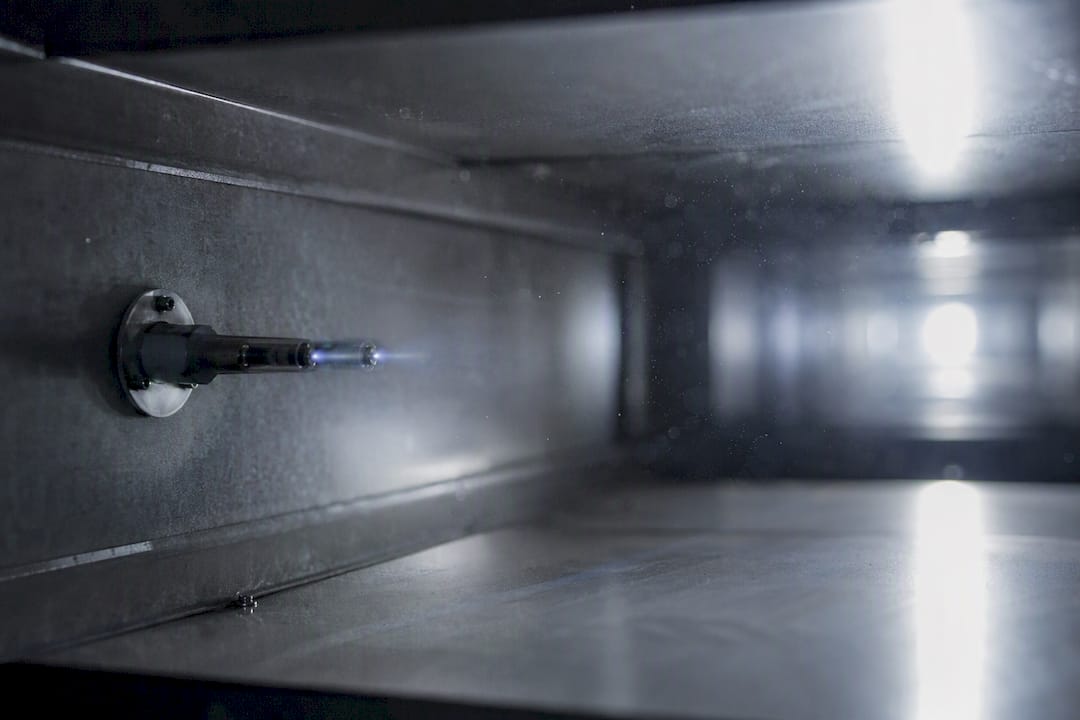
Bipolar ionization in HVAC systems is a conditional yes, not a blanket recommendation. The technology can produce measurable benefits in controlled lab conditions, but real-world results are mixed, and independent field studies have found no meaningful reduction in airborne bacteria in occupied spaces. Before you install anything, two things matter more than any sales brochure: safety validation and evidence quality.
Any device you consider should carry UL 2998 zero-ozone validation, since ionizers can produce ozone and secondary byproducts as a side effect of ion generation. The EPA classifies bipolar ionization as an emerging technology with limited evidence outside lab settings, which is exactly why you need documentation, not marketing claims, before you commit budget to it.
Before signing anything, request:
- As-used efficacy data from the specific building type and airflow conditions you have
- Ozone and VOC measurements taken under normal operating settings, not idealized test chambers
- A copy of the UL 2998 certificate, not just a vendor’s verbal assurance
Key Takeaways
Bipolar ionization can improve filter performance and reduce odors in some settings, but it requires UL 2998 validation and should never replace ventilation or filtration as your primary indoor air quality strategy.
| Point | Details |
|---|---|
| Demand UL 2998 first | Never approve an ionization purchase without a verified zero-ozone certificate from the vendor. |
| Lab results don’t equal field results | A 2024 lecture-hall study found no bacterial reduction versus the ionizer being off. |
| Watch for VOC byproducts | Some tested units showed increased oxygenated VOCs downstream, per a 2021 field evaluation. |
| Fix ventilation and filtration first | ASHRAE guidance treats ionization as a supplement, not a substitute, for core IAQ controls. |
| Get a measurement-based assessment | Brightonaircorp evaluates your building’s airflow and occupancy before recommending ionization or alternatives. |
Table of Contents
- How Does Bipolar Ionization Work in HVAC Systems?
- Does the Research Support Bipolar Ionization Claims?
- What Are the Real Benefits and Limits of HVAC Ionization?
- Is Bipolar Ionization Safe for Indoor Air?
- How Should Bipolar Ionization Be Installed and Maintained?
- What Should You Ask Vendors Before Buying?
- Why Trust Brighton Air Corp on HVAC Air Cleaning Decisions
- What Facility Managers Get Wrong About Ionization
- Get an Evidence-Based HVAC Air Quality Assessment
- Sources
How Does Bipolar Ionization Work in HVAC Systems?
Needlepoint bipolar ionization (NPBI) uses carbon fiber brushes or metal needles to split air molecules into positive and negative ions. Corona discharge ionizers use a charged electrode instead, generating a similar ion cloud through a different physical process. Both approaches aim for the same “bipolar” balance: equal parts positive and negative ions released into the airstream so they don’t accumulate a net charge in the duct or room.
Here’s what happens once those ions leave the emitter:
- Particle agglomeration. Charged ions attach to airborne particles, causing smaller particles to clump into larger ones that filters or gravity can capture more easily.
- Claimed pathogen interaction. Some manufacturers argue that ions disrupt proteins on virus and bacteria surfaces, though this pathway is far better demonstrated in sealed lab chambers than in occupied buildings.
- Distribution dependency. Ion concentration drops fast with distance from the emitter, so fan run-time, duct layout, and how much air actually recirculates through the ionized zone determine whether occupants get meaningful exposure at all.
That third point is the one vendors gloss over most. A device rated for impressive ion output in a 500 cubic foot test chamber can deliver a fraction of that concentration by the time air travels through ductwork, mixes with return air, and reaches a room forty feet away.
Does the Research Support Bipolar Ionization Claims?
Independent evidence on bipolar ionization is genuinely split, and that split matters more than any single test result. The strongest support comes from EPA’s own chamber testing, which found reductions of an aerosolized surrogate virus (MS2) under specific chamber conditions using a cold-plasma bipolar ionization device. EPA researchers were careful to note that chamber conditions don’t map cleanly onto real buildings with variable occupancy and airflow.
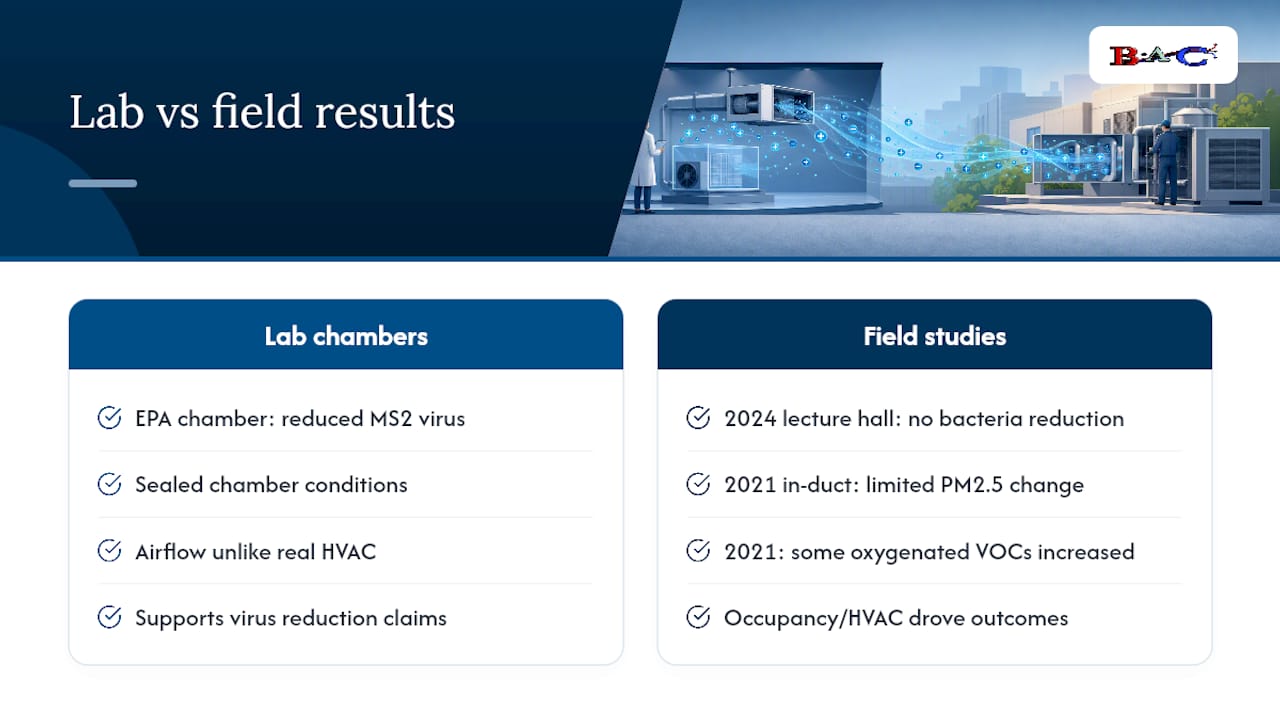
Field data tells a more sobering story. A 2024 lecture-hall study found that bipolar ionization did not reduce airborne culturable bacteria compared to when the ionizer was switched off. Occupancy and normal HVAC operation, not the ionizer, remained the main drivers of bacterial load in the room.
A separate 2021 laboratory and field evaluation of a commercial in-duct bipolar ionization unit found limited net change in PM2.5 and, more concerning, an increase in some oxygenated VOCs downstream of the device.
The pattern to watch for: many lab studies reporting significant virus reductions used sealed chambers with airflow that doesn’t resemble a typical office or classroom, which is a critical detail when a vendor hands you a lab report and calls it proof of real-world performance.
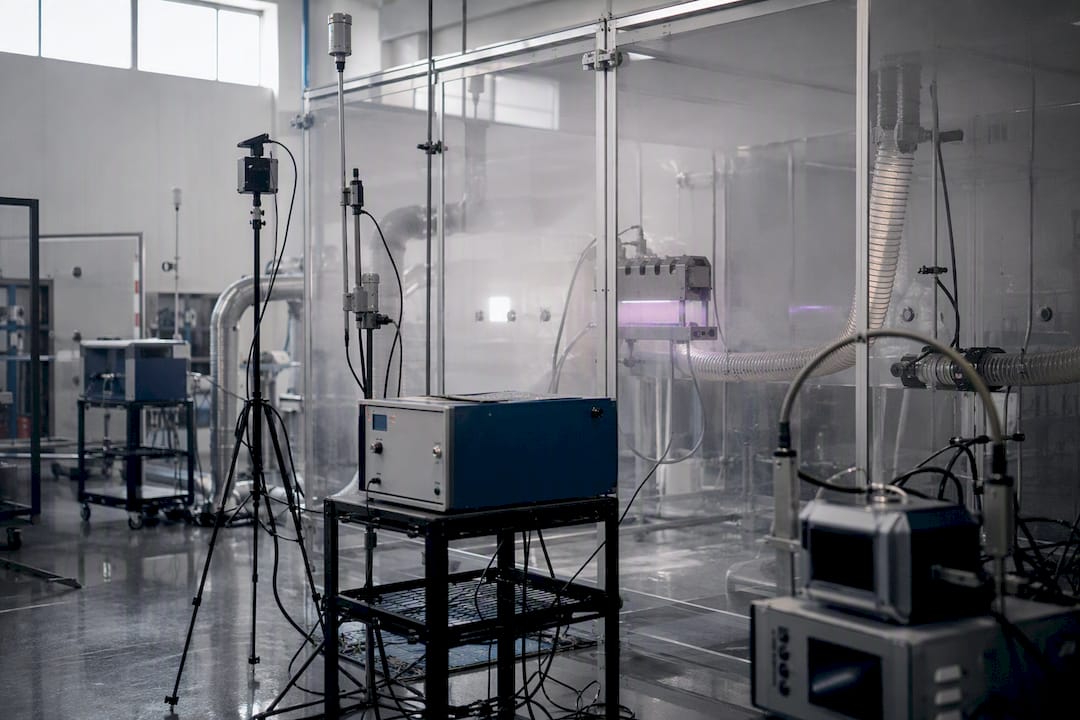
When you read a test report, check the chamber size, the ion concentration used, and whether airflow matched a real HVAC system. A result from a two-cubic-foot sealed box tells you almost nothing about a 10,000-square-foot office floor.
What Are the Real Benefits and Limits of HVAC Ionization?
Facility teams sometimes see genuine gains from bipolar ionization, but the honest list is shorter than most sales pitches suggest.
Documented benefits:
- Improved filter capture when agglomerated particles are large enough for existing filtration to catch
- Reduced odor complaints in some commercial and industrial spaces
- Continuous, zone-wide treatment that doesn’t depend on occupants doing anything
Common limitations:
- Field evidence for pathogen inactivation remains thin compared to lab claims
- Some tests show minimal or no net PM2.5 reduction once installed in real duct systems
- Performance depends heavily on airflow and emitter placement, which varies by building
Pro Tip: Treat bipolar ionization as a supplement to your filtration and ventilation strategy, never a replacement for it. If your building’s outdoor air rate or filter MERV rating is already inadequate, fix that first. Ionization won’t compensate for a ventilation deficit.
Is Bipolar Ionization Safe for Indoor Air?
Ozone is the primary safety concern with any ionization technology, and it’s not a hypothetical risk. Ion generation can produce ozone as a byproduct, and ozone reacting with other indoor chemicals can create secondary oxygenated VOCs, the same effect the 2021 Building and Environment study flagged downstream of a tested unit.
Here’s what to require before installation:
- UL 2998 zero-ozone validation, a far stricter standard than the older UL 867 benchmark, which allowed measurable ozone output
- EPA and ASHRAE guidance review, since both agencies recommend devices meeting UL 2998 and caution that ionization should not replace standard filtration or ventilation
- Minimum test data, including ozone concentration in parts per billion, a VOC profile before and after installation, and as-used ion counts, not lab-only figures
A vendor unwilling to produce a UL 2998 certificate on request is telling you something important without saying a word.
How Should Bipolar Ionization Be Installed and Maintained?
Placement and upkeep decide whether an ionizer earns its keep or just adds an electric bill line item.
- Mount in-duct near the main air handler rather than as a standalone room unit, so ions reach the whole conditioned space instead of one corner.
- Run fans continuously, or on a schedule matched to occupancy, since intermittent operation sharply cuts real exposure time compared to lab conditions.
- Commission with real measurements: verify ion counts at supply registers, confirm ozone stays near zero, and check airflow hasn’t changed from baseline.
- Inspect and clean emitters on a set schedule. Field observations show carbon fiber brushes and emitter needles accumulate dust over time, and neglected emitters lose ion output well before anyone notices a performance drop.
Tie emitter checks to your existing filter change schedule so nothing gets forgotten between HVAC service visits.
What Should You Ask Vendors Before Buying?
Procurement is where good intentions on ionization either hold up or fall apart. Build your RFP around documentation, not promises.
- Require the UL 2998 certificate and full independent test reports, including methodology and as-used conditions, not summary slides
- Ask for ion concentration ranges, ozone readings in ppb, VOC test results, and clean air delivery rate figures where available
- Write a monitoring and verification plan into the contract, plus a maintenance service level agreement and a remediation clause if ozone or VOC thresholds get exceeded
- Compare the total cost against upgrading filtration or adding portable HEPA units, since sometimes that route solves your actual problem faster
Pro Tip: If a vendor’s only performance evidence is a single small-chamber test with no ozone data, that’s a red flag, not a technical footnote. Walk away or ask for better documentation.
For a broader read on how ventilation and airflow drive indoor air quality independent of any single device, see this overview of HVAC systems and air quality.
Why Trust Brighton Air Corp on HVAC Air Cleaning Decisions
Brightonaircorp has serviced HVAC systems since 1993, with technicians bringing over 150 years of combined field experience across residential, commercial, and industrial jobs.
- Full-service capability: repairs, installations, indoor air quality solutions, and 24/7 emergency response
- On-site assessment before recommending any air-cleaning technology, including baseline and post-install measurement
- Specifications aligned with ASHRAE and UL guidance, not vendor talking points
- Financing options and free estimates available for IAQ upgrades
Request a measurement report before you approve any ionization purchase, and schedule a site consult if you want a second opinion grounded in standards rather than a spec sheet.
What Facility Managers Get Wrong About Ionization
Most conventional advice on bipolar ionization treats it as a binary: either a miracle air cleaner or a scam. Neither framing holds up against the actual research. The technology does something measurable in controlled conditions, and it does something far less certain once it’s sitting in a real duct system with real occupants and real airflow variability.
The bigger mistake I see is sequencing. Building owners chase ionization as a headline IAQ upgrade before they’ve fixed outdoor air rates or upgraded filtration to a reasonable MERV rating. That’s backwards. Ventilation and filtration are the primary IAQ controls that ASHRAE recognizes, and ionization sits downstream of those decisions, not ahead of them.
If you’re evaluating this technology, prioritize the paperwork over the pitch: UL 2998 certification, as-used test data, and a maintenance plan that accounts for emitter degradation. Skip any vendor who can’t produce those documents on request. The gap between what ionization promises and what it reliably delivers is exactly the size of the evidence a vendor is willing to show you.
— John
Get an Evidence-Based HVAC Air Quality Assessment
If you’re weighing bipolar ionization against filtration upgrades, added ventilation, or UVGI, the honest answer is that the right choice depends on your building’s airflow, occupancy, and existing equipment, not a one-size answer from a product page. Brightonaircorp evaluates all of it together instead of selling a single device and hoping it solves your air quality complaints.

Our technicians assess your current system, measure baseline air quality, and recommend whether ionization, filtration upgrades, or a combination makes sense for your specific ductwork and usage pattern, backed by the same UL 2998 and ASHRAE standards covered above. That’s a different starting point than a vendor pitching one product before seeing your building. If you’re planning a broader equipment upgrade alongside any IAQ decision, our HVAC lifecycle cost guide is worth reading first.
Schedule a free on-site assessment with Brightonaircorp to get a measurement-based recommendation for your building before you sign a contract with any ionization vendor.
Sources
- Bipolar Ionization Did Not Reduce Airborne Bacteria in a Lecture Hall (2024)
- Can air cleaning devices that use bipolar ionization… protect me from COVID-19? | US EPA
- Evaluating a commercially available in-duct bipolar ionization device for pollutant removal and potential byproduct formation (Building and Environment, 2021)
- Zero Ozone Emissions Validation | UL Solutions