
Avoid Common HVAC Installation Mistakes: 2026 Guide
Avoid Common HVAC Installation Mistakes: 2026 Guide
A bad HVAC installation costs you money every single month. The most critical HVAC installation errors, including incorrect system sizing, leaky ductwork, and skipped commissioning, reduce energy efficiency and shorten equipment life before your first winter. To avoid common HVAC installation mistakes, you need to understand exactly where the process breaks down and what proper installation actually looks like. This guide covers the errors that matter most, with specific standards, techniques, and real examples to help you get it right.
How to avoid common HVAC installation mistakes from the start
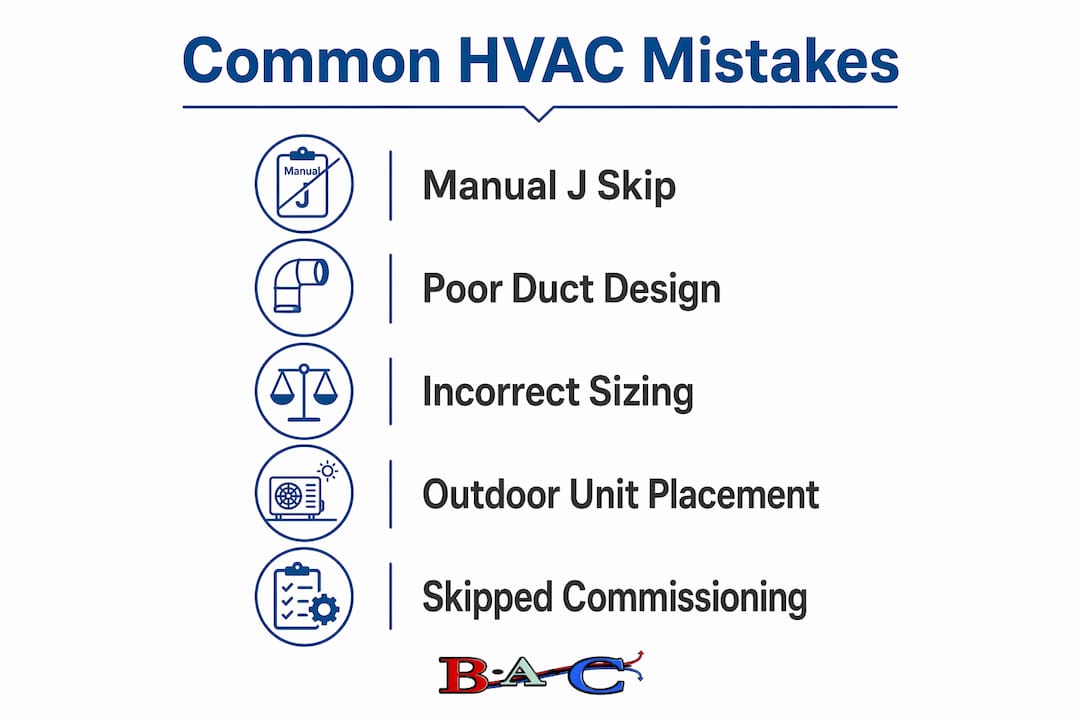
The single most damaging mistake in any HVAC installation is skipping the Manual J load calculation. Box swapping, which means replacing an old unit with a new one of the same size without recalculating, is a leading cause of comfort failure in American homes. Your home’s heat load changes over time as insulation improves, windows get replaced, or additions get built. Guessing the right size based on the old unit is not a method. It is a gamble you will lose.

What happens when your system is the wrong size
An oversized system short-cycles. It reaches the thermostat setpoint too fast, shuts off, and never runs long enough to pull humidity out of the air. You end up with a home that feels clammy even when the temperature reads correctly. An undersized system runs constantly, never quite reaching the setpoint on the hottest or coldest days, and wears out its components years ahead of schedule.
Manual J is the industry standard load calculation method developed by ACCA (Air Conditioning Contractors of America). It accounts for square footage, insulation values, window area, local climate data, and occupancy. A proper Manual J calculation takes time and specific software. No legitimate installer should quote you a system size based on square footage alone.
- Oversized system symptoms: Short run cycles, high indoor humidity, frequent on/off cycling, uneven temperatures between rooms
- Undersized system symptoms: System runs all day, rooms never reach setpoint, high energy bills, premature compressor failure
- What Manual J covers: Insulation R-values, window U-factors, local design temperatures, internal heat gains, infiltration rates
Pro Tip: Ask your installer to show you the printed Manual J report before any equipment gets ordered. If they cannot produce one, find a different contractor.
Understanding the types of central AC systems available also helps you ask better questions about sizing before the conversation starts.
What ductwork mistakes cost you in energy and comfort
Duct design is where most HVAC installations quietly fail. Leaky ductwork causes energy losses of up to 25–30% in new construction, meaning nearly a third of your conditioned air escapes into attics, crawl spaces, and wall cavities before it reaches a single room. That is not a minor inefficiency. It is a structural flaw that no thermostat adjustment will fix.
The design error builders make most often
Builders routinely force ductwork routes into whatever framing gaps remain after construction, rather than engineering duct paths before framing begins. The result is a system full of sharp bends, undersized trunk lines, and supply runs that are too long to deliver adequate airflow. Once the walls are closed, those restrictions are permanent. The fix costs far more than getting the design right before framing.
Proper duct design follows Manual D, the companion standard to Manual J. It specifies duct sizing based on actual airflow requirements for each room, not on what fits between the joists. A well-designed duct system delivers the right cubic feet per minute (CFM) to every register, balancing the whole house.
| Common duct mistake | Why it matters | Correct approach |
|---|---|---|
| Routing ducts after framing | Creates sharp bends and undersized runs | Engineer duct layout before framing starts |
| Using standard duct tape for sealing | Duct tape fails within months at temperature | Use mastic sealant or UL-listed metal tape |
| Undersized trunk lines | Restricts total system airflow | Size trunk lines to Manual D specifications |
| Uninsulated ducts in unconditioned spaces | Massive heat gain or loss in attic runs | Wrap all ducts in unconditioned spaces with R-8 minimum insulation |
Mastic sealant is the gold standard for sealing duct joints. It stays flexible through temperature cycles and does not peel. UL-listed metal foil tape is an acceptable alternative. Standard silver duct tape, despite its name, fails at sealing because it dries out and peels away from the duct surface within one to two heating seasons.
Pro Tip: Schedule a duct leakage test (called a Duct Blaster test) after installation and before drywall goes up. Fixing leaks at that stage costs a fraction of what it costs after the walls are closed.
Learning how to coordinate HVAC installation in new construction gives you a clear picture of when duct planning needs to happen in the build sequence.
Why outdoor unit placement and refrigerant charging matter more than you think
Outdoor unit placement errors are among the most common HVAC errors that homeowners discover only after the system underperforms for years. Outdoor units require a minimum of 24 inches clearance on all sides for proper condenser airflow. Placing a unit against a fence, under a deck, or surrounded by shrubs starves it of the airflow it needs to reject heat. The compressor works harder, runs hotter, and fails sooner.
The pad under the outdoor unit must also be level. An unlevel pad causes oil circulation problems inside the compressor and generates vibration that loosens refrigerant line connections over time. A concrete or composite pad set on compacted gravel is the correct approach. Plastic risers are acceptable for minor leveling adjustments but should not substitute for a properly prepared base.
Refrigerant charging is the other major failure point at the outdoor unit. The charge must match the manufacturer’s specification for the actual line set length installed. Under-charging causes the evaporator coil to freeze. Over-charging raises head pressure and stresses the compressor. Both conditions shorten system life significantly.
- Clearance requirement: Minimum 24 inches on all sides of the outdoor condenser unit
- Pad requirement: Level within 1/4 inch, set on compacted gravel or concrete
- Refrigerant charge: Must be verified by weight or superheat/subcooling measurement, not by feel or guesswork
- 500-micron vacuum: The 500-micron vacuum step removes moisture from refrigerant lines before charging. Skipping it leaves moisture that forms acid inside the system, destroying the compressor from within.
Pro Tip: Ask your installer to show you the manifold gauge readings and vacuum pump log during commissioning. A technician who cannot explain these readings has not completed the job correctly.
What does commissioning actually check, and why skip it at your peril?
Commissioning is the verification phase that happens after installation is complete but before you accept the system. Skipping commissioning leaves system performance to chance, and problems that go undetected at startup often become expensive failures within the first year. A properly commissioned system has been measured, not assumed.
A complete commissioning process covers these steps in order:
- Airflow verification: Measure actual CFM at each supply and return register and compare to the design values from Manual D.
- Static pressure measurement: Check total external static pressure against the equipment’s rated capacity. High static pressure signals duct restrictions.
- Refrigerant charge verification: Confirm superheat or subcooling readings match manufacturer specifications for the installed line set length.
- Electrical checks: Verify voltage and amperage at the disconnect, air handler, and outdoor unit against nameplate ratings.
- Thermostat calibration: Confirm the thermostat reads accurately and all stages of heating and cooling respond correctly.
- Documented report: The installer provides a written commissioning report with all measured values recorded.
HVAC expert Joey Henderson, known in the industry as “Joe Joe the HVAC Man,” identifies poor duct airflow design as the industry’s most critical installation error. His point applies directly to commissioning: airflow problems that are not measured are not fixed. A technician who installs equipment and leaves without verifying airflow is not finished with the job.
Commissioning is the most skipped step in residential HVAC installation. Homeowners rarely know to ask for it, and installers who skip it save time at the customer’s expense. Requesting a documented commissioning report is the single most effective thing you can do to protect your investment.
Pro Tip: Before your installer leaves, ask for a written commissioning report. If they do not have a standard form, that tells you something important about their process.
Keeping the system performing well after installation also means staying on top of maintenance. Clogged filters increase energy consumption by up to 15%, which compounds any efficiency loss from a substandard installation. Learning how to clean HVAC air vents properly is a simple step that protects the work done during installation.
Key takeaways
Avoiding HVAC installation mistakes requires precise load calculations, sealed and properly designed ductwork, correct outdoor unit placement, accurate refrigerant charging, and documented commissioning before you accept the system.
| Point | Details |
|---|---|
| Always use Manual J sizing | Never accept a system sized by square footage alone. Demand a printed load calculation report. |
| Seal ducts with mastic or metal tape | Standard duct tape fails within seasons. Duct leaks waste up to 30% of your energy. |
| Maintain 24-inch outdoor unit clearance | Restricted airflow around the condenser forces the compressor to work harder and fail sooner. |
| Complete the 500-micron vacuum step | Skipping this step leaves moisture in refrigerant lines that forms acid and destroys the compressor. |
| Require a written commissioning report | Documented airflow, static pressure, and refrigerant charge readings prove the system was verified, not assumed. |
What I have learned after watching too many installations go wrong
The pattern I see most often is not a single catastrophic error. It is a series of small shortcuts that compound into a system that never quite works right. The homeowner feels too warm in one room and too cold in another. The bills are higher than expected. The installer says everything checks out. But no one ever measured the airflow.
The ductwork is almost always the culprit. HVAC equipment has become remarkably reliable. The equipment itself rarely fails in the first few years. What fails is the air distribution system around it, because ducts get designed around framing constraints instead of airflow physics. I have seen brand-new systems with static pressure readings double what the equipment was rated to handle. The blower motor works twice as hard and lasts half as long.
My honest advice to any homeowner: treat the commissioning report the way you would treat a home inspection report. You would not buy a house without an inspection. Do not accept an HVAC system without documented performance verification. Ask for the numbers. If the installer cannot produce them, that is your answer.
Proactive maintenance matters too, but it cannot rescue a poorly installed system. A well-installed system with consistent filter changes and annual tune-ups will outperform a poorly installed one with perfect maintenance every time. Get the foundation right first.
— John
Brightonaircorp gets your HVAC installation right the first time
Brightonaircorp has served New Jersey homeowners and businesses since 1993, with over 150 years of combined technician expertise across every type of residential and commercial HVAC installation. Every installation Brightonaircorp performs includes proper Manual J load calculations, correct duct sealing practices, and full system commissioning before the job is considered complete.

Brightonaircorp offers free estimates on HVAC installations and backs its work with licensed technicians who follow industry best practices on every job. Whether you need a new system installed correctly or want a second opinion on an existing installation, Brightonaircorp is available 24/7 for consultations and emergency service across New Jersey.
FAQ
What is the most common HVAC installation mistake?
Skipping the Manual J load calculation is the most common error. It leads to oversized or undersized systems that short-cycle, fail to control humidity, or run constantly.
How much energy do leaky ducts waste?
Leaky ductwork wastes up to 25–30% of total HVAC energy in new construction. That loss comes from conditioned air escaping into unconditioned spaces before reaching living areas.
Why does outdoor unit clearance matter?
Outdoor condenser units need at least 24 inches of clearance on all sides. Restricted airflow forces the compressor to run hotter, reducing efficiency and shortening its lifespan.
What is the 500-micron vacuum step?
The 500-micron vacuum step removes moisture and non-condensable gases from refrigerant lines before charging. Skipping it allows moisture to form acid inside the system, which destroys the compressor.
How do I know if my HVAC was commissioned properly?
Ask your installer for a written commissioning report that includes airflow measurements, static pressure readings, and refrigerant charge verification. No report means no commissioning was done.